Home / Louisiana / Monroe & the Louisiana Delta / Louisiana State Cotton Museum
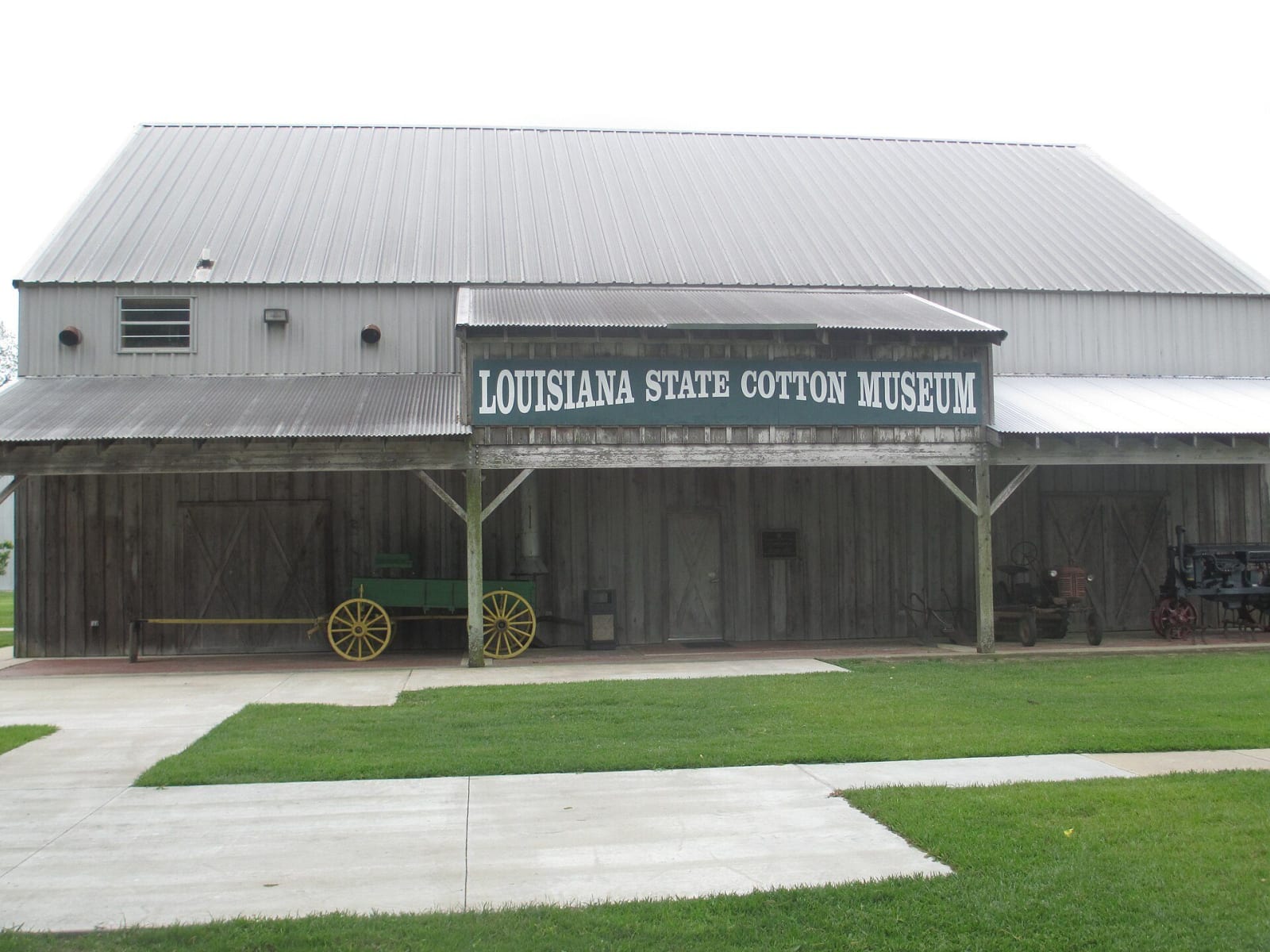
Gin-house building of the Louisiana State Cotton Museum with a green wagon and old tractors under its porchBilly Hathorn / CC BY-SA 3.0 via Wikimedia Commons
🏛️Historical

Louisiana State Cotton Museum

Part ofMonroe & the Louisiana Delta

A state museum on US 65 north of Lake Providence with a sharecropper's cabin, a commissary and a gin house, in the parish where John H. Scott worked for Black voting rights.

⏱
Duration
One to two hours.
🎟
Admission
Free (Explore Louisiana).
📅
Best Season
Tuesday to Saturday, 9 a.m. to 4 p.m., closed on holidays (Louisiana Secretary of State, November 2026); call 318-559-2041.

The Story

According to 64 Parishes, sharecropping "came out of the Civil War and lasted until the 1950s." It began in the old plantation districts along the Mississippi and Red rivers as a compromise between newly freed, landless Black workers and planters short of cash. Croppers farmed 10 to 30 acres for a quarter to a half of the cotton and seed. Landlords controlled marketing and settled accounts, and used the crop lien and pressure, including violence, to keep control; Black tenants could not vote.

The museum puts that system on the ground. Its grounds hold a farmhouse, a commissary, a chapel, a tenant house, a sharecropper's cabin and a replica gin house, and it shows the first electric cotton gin in Louisiana. Exhibits include American Cotton History, Rhythm of the Land, Cotton Pickin' and Boll Weevil, and Delta Blues and Jazz. The main gallery has life-sized dioramas, farm equipment and a re-created juke joint, and the story runs to the mechanical picker and the tractor after World War II.

East Carroll Parish, then mostly African American, was also home to John H. Scott, born near Atherton in 1901, who called sharecropping a form of slavery and worked for Black voting rights; a federal court ruled for the East Carroll plaintiffs in 1962. The museum is at 7162 Highway 65 North, Lake Providence. Explore Louisiana lists free admission, and the Louisiana Secretary of State lists Tuesday to Saturday hours of 9 a.m. to 4 p.m. (November 2026).

Visitor Info

⏱
Time Needed
One to two hours.
🎟
Admission
Free (Explore Louisiana).
📅
Best Season
Tuesday to Saturday, 9 a.m. to 4 p.m., closed on holidays (Louisiana Secretary of State, November 2026); call 318-559-2041.
🛣️
Highway
US 65

On the Map

Nearby

The closest stops worth working into your route

historical2.2 mi away
Grant's Canal, Lake Providence
About 1,000 feet of the ditch Union troops dug in early 1863 to get Grant's army around Vicksburg, with a boardwalk, a pier and a visitor center in the Byerley House.
historical17 mi away
Poverty Point World Heritage Site
Louisiana's only World Heritage Site: six C-shaped ridges, a 43-acre plaza and Mound A, raised on Macon Ridge between about 1700 and 1100 BCE.
historical30 mi away
Lakeport Plantation
Arkansas's grandest surviving Greek Revival plantation house, built about 1858 by a planter who held 155 enslaved people in 1860, now an Arkansas State University museum.
natural36 mi away
Tensas River National Wildlife Refuge
Nearly 80,000 acres of bottomland hardwood forest and oxbow lakes, with the state's largest population of Louisiana black bears and Theodore Roosevelt's 1907 hunt nearby.
recreational38 mi away
Chemin-A-Haut State Park
A 1935 park on the ridge above Bayou Bartholomew, the 359-mile bayou, named for the French 'high road' that followed the ridge.
recreational38 mi away
Lake Chicot State Park
A state park on the largest natural lake in Arkansas, a 20-mile oxbow of the Mississippi River that was cleaned up and reopened after decades of silt.