Home / North Carolina / Raleigh, Durham & the Triangle / Historic Stagville
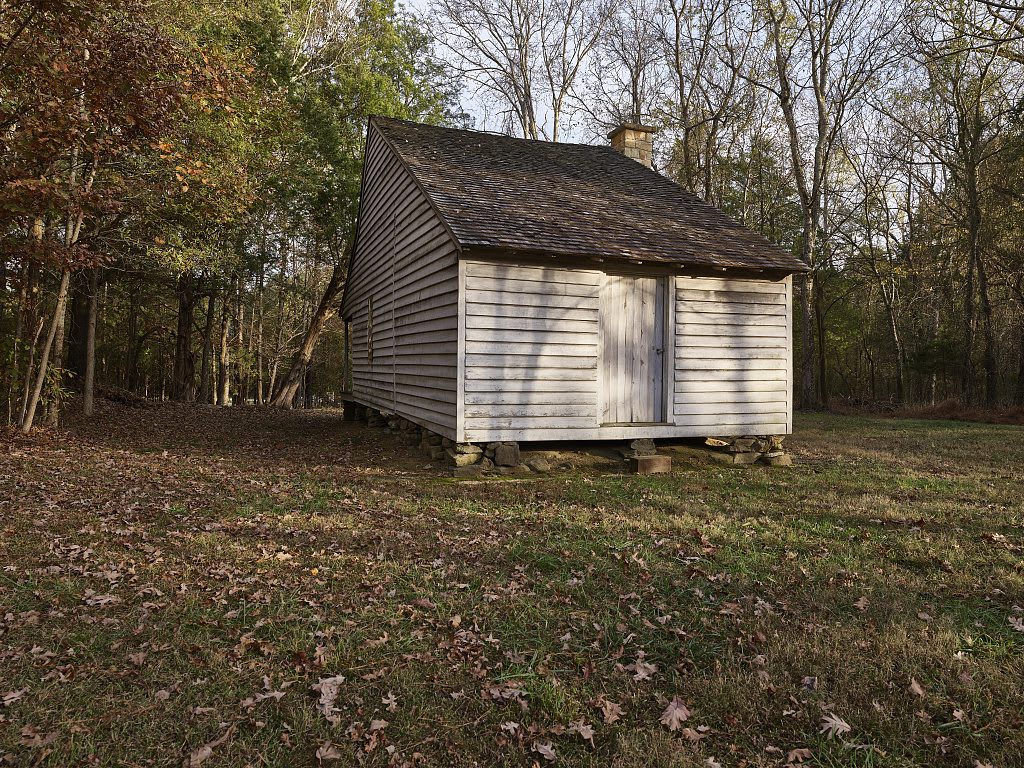
A weathered white clapboard quarter on a stone foundation, with a brick chimney, at the edge of autumn woods.Carol M. Highsmith / public domain via Library of Congress
🏛️Historical

Historic Stagville

Part ofRaleigh, Durham & the Triangle

A surviving piece of the Bennehan and Cameron plantations north of Durham, where more than nine hundred people were enslaved in 1860, with the two-story quarters of Horton Grove.

⏱
Duration
One and a half to two hours; the guided tour runs about 75 minutes.
🎟
Admission
Free admission and outdoor self-guided tours; guided tours $2 for adults, $1 for seniors, military and youth 3-17, plus tax (NC Historic Sites, 2026).
📅
Best Season
Year round. Open Tuesday to Saturday 9 a.m. to 5 p.m.; guided tours weekdays at 1 and 3 p.m. and Saturdays at 11 a.m., 1 and 3 p.m. Closed Sunday, Monday and state holidays (NC Historic Sites, 2026).

The Story

From 1771 to 1865 the Bennehan and Cameron families built one of the largest plantation holdings in North Carolina on the forced labor of enslaved Africans and African Americans. By the 1860s the Cameron heirs held about 30,000 acres and enslaved more than a thousand people, over nine hundred of them on this complex in 1860. Families were separated year after year, sold or forced to other Cameron lands; in 1844 the Hargis siblings were forced to a Cameron cotton plantation in Alabama, where after emancipation they became landowners. Mary Walker escaped the Camerons and struggled for years to free her family, and Virgil Bennehan, born enslaved here, was freed in 1847.

The state site keeps 165 acres in two places a mile apart. At Horton Grove stand four dwellings that enslaved carpenters built around 1851, the only two-story slave quarters left in North Carolina, with brick chimneys, shuttered windows and raised stone foundations. Families lived in them as sharecroppers after the war and until the 1970s, and digs around them have turned up the traces of African practices kept alive. The site also keeps the Great Barn of 1860, a huge timber-framed mule barn, the Bennehan family house of about 1799, and the excavated foundations of an enslaved family's house and a plantation kitchen.

Stagville calls itself a site of conscience and works with descendant families, and its guides tell the place from the quarters outward. You drive yourself between the two locations, and the ground is grass and gravel.

Visitor Info

⏱
Time Needed
One and a half to two hours; the guided tour runs about 75 minutes.
🎟
Admission
Free admission and outdoor self-guided tours; guided tours $2 for adults, $1 for seniors, military and youth 3-17, plus tax (NC Historic Sites, 2026).
📅
Best Season
Year round. Open Tuesday to Saturday 9 a.m. to 5 p.m.; guided tours weekdays at 1 and 3 p.m. and Saturdays at 11 a.m., 1 and 3 p.m. Closed Sunday, Monday and state holidays (NC Historic Sites, 2026).
🛣️
Highway
Old Oxford Highway

On the Map

Nearby

The closest stops worth working into your route

historical7.6 mi away
Duke Homestead State Historic Site
Washington Duke's 1852 farm and early tobacco factories north of Durham, where the family business that became the American Tobacco Company began.
natural9.7 mi away
Eno River State Park
Some 4,000 acres along the rocky Eno northwest of Durham, saved from a city reservoir by a citizens' campaign begun in 1966, with the Fews Ford rapids and the historic Occoneechee Speedway.
historical9.9 mi away
Pauli Murray Center for History and Social Justice
The Durham house where Pauli Murray grew up, built by her grandparents in 1898 and opened in 2024 as a museum of the lawyer, poet and priest's life and work.
historical9.9 mi away
Bennett Place State Historic Site
The rebuilt farmhouse west of Durham where Johnston surrendered 89,270 Confederate soldiers to Sherman on April 26, 1865, the largest surrender of the war.
cultural10 mi away
Hayti Heritage Center
The 1891 St. Joseph's AME Church in Durham, saved from demolition in 1975 as the cultural home of Hayti, the Black district the Durham Freeway cut in two.
historical15 mi away
Hillsborough Historic District
Orange County's colonial seat on the Eno, where six Regulators were hanged in 1771, the 1788 convention balked at the Constitution, and Elizabeth Keckly was held enslaved.

Historical markers nearby

Roadside plaques and monuments within a short detour

Marker3.7 mi away
Mount Bethel Methodist Church
Bahama
Marker4.2 mi away
Stephen B. Weeks
Bahama
Marker4.2 mi away
Willie P. Mangum
Bahama
Marker4.2 mi away
William B. Umstead
Bahama
Marker6.2 mi away
Camp Butner
Butner
Marker8.4 mi away
N.C. School of Science and Mathematics
Durham