 Ildar Sagdejev (Specious) / CC BY-SA 4.0 via Wikimedia Commons
The Story
After the Civil War, freed people came to Durham for work in the tobacco factories and settled on its southern edge near Old Fayetteville Road, naming their community for Haiti, the first Black republic in the hemisphere. Rented land became owned land. By the early twentieth century Hayti had more than two hundred Black-owned businesses along Fayetteville, Pettigrew and Pine streets, its own library, theaters, hotels and Lincoln Hospital, opened in 1900, while Parrish Street downtown, home of North Carolina Mutual from 1898, was its financial heart.
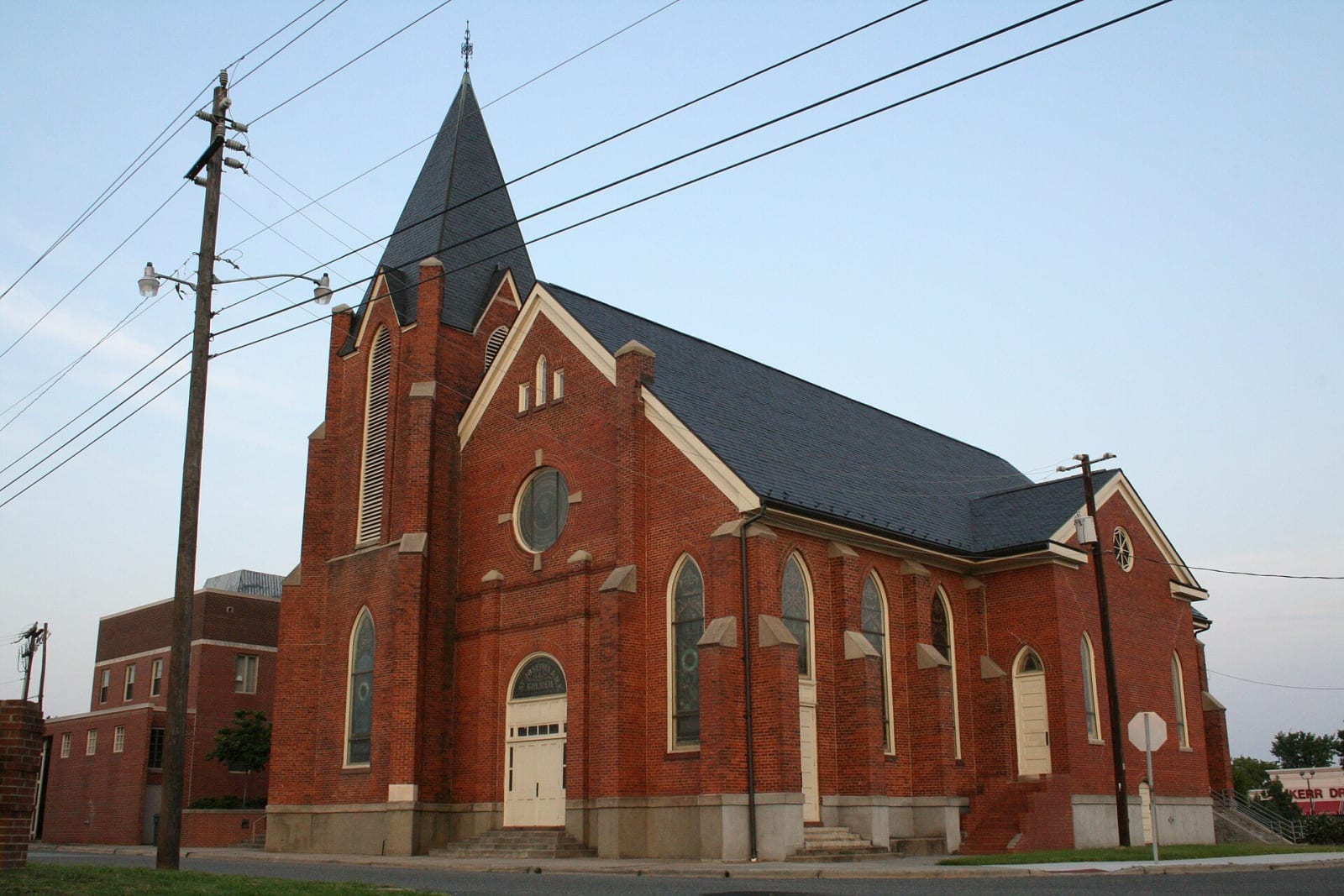
This church began in 1868 when Edian Markham, an AME missionary born enslaved, held services under a brush arbor; the congregation organized in 1869 as Union Bethel and built this brick church in the early 1890s, renaming itself St. Joseph's. White industrialists, Washington Duke and Julian Carr among them, gave to the building, and their names are in the stained glass beside those of Black donors. In June 1957 the Rev. Douglas Moore of Asbury Methodist in Hayti and six others, Mary Elizabeth Clyburn, Claude Glenn, Jesse Gray, Vivian Jones, Melvin Willis and Virginia Williams, sat in the white section of the Royal Ice Cream parlor and were arrested.
Urban renewal from the late 1950s cleared more than two hundred acres of Hayti, and the Durham Freeway was run through its middle; residents largely shut out of the vote had no say in the route. By 1975 this church was slated to go. Lyda Moore Merrick and her daughter Lyda Constance Merrick Watts formed a foundation and saved it, and the sanctuary now holds concerts, plays and festivals.
Visitor Info
On the Map
Nearby
The closest stops worth working into your route
Historical markers nearby
Roadside plaques and monuments within a short detour