Home / Nebraska / North Platte & the Great Platte River Road / Golden Spike Tower and Bailey Yard
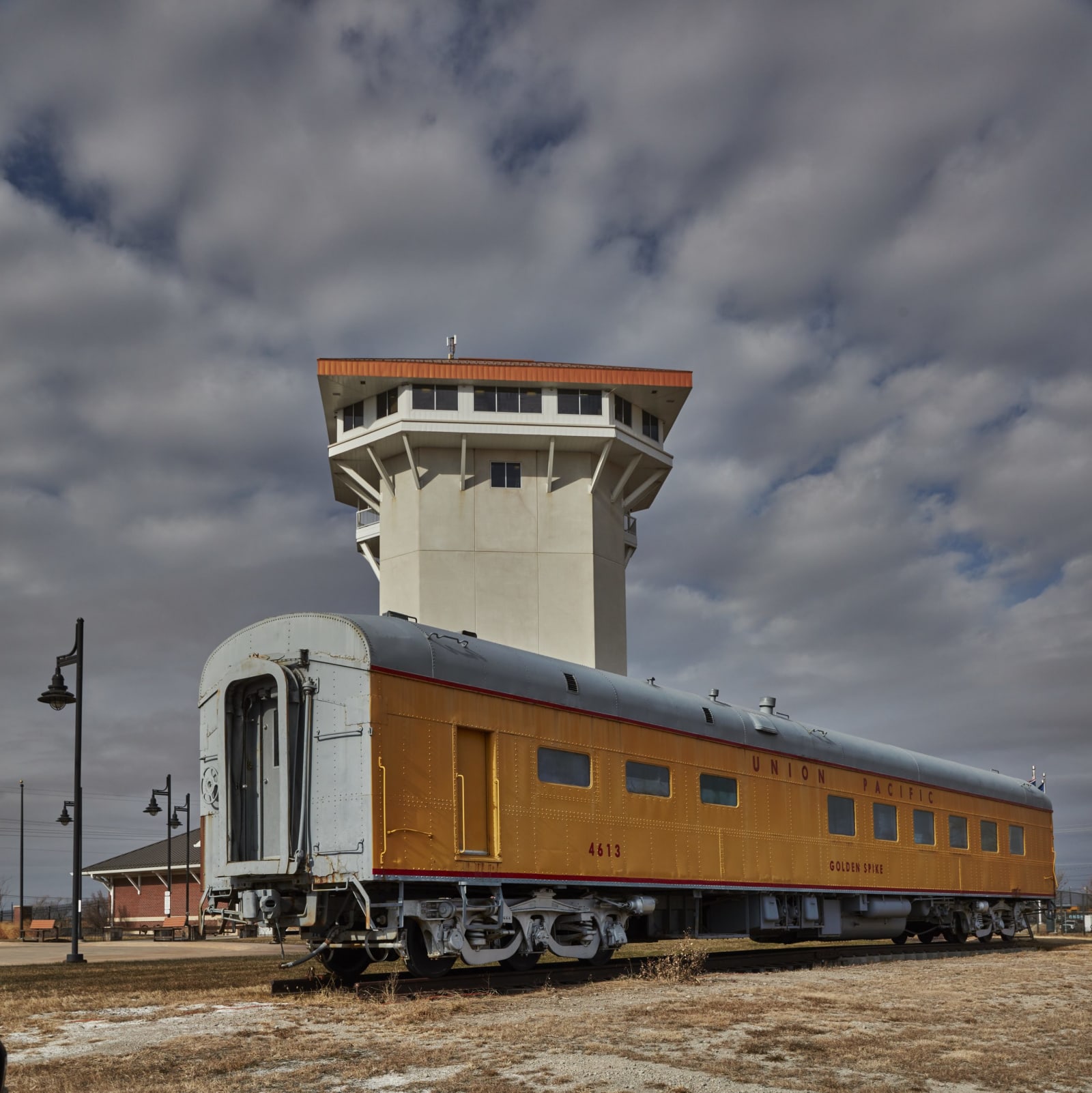
The Golden Spike Tower rises behind a yellow Union Pacific passenger car beside Bailey Yard in North Platte.Carol M. Highsmith / public domain via the Library of Congress
🏭Industrial

Golden Spike Tower and Bailey Yard

Part ofNorth Platte & the Great Platte River Road

A tower with seventh- and eighth-floor decks over Union Pacific's Bailey Yard in North Platte, the world's largest railroad classification yard, in a town the railroad laid out and fed troops from.

⏱
Duration
One to two hours.
🎟
Admission
$12 adults; $10 seniors 62 and up, military and AAA; $6 ages 6 to 16; free 5 and under.
📅
Best Season
Open year-round: 9 a.m. to 7 p.m. Memorial Day to Labor Day, 9 a.m. to 5 p.m. the rest of the year.

The Story

North Platte has been a railroad town from its first plat. Grenville Dodge, the Union Pacific's chief engineer, is tied to the town's founding, the first train arrived in 1866, and the company put shops and winter quarters for its crews here. The yard that grew from them is named for Edd H. Bailey, a former Union Pacific president. It covers about 2,850 acres over eight miles of the valley, and Union Pacific calls it the largest railroad classification yard in the world; Guinness World Records recognized it as the largest rail yard in 1995. Freight cars are sorted over two humps, an eastbound one 34 feet high and a westbound one of 20 feet, and the service tracks handle thousands of locomotives a month.

The Golden Spike Tower opened beside the yard on June 26, 2008. Union Pacific's old viewing platform was falling apart in the mid-1990s, and local leaders wanted something better; a private nonprofit runs the tower. An elevator climbs to an open-air deck on the seventh floor and an enclosed eighth floor with a view all the way around, where volunteers, many of them retired from the yard, explain what is moving below.

The town's other railroad story has no building left. From Christmas Day 1941 to April 1, 1946, volunteers from North Platte and 125 other communities met every troop train during its ten-minute stop and served an estimated six million service members. The depot was torn down in 1973, and the tower's exhibits cover the North Platte Canteen.

Visitor Info

⏱
Time Needed
One to two hours.
🎟
Admission
$12 adults; $10 seniors 62 and up, military and AAA; $6 ages 6 to 16; free 5 and under.
📅
Best Season
Open year-round: 9 a.m. to 7 p.m. Memorial Day to Labor Day, 9 a.m. to 5 p.m. the rest of the year.
🛣️
Highway
US-30

On the Map

Nearby

The closest stops worth working into your route

historical2.1 mi away
Buffalo Bill Ranch State Historical Park
Scout's Rest, the North Platte ranch house and barn of William F. Cody, in the town where his Old Glory Blowout of July 4, 1882 became the first act of the Wild West.
recreational44 mi away
Lake McConaughy and Kingsley Dam
Nebraska's largest reservoir, 22 miles of North Platte water and white sand beaches behind a 1941 hydraulic-fill dam, built so farms far downstream could water their crops.
architectural53 mi away
Pilgrim Holiness Church (Baled Hay Church)
A church raised in 1928 from bales of hand-tied rye straw in treeless Arthur, the oldest known straw-bale church in North America and a survivor of a Sandhills building habit.
natural59 mi away
Nebraska National Forest, Bessey Ranger District
A pine forest planted by hand on the Sandhills from 1902 to prove a botanist's theory, still raising seedlings at its nursery and still recovering from the Bovee Fire of 2022.
historical65 mi away
Massacre Canyon Monument
A granite shaft east of Trenton above the canyon where Lakota warriors attacked a Pawnee buffalo-hunting camp on August 5, 1873, a year before the Pawnee left Nebraska.
historical66 mi away
Senator George Norris State Historic Site
The McCook house George W. Norris kept as his home base for forty-two years, given to the state with its furniture by his wife Ellie, by the senator who wrote the lame-duck amendment.