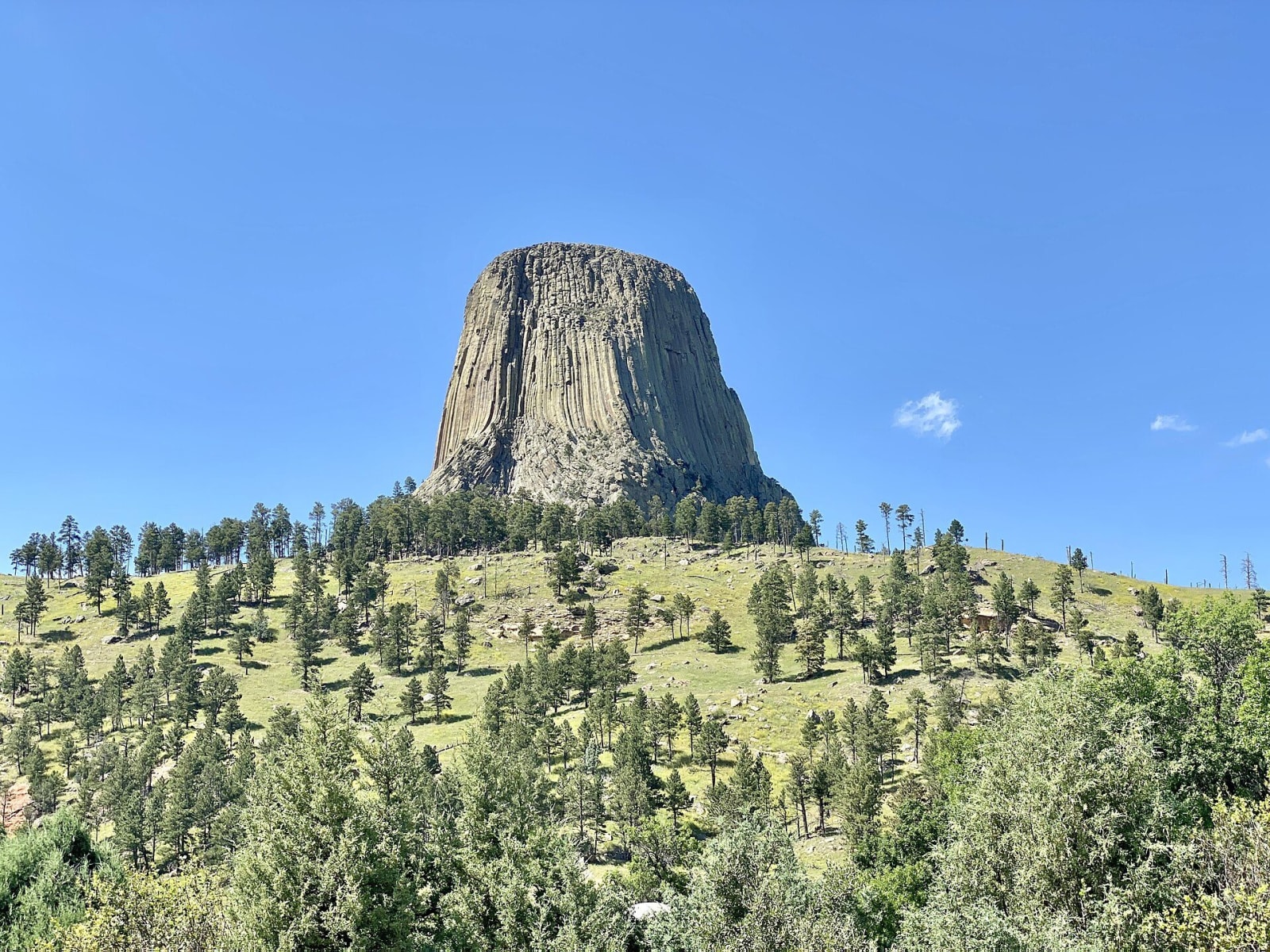
 w_lemay / CC BY-SA 2.0 via Wikimedia Commons
The Story
The tower is a plug of phonolite porphyry, a gray-green igneous rock flecked with white feldspar, that pushed up into the sandstones and shales here about 40.5 million years ago and cooled underground into columns, most of them six-sided, some twenty feet across and six hundred feet tall. Over millions of years the softer rock around it wore away. Geologists still argue over whether the magma ever reached the surface. Columns still crack loose and fall, and the boulder field around the base is made of them. The tower stands 867 feet from base to summit and about 1,267 feet above the Belle Fourche River.
On July 4, 1893, two local ranchers, William Rogers and Willard Ripley, climbed it on a ladder of wooden stakes they had driven into a crack between two columns, with a crowd watching from below. Other climbers used the ladder until it fell apart in the 1920s, and what is left of it, partly restored in 1972, can still be picked out with binoculars. Fritz Wiessner, William House and Lawrence Coveney made the first free climb in 1937. In 1941 a parachutist named George Hopkins landed on the summit as a stunt and could not get down; he spent six days there before a team led by Jack Durrance climbed up and brought him off.
The paved Tower Trail circles the base in 1.3 miles.
Visitor Info
On the Map
Nearby
The closest stops worth working into your route