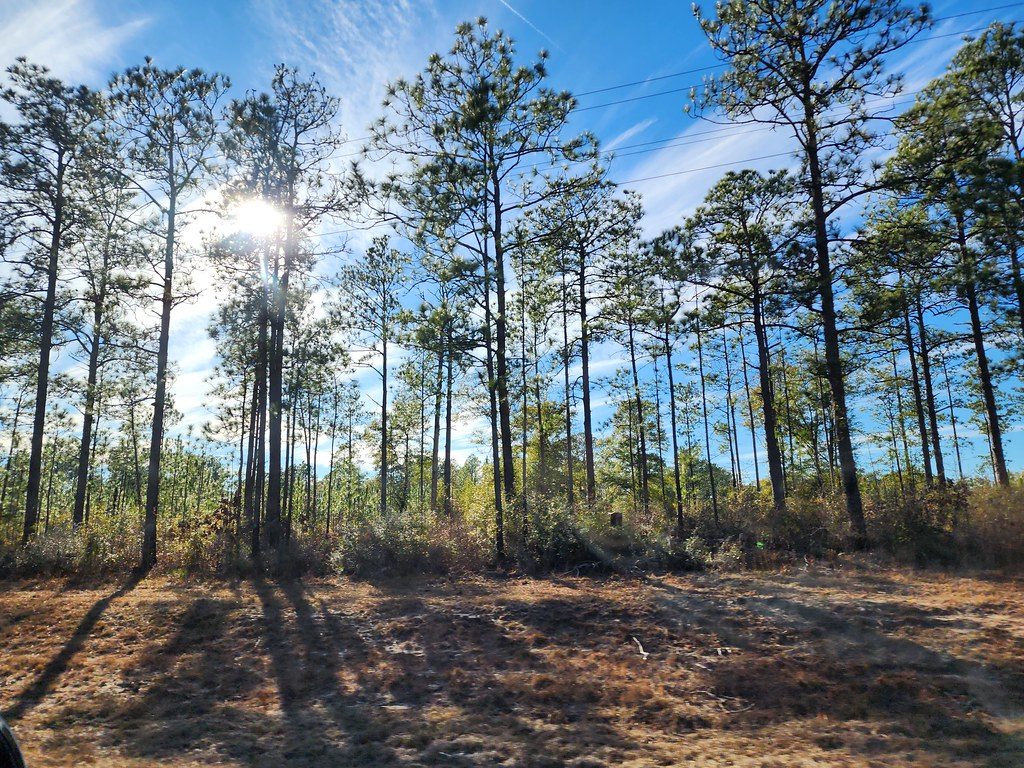
 Carol VanHook / CC BY-SA 2.0 via Flickr
The Story
This corner of Covington County was Creek country until the 1814 Treaty of Fort Jackson, and for generations afterward it was the kind of forest the Wiregrass was named for: tall longleaf pine over a carpet of wiregrass. Loggers cut the bottomlands first and then the uplands once the railroads came in the 1880s. The national forest was established in the mid-1930s, and the Civilian Conservation Corps built the group shelter that still stands at Open Pond.
Today the forest covers more than 83,000 acres along the Florida line, and the Forest Service has spent decades bringing longleaf back with planting and prescribed fire. The Conservation Fund calls it one of the largest continuous stretches of longleaf in the Southeast. It holds at least 88 clusters of endangered red-cockaded woodpeckers, which nest in living old pines marked with white bands, along with gopher tortoises and eastern indigo snakes. Bachman's sparrows are common in the open pine woods, and swallow-tailed kites and ospreys work the ponds.
From Andalusia, take U.S. 29 south and fork left onto Alabama 137. Open Pond has a campground and a picnic ground looking over the water, and Blue Lake, a few minutes away, has a swimming beach in the warm months. The Conecuh Trail, about 20 miles long, crosses the forest past ponds and through the pines. Watch for smoke: controlled burns are part of how this forest is kept.
Visitor Info
On the Map
Nearby
The closest stops worth working into your route
Historical markers nearby
Roadside plaques and monuments within a short detour