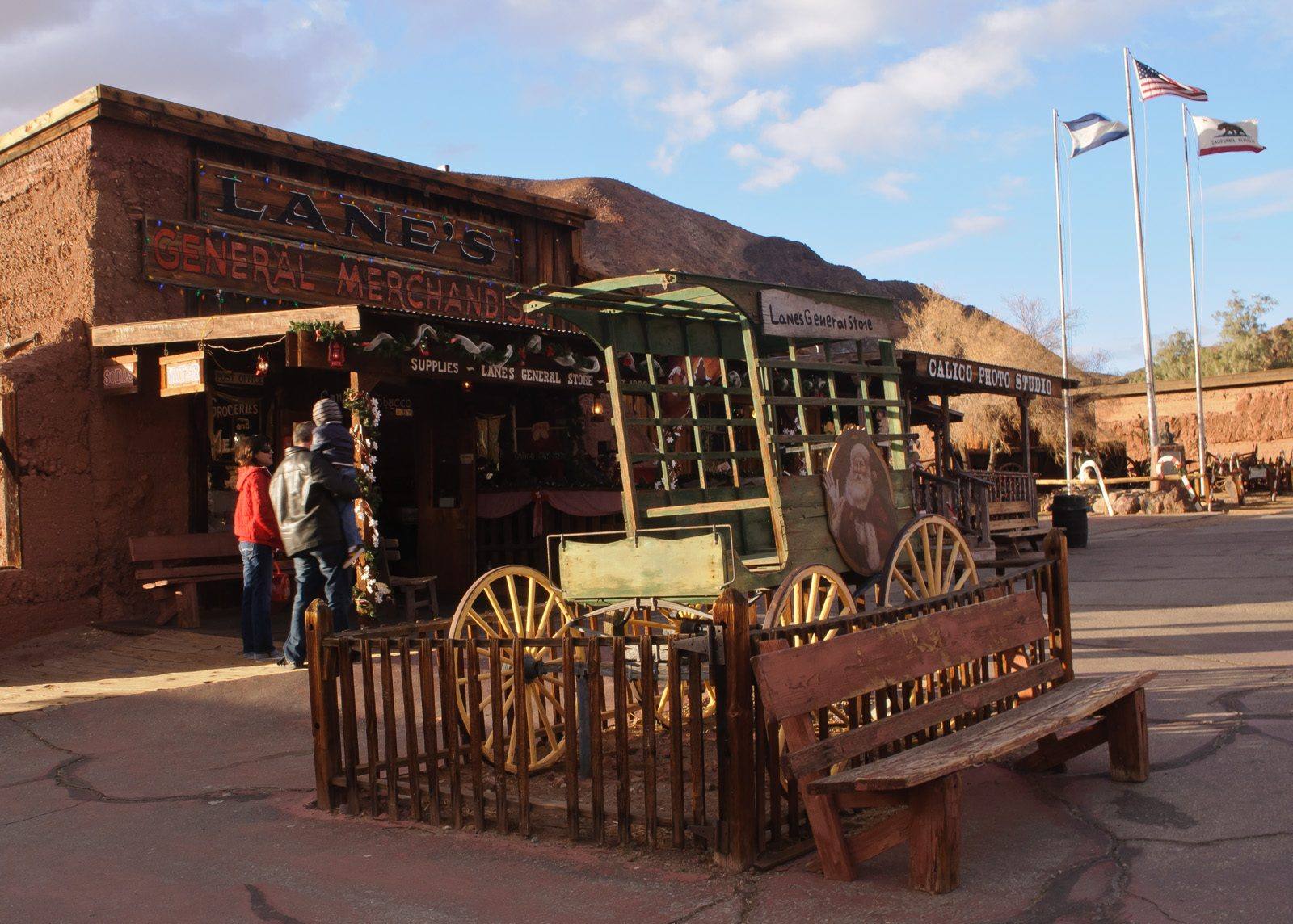
 InSapphoWeTrust / CC BY-SA 2.0 via Wikimedia Commons
The Story
Calico climbs a set of hills so streaked with color that four prospectors leaving Grapevine Station, the settlement that became Barstow, named the peak, the range, and the town after a bolt of calico cloth. Silver turned up in 1881, the Silver King became the district's richest mine, and within a couple of years Calico was the biggest silver producer in California, a town of some 3,500 people with a school, a newspaper, saloons, and around 500 mines working the hills. It produced on the order of 20 million dollars in silver before the metal's price collapsed in the mid-1890s and took the town with it; borax mining nearby held on a little longer, then it too gave out, and by about 1900 Calico was empty. It might have vanished entirely except that Walter Knott, the man behind Knott's Berry Farm, had worked here briefly as a young carpenter, and his uncle had been a founding partner of the Silver King. Knott bought the whole town in 1951 and rebuilt it, keeping the five original structures and reconstructing the rest to look as it had in the 1880s. In 1966 he deeded Calico to San Bernardino County, which still runs it as a regional park; in 2005 the state named it California's official Silver Rush ghost town. It is frankly restored rather than raw, part genuine relic and part Old West set, but the mine tunnels, the grade of the streets, and the colored hills are exactly as they were.
Visitor Info
On the Map
Nearby
The closest stops worth working into your route
Historical markers nearby
Roadside plaques and monuments within a short detour