Home / North Carolina / Charlotte & the Southern Piedmont / Bunker Hill Covered Bridge
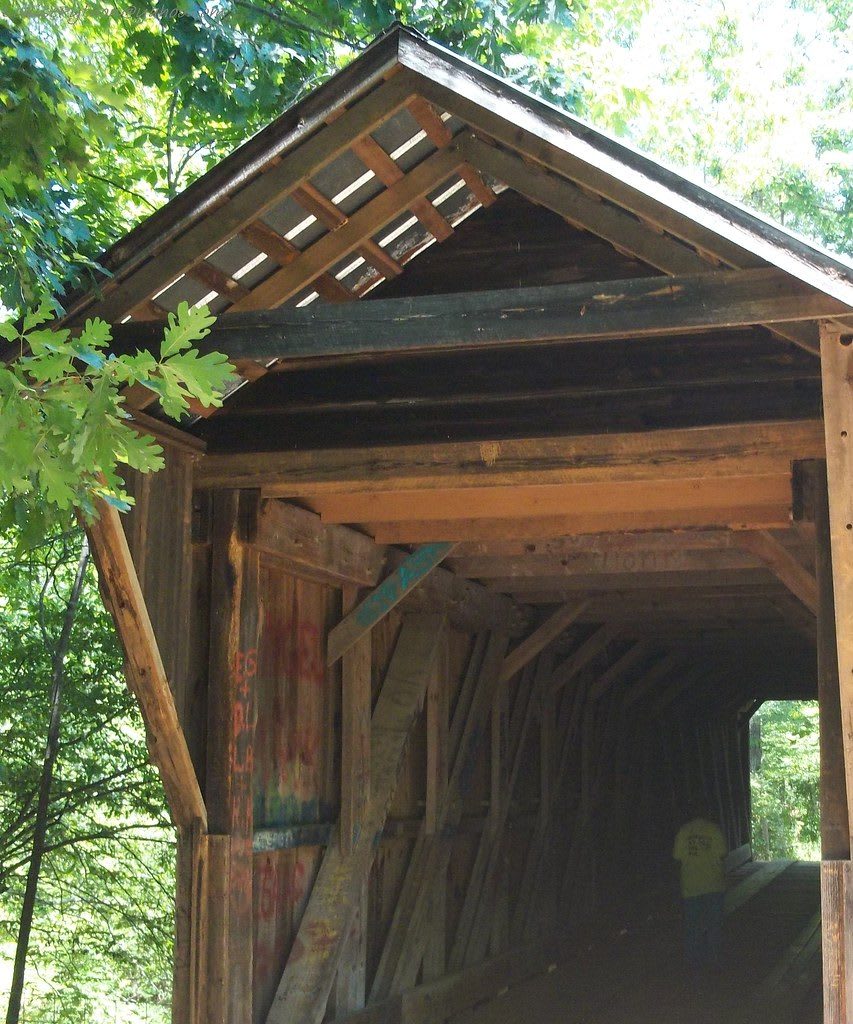
The weathered wooden portal of a covered bridge with a gabled roof, framed by green leaves.Louise Python / CC BY 2.0 via Flickr
🏗️Architectural

Bunker Hill Covered Bridge

Part ofCharlotte & the Southern Piedmont

One of North Carolina's two surviving covered bridges, built over Lyle Creek in 1895 and thought to be the last wooden Haupt truss in the country.

⏱
Duration
Thirty minutes.
🎟
Admission
Free.
📅
Best Season
Year round; the grounds are open dawn to dusk daily (Historical Association of Catawba County, 2026).

The Story

The road this bridge carries, the old Island Ford Road, began as a Native American trail. In 1781, after the Battle of Cowpens, Daniel Morgan sent 531 British prisoners north along it under guard, and they forded Lyle Creek right here on their way to Virginia.

In 1894 the Catawba County commissioners asked the owners of nearby Bunker Hill Farm to build and keep up a bridge over the creek. Andrew Loretz Ramsour, keeper of the Horseford covered bridge over the Catawba River, built it in 1895 to the improved lattice truss patented by Herman Haupt, the Philadelphia engineer who later ran the Union Army's military railroads; Ramsour likely found the design in a popular book on bridge building. The 91-foot span stood open until a roof went on in 1900, to keep the timbers dry, and tin replaced its wooden shingles in 1921. It is thought to be the last wooden Haupt truss in the United States, and in 2001 the American Society of Civil Engineers named it a National Historic Civil Engineering Landmark.

The Bolick family gave the bridge to the Catawba County Historical Association in 1985, and Arnold Graton, a bridgewright from New Hampshire, restored it in 1994. It is one of only two covered bridges left in North Carolina, the other at Pisgah in Randolph County. The grounds lie off U.S. 70 two miles east of Claremont and are open dawn to dusk; leashed dogs are welcome, but fishing and kayaking are not.

Visitor Info

⏱
Time Needed
Thirty minutes.
🎟
Admission
Free.
📅
Best Season
Year round; the grounds are open dawn to dusk daily (Historical Association of Catawba County, 2026).
🛣️
Highway
US 70

On the Map

Nearby

The closest stops worth working into your route

historical14 mi away
Fort Dobbs State Historic Site
North Carolina's only permanent frontier fort of the French and Indian War, reconstructed near Statesville, where Cherokee warriors attacked in February 1760.
historical29 mi away
Fort Defiance
William Lenoir's 1792 plantation house in Happy Valley, named for a frontier stockade of the 1776 Cherokee war, with tours that include the people he enslaved.
cultural30 mi away
Wilkes Heritage Museum and MerleFest
Wilkesboro's 1902 courthouse holds the Blue Ridge Music Hall of Fame, a few miles from the college grounds where Doc Watson's MerleFest has played each April since 1988.
historical32 mi away
Loray Mill
Gastonia's Million Dollar Mill, center of the 1929 strike in which Police Chief Orville Aderholt and the union balladeer Ella May Wiggins were killed.
cultural32 mi away
Schiele Museum and Catawba Indian Village
Gastonia's natural history museum, home to one of the largest collections of Catawba pottery anywhere and an outdoor village interpreting four centuries of Catawba life.
historical36 mi away
Salisbury National Cemetery
The national cemetery laid out over the trench graves of Union prisoners who died in Salisbury's Confederate prison, told through the men held there.

Historical markers nearby

Roadside plaques and monuments within a short detour

Marker5.7 mi away
Concordia College 1881-1935
Conover
Marker7.3 mi away
Charles H. Mebane
Newton
Marker7.5 mi away
Hoke Smith
Newton
Marker7.8 mi away
Old St. Paul's Lutheran Church
Newton
Marker8 mi away
Catawba College
Newton
Marker12 mi away
Lenoir Rhyne
Hickory