 UNC Libraries / public domain via Flickr
The Story
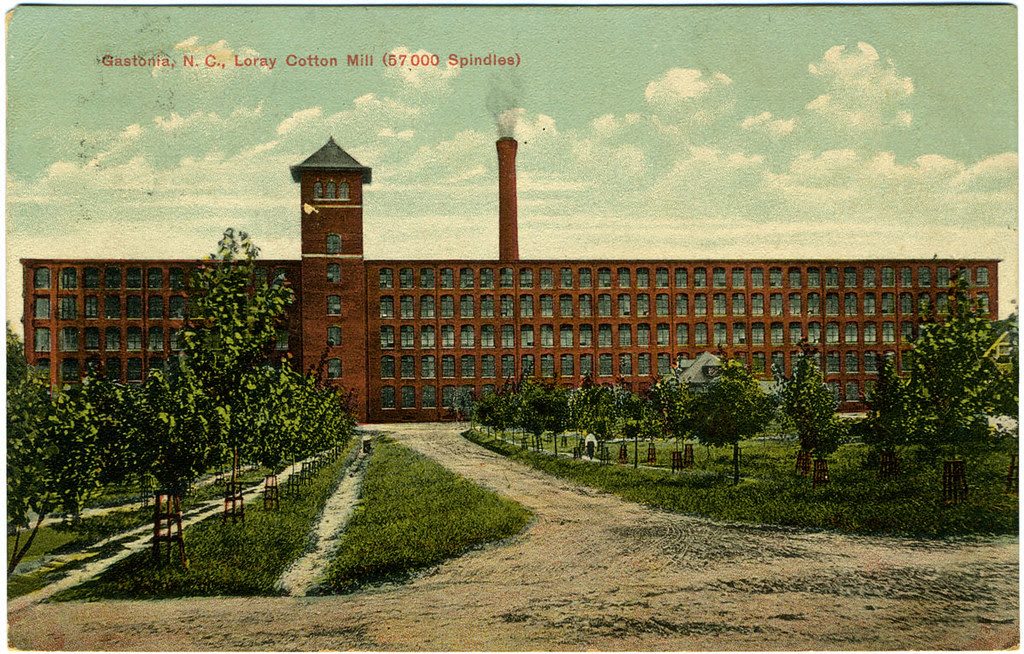
Loray Mill took its name from its builders, John Love and George Gray, whose first phase opened in west Gastonia in 1901. Lockwood, Greene and Company of Boston designed it, five stories of brick behind an eight-story tower, and it was billed as the largest textile mill under one roof in the world: the Million Dollar Mill. Workers rented frame houses from the company, eventually some 625 of them. The Rhode Island firm Manville-Jenckes bought the mill in 1921, and by the late 1920s its hands faced the stretch-out: more machines for the same pay or less.
On April 1, 1929, about 1,800 workers walked out under the Communist-led National Textile Workers Union, demanding a forty-hour week, a twenty-dollar minimum, recognition and an end to the stretch-out. The governor sent the Guard, the company evicted families, masked men wrecked the union hall, and strikers set up a tent colony. Police Chief Orville Aderholt was shot dead there on June 7, and seven strikers and organizers were convicted in his death. On September 14, Ella May Wiggins, a Bessemer City spinner, balladeer and mother of nine, was shot and killed in the back of a truck on the way to a union meeting. Five Loray employees were acquitted of her murder. The strike collapsed; her "Mill Mother's Lament" outlived it.
Firestone made tire cord here from 1935 to 1993 and gave the building to Preservation North Carolina in 1998. Reopened from 2014 as lofts, shops and offices, it keeps history exhibits in its public spaces, and a state marker tells of the strike.
Visitor Info
On the Map
Nearby
The closest stops worth working into your route
Historical markers nearby
Roadside plaques and monuments within a short detour