Home / Kansas / The Little Balkans & the Southeast / Big Brutus
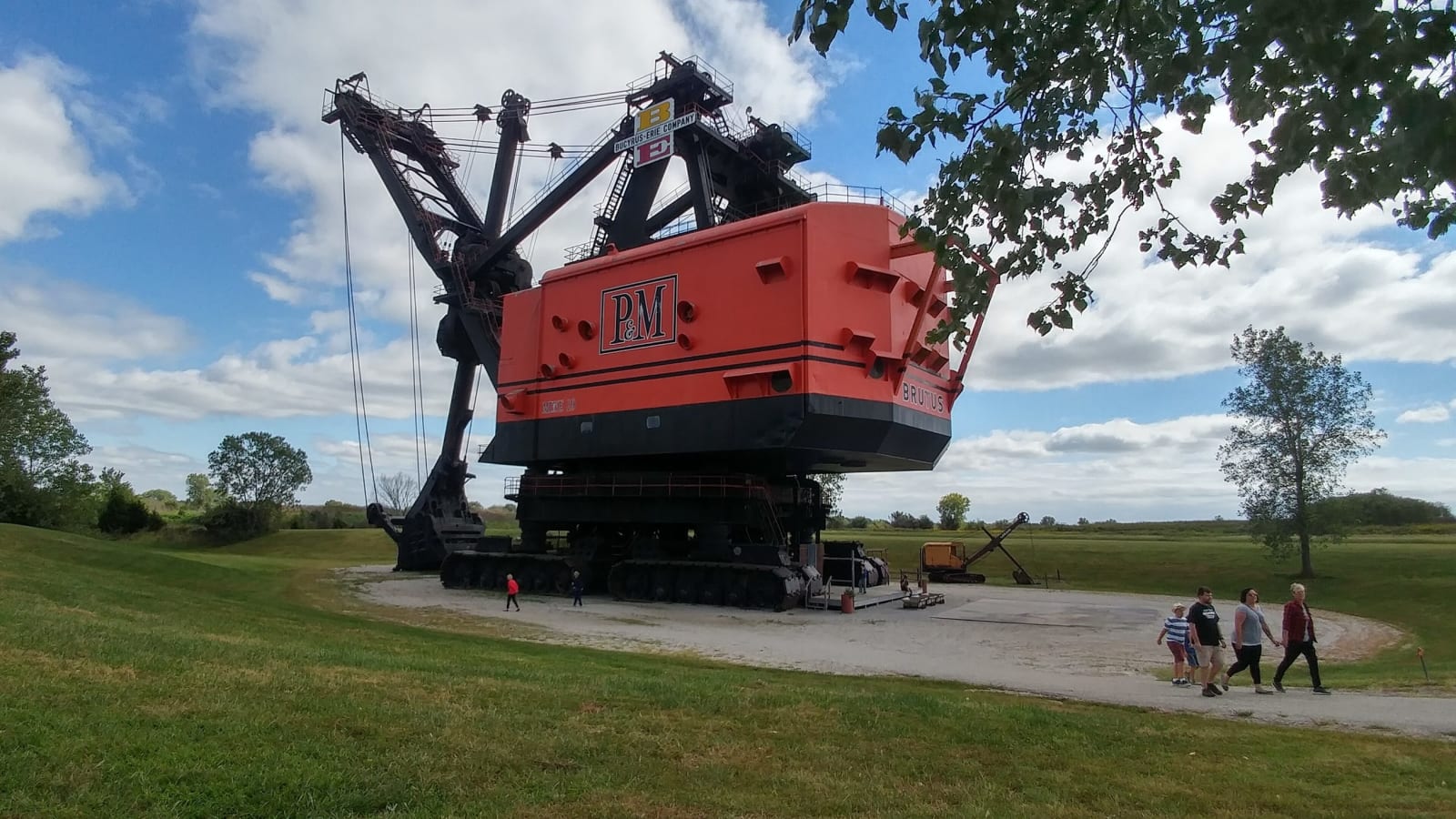
Big Brutus, a giant orange-and-black electric shovel with a tall boom, towering over visitors on a gravel path at West Mineral.Jessicarhein / CC BY-SA 4.0 via Wikimedia Commons
🏭Industrial

Big Brutus

Part ofThe Little Balkans & the Southeast

A 16-story electric coal shovel parked in 1974 where it stopped digging, among the flooded strip pits and reclaimed grassland of the Cherokee County coal field.

⏱
Duration
One to two hours.
🎟
Admission
Adults $10, seniors and military $9, children 6 to 12 $5.50, children 5 and under free.
📅
Best Season
Year-round except Thanksgiving and Christmas; 9 a.m. to 5 p.m. daily from March to November, 9 a.m. to 4 p.m. in winter.

The Story

Big Brutus is a Bucyrus-Erie 1850-B electric shovel that the Pittsburg & Midway Coal Mining Company bought in 1962 for $6.5 million. It came to West Mineral on 150 railroad cars and was put together on site. It stands 16 stories tall and weighs 11 million pounds, with a 150-foot boom and a dipper that held 90 cubic yards, enough, the museum says, to fill three railroad cars. Its top speed was .22 miles an hour. Its job was to strip off 20 to 69 feet of earth and rock and lay bare the shallow coal seams beneath, which smaller machines then dug out.

It worked until 1974, when the coal here no longer paid to mine, and it was too big to move, so it stayed where it stopped. P&M donated it in 1984, and it opened as a museum and miners' memorial in 1985. Engineers made it a regional historic mechanical engineering landmark in 1987, and it was listed on the National Register of Historic Places in 2018. It was never the largest shovel ever built, but it is the largest still standing.

Around it lies the ground that shovels like it made. The Mined Land Wildlife Area takes in 15,000 acres of stripped land gone back to grass, woodlots and long water-filled pits, now stocked with bass. Visitors walk a self-guided tour of the machine and the visitor center's exhibits, and the site has tent and RV camping by reservation.

Visitor Info

⏱
Time Needed
One to two hours.
🎟
Admission
Adults $10, seniors and military $9, children 6 to 12 $5.50, children 5 and under free.
📅
Best Season
Year-round except Thanksgiving and Christmas; 9 a.m. to 5 p.m. daily from March to November, 9 a.m. to 4 p.m. in winter.
🛣️
Highway
K-7 / K-102

On the Map

Nearby

The closest stops worth working into your route

roadside18 mi away
Brush Creek Bridge (Rainbow Bridge)
The last of three Marsh rainbow arch bridges on Kansas's short stretch of Route 66, built in 1923 and kept standing in 1992 when the road association refused to let it go.
historical21 mi away
Miners Hall Museum
Franklin's museum of the Crawford County coal camps and their immigrant families, and of the December 1921 morning the miners' wives marched to shut the mines.
cultural40 mi away
Martin and Osa Johnson Safari Museum
Chanute's museum of the hometown singer and the jeweler's son who filmed the South Seas, East Africa and Borneo for paying audiences, and of the West African art that now shares their building.
historical41 mi away
Dalton Defenders Museum
Coffeyville's museum named for the four townsmen killed on October 5, 1892, when the Dalton gang tried to rob two banks at once, across the street from the bank where the plan fell apart.
historical41 mi away
Fort Scott National Historic Site
An 1840s army post on the old Missouri border where officers kept enslaved servants, and where twenty years later the 1st Kansas Colored Infantry was mustered onto the parade ground.
historical51 mi away
Little House on the Prairie Museum
The Ingalls family's claim of 1869 and 1870 southwest of Independence, a squatter's homestead on the Osage Diminished Reserve, with a replica cabin, schoolhouse and post office.

Historical markers nearby

Roadside plaques and monuments within a short detour

Marker17 mi away
The Legend of Greenbush
Marker20 mi away
Baxter Springs Massacre
Marker21 mi away
Osage Catholic Mission
Marker28 mi away
Osage Nation