Home / Kentucky / Bardstown, Bourbon & Lincoln Country / Basilica of St. Joseph Proto-Cathedral
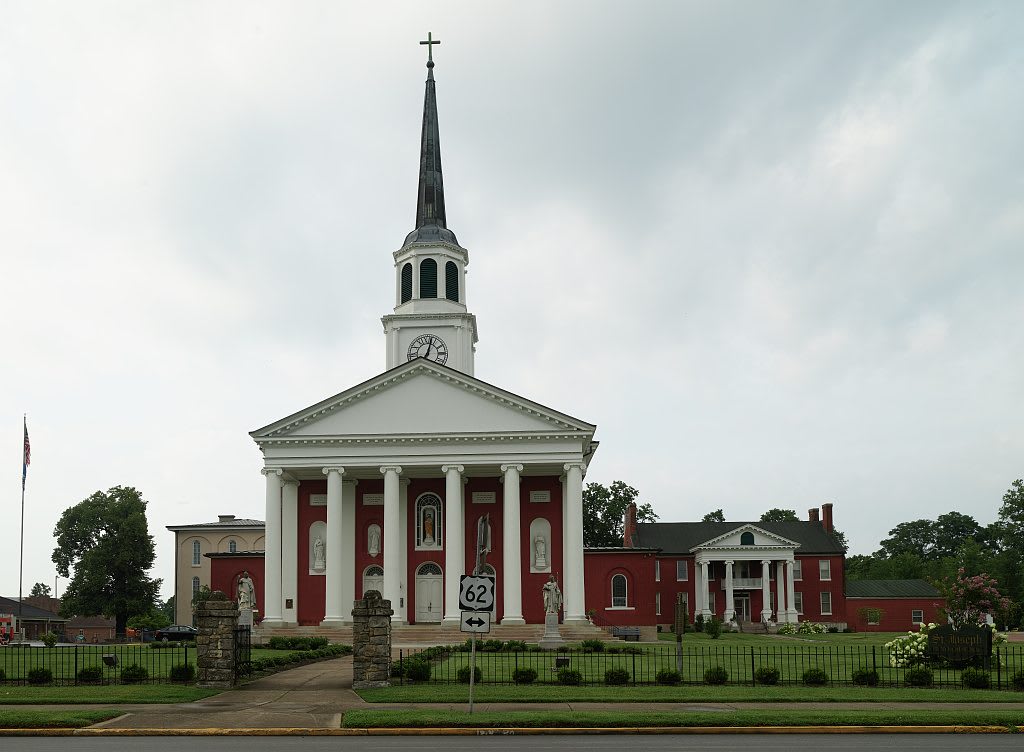
The red-brick proto-cathedral with its white columned portico and tall white steeple, behind an iron fence on the Bardstown street.Carol M. Highsmith / public domain via Library of Congress
🏗️Architectural

Basilica of St. Joseph Proto-Cathedral

Part ofBardstown, Bourbon & Lincoln Country

Bardstown's cathedral of 1816-1819, the first Catholic cathedral west of the Alleghenies, and the enslaved family whose son founded a national Black Catholic press.

⏱
Duration
Thirty minutes to an hour; longer with a walk through downtown Bardstown.
🎟
Admission
Free; an active parish church, open to visitors outside services.
📅
Best Season
Year round.

The Story

Bardstown became the seat of a new Catholic diocese in 1808, and its first bishop, Benedict Joseph Flaget, set out to build a cathedral in a small frontier town. The cornerstone went down on July 16, 1816. John Rogers of Baltimore designed it and built it from local materials, Mass was said inside by 1819 and the interior was finished in 1823. Its paintings came as gifts from European patrons; parish tradition credits several to King Louis-Philippe of France. Later the bishop's seat moved to Louisville, which is why this is a proto-cathedral, and in 2001 it was made a minor basilica.

The church and St. Joseph's College beside it, founded by Flaget in 1819, ran on slave labor. Flaget was among Kentucky's largest slaveholders, the college held 18 enslaved people by 1840 and borrowed and rented more, and the Jesuits who took over in 1848 kept between 10 and 20 at work until 1865. Robert Rudd and Eliza Frances Smith were enslaved sextons of St. Joseph Church. Their son Daniel Rudd, born in 1854, founded the American Catholic Tribune, the first Black-owned national Catholic newspaper, and in 1889 the Colored Catholic Congress.

On a November night in 1952 thieves cut nine paintings from their frames; the FBI found them in Chicago and New York, and they hung again in 1958. The old college buildings beside the church, Spalding Hall and Flaget Hall, are part of the same National Register listing.

Visitor Info

⏱
Time Needed
Thirty minutes to an hour; longer with a walk through downtown Bardstown.
🎟
Admission
Free; an active parish church, open to visitors outside services.
📅
Best Season
Year round.
🛣️
Highway
US 62

On the Map

Nearby

The closest stops worth working into your route

historical0.8 mi away
My Old Kentucky Home State Park (Federal Hill)
Federal Hill, the Rowan family's 1818 mansion at Bardstown, told with the at least 54 people the Rowans enslaved and the history of Stephen Foster's song.
cultural11 mi away
Abbey of Our Lady of Gethsemani
The Trappist monastery in the Nelson County knobs, founded in 1848, where Thomas Merton lived and wrote for 27 years and lies buried.
industrial13 mi away
Kentucky Railway Museum
The rail museum at New Haven, on the L&N's old Lebanon branch, where excursion trains run the Rolling Fork valley and L&N No. 152 is the state locomotive.
natural13 mi away
Bernheim Arboretum and Research Forest
More than 16,000 acres of knobs and woods that a whiskey man bought for a dollar an acre and gave to Kentucky, with an Olmsted-designed arboretum at the center.
industrial13 mi away
Jim Beam American Stillhouse
The Clermont distillery that James B. Beam rebuilt in 1933 and 1934, after Prohibition, for a family that had sold whiskey since about 1795.
industrial13 mi away
Maker's Mark Distillery
The Hardin Creek distillery farm at Loretto, on a mill site of 1805, where the Samuels family began Maker's Mark in 1954 and the first working distillery to become a National Historic Landmark.

Historical markers nearby

Roadside plaques and monuments within a short detour

Marker0.1 mi away
Spalding Hall
Bardstown
Marker0.2 mi away
Steamboat Inventor
Bardstown
Marker0.3 mi away
County Named, 1784
Bardstown
Marker0.3 mi away
Edgewood
Bardstown
Marker0.4 mi away
Austin Hubbard (Narcissa) House
Bardstown
Marker0.5 mi away
Alexander Walters (1858-1917)
Bardstown