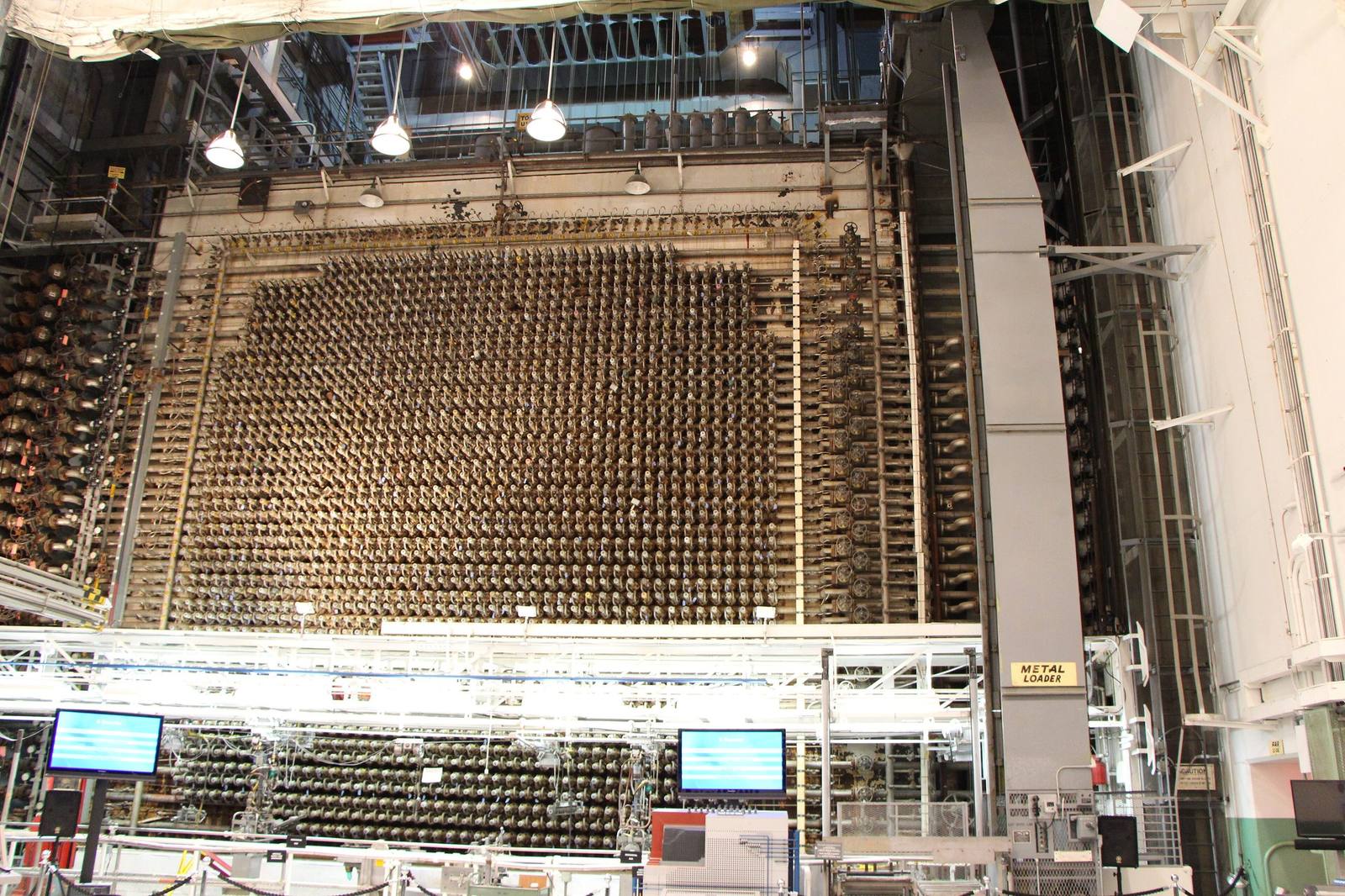
 Ryan Adams / CC BY-SA 3.0 via Wikimedia Commons
The Story
B Reactor went critical late on the evening of September 26, 1944, the first full-scale reactor ever run, and by the next day it was dead. Its power sagged through the night and then fell away entirely. Leona Woods Marshall, the only woman on the team that had built the first reactor in Chicago and on the night shift with Enrico Fermi, remembered everyone standing around staring at it.
The engineers suspected a water leak and shut it down to look. By the morning of September 29, the physicist John Wheeler had the answer: a radioactive iodine made in fission decays within hours into xenon-135, which absorbs neutrons so readily that it was choking the chain reaction, and which decays away again once the reactor stops. The cure was more uranium, and there was room for it. The story at Hanford is that Fermi had thought 1,500 fuel tubes enough. DuPont's Crawford Greenewalt, pushed by his engineer George Graves, had ordered the corners of the graphite stack drilled for 2,004, a hedge against trouble with the aluminum fuel cans. Loading the spare channels overrode the poison.
Every reactor built since has had to account for xenon. The Park Service tour walks the control room, with a gauge for each of the 2,004 tubes, and the front face of the reactor where the fuel went in.
Visitor Info
On the Map
Nearby
The closest stops worth working into your route