County guide · New Mexico
Socorro County
3 places to stop and 32 historical markers in Socorro County, New Mexico.
Towns: Socorro (13), San Antonio (8), Magdalena (5), La Joya (3), San Acacia (2), Belen (1), Las Nutrias (1), Datil (1), Lemitar (1)
Places to stop
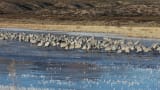
natural · San Antonio
Bosque del Apache National Wildlife Refuge
A Rio Grande refuge south of Socorro where cranes and geese winter by the tens of thousands on wetlands and fields kept by people, because the river no longer floods to make them.
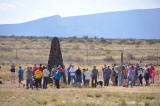
historical · San Antonio
Trinity Site
Where the first atomic bomb was exploded on July 16, 1945, open one day a year, and remembered by its neighbors as the start of decades of illness the government took eighty years to acknowledge.
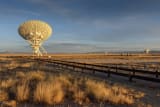
attraction · Magdalena
Very Large Array
Twenty-seven radio dishes, each 82 feet across and 230 tons, spread in a Y across an Ice Age lakebed on the Plains of San Agustin and moved on rails to change how sharply they see.
Historical markers
Belen
Abó Pass Trail
The Santa Fe railroad wanted a way around Raton and Glorieta passes, where its grades ran to 3.5 percent; through Abó Canyon it found a line no steeper than 1.25.
La Joya
Acomilla
The black mesa east of San Acacia carries more than a name. In 1855 the surveyor John W.
San Antonio
Carthage-Tokay-Farley
Tokay took its name not from coal but from a very sweet grape and the wine made from it.
San Acacia
Doña Eufemia
Everything known of Doña Eufemia comes from one book, Gaspar Pérez de Villagrá's epic poem on the Oñate expedition, printed in Spain in 1610.
Socorro
Espejo's Expedition
Antonio de Espejo was on the northern frontier because he had been convicted as an accomplice in a murder case and preferred not to pay the fine.
San Antonio
Fort Craig
When the Army gave up the post in 1885, its buildings were sold to Captain Jack Crawford, the Poet Scout the panel names.
Socorro
Fort Craig
Captain Louis S. Craig, for whom the fort was named, had been killed by deserters in California on June 6, 1852.
Socorro
Fort Craig Rest Area
The San Mateo Mountains to the west are the wreckage of several volcanoes rather than one.
Socorro
Jumbo
Jumbo was the Manhattan Project's insurance: if the plutonium failed to chain-react, the steel jug would hold the conventional blast and keep the scarce metal from…
Magdalena
Kelly
The town is Kelly rather than Kelley because a clerk misspelled Patrick H. Kelley's claim when he registered it.
La Joya
La Joya de Sevilleta
The Piro town Oñate renamed Nueva Sevilla in 1598 was Tzelaqui, or Seelocú. Franciscans made it the mission of San Luis Obispo de Sevilleta, and in 1680 most of its…
Las Nutrias
Las Nutrias
Nutria is old rural Castilian for beaver, and the meadow here was a recognized paraje a day's travel north of La Joya.
Magdalena
Magdalena
The railhead made Magdalena the end of a cattle trail. When the branch from Socorro opened in January 1885, ranchers in western New Mexico and eastern Arizona began…
Magdalena
Magdalena Fault
The summit the panel names carries a laboratory. New Mexico Tech built Langmuir Laboratory for Atmospheric Research near South Baldy in 1963, with National Science…
San Antonio
Mesa Del Contadero
The mesa is a 300-foot mass of black volcanic rock, and the Valverde fords lay just north of it.
Socorro
New Mexico Bureau of Mines and Mineral Resources Museum
The panel's C. T. Brown was Cony T. Brown, a benefactor of the School of Mines. The school had kept minerals since its founding in 1889, but that first collection was…
Socorro
New Mexico Tech
The territorial legislature placed the School of Mines in Socorro in 1889, in the silver boom, and forbade it to build anything until it owned twenty acres.
Socorro
Paraje de Fra Cristobal
Fray Cristóbal de Salazar was Oñate's cousin and one of the friars who came north in 1598; he preached the sermon at the ceremony where Oñate assigned the Franciscans…
Socorro
Paraje De Fra Cristobal
This was where the Camino Real came back to the river after the Jornada del Muerto, and travelers from Diego de Vargas in 1692 to Josiah Gregg in 1833 wrote it down.
Datil
Plains of San Augustin
The old lake the panel describes left its shorelines on the basin's edges, and one of them made an archaeological site.
Magdalena
Riley
Farmers founded Santa Rita about 1880, and when the post office opened in 1890 the name on the records was Riley, after a local sheep rancher.
La Joya
Rio Salado Sand Dunes
The range the panel calls the Ladrones takes its name from thieves: Navajo and Apache raiding parties, and later Hispanic and Anglo rustlers, used its canyons to hide…
San Acacia
Rio Salado Sand Dunes
This is the rewrite of the northbound rest area's older panel, and its subject is the trench.
Lemitar
Sabino y Lemitar
Lemitar appears on no Mexican-era list of settlements; it seems to have begun about 1831, and its church of the Sagrada Familia was finished by 1835.
San Antonio
San Antonio
Conrad Hilton was born here on Christmas Day, 1887, the son of Gus Hilton, a Norwegian immigrant whose general store stood beside the railroad tracks.
San Antonio
San Pedro
An army lieutenant first recorded the village in 1846, as Don Pedro. Its farmers grew Mission grapes for wine and a local champagne, and when the railroad came, miners…
Socorro
Socorro
The panel puts Oñate at Pilabó, but the town that gave his column corn on June 4, 1598, and got the name Socorro was Teypana, about three leagues north; the name moved…
Socorro
Socorro
This panel gets the two pueblos straight: Teypana gave Oñate corn, and Pilabó took the mission.
Socorro
The Garcia Opera House
The widow the panel leaves unnamed was Francisca G. Garcia, from a family long tied to Socorro's history, and the National Register dates the building to 1886.
San Antonio
Trinity Site
In 1962 General Leslie Groves wrote to ask whether Trinity had been picked because the name was common on western rivers and peaks.
Socorro
Vásquez de Coronado's Route
The source is Pedro de Castañeda, writing his chronicle of the Coronado expedition decades later, in 1565.
Socorro
Women of the Camino Real
The panel's numbers come from the expedition's musters: Ulloa's inspection of 1597 and Juan de Frías Salazar's, run from November 1597 into February 1598, from which…