County guide · New Mexico
Eddy County
2 places to stop and 17 historical markers in Eddy County, New Mexico.
Towns: Carlsbad (8), Artesia (5), Whites City (3), Loving (3)
Places to stop
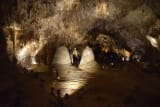
geological · Carlsbad
Carlsbad Caverns National Park
The way into the cave has changed four times: a guano miner's bucket, a wooden staircase, a 750-foot elevator, and now a timed ticket and a switchback trail down the natural entrance.
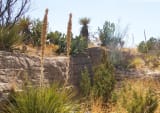
natural · Carlsbad
Living Desert Zoo and Gardens State Park
A zoo and garden of the Chihuahuan Desert on the Ocotillo Hills above Carlsbad, whose animals are injured or orphaned wildlife that cannot go back to the wild.
Historical markers
Artesia
Artesia
When the water gave out, oil came in. In 1924, after two dry holes, Martin Yates and his partners drilled a third well at a site his wife, Mary, is said to have chosen…
Artesia
Artesia
Artesia is the town's third name. The railroad siding of 1894 was Miller, for a brakeman or an engineer depending on the source; when a post office came it became…
Whites City
Carlsbad Caverns National Park
Ordinary groundwater did not hollow these caves. Unlike most limestone caves, which carbonic acid dissolves, the caverns of the Guadalupe Mountains were eaten out from…
Whites City
Carlsbad Caverns National Park
The panel's order runs backwards. The park's water already came from Rattlesnake Springs by 1935, when six miles of pipe were laid to the cavern to replace Oak Springs…
Carlsbad
Carlsbad Irrigation Flume
The concrete flume was a rescue. By 1902 the wooden flume was failing, and the engineer Johnston designed a reinforced concrete aqueduct 497 feet long and up to 47 feet…
Carlsbad
Carlsbad Irrigation Flume
The flume began as a ranchers' scheme. In 1887 Charles B. Eddy and Pat Garrett, the sheriff who killed Billy the Kid, formed an irrigation company to water the lower…
Carlsbad
Carlsbad Irrigation Flume
The flume is one piece of a working landmark. The Carlsbad Irrigation District was designated a National Historic Landmark in 1964, a district of seven buildings and…
Artesia
Castaño de Sosa's Route
Castaño de Sosa did not lead an expedition so much as move a town. On July 27, 1590, he took the whole settlement of Almadén in Nuevo León, nearly 200 people with ox…
Carlsbad
Civilian Conservation Corps Carlsbad Campsite
This panel has moved and been corrected. Its first version stood on US-285 at North 8th Street, by the Carlsbad hospital that now covers the ground where the three CCC…
Loving
Espejo's Trail
This panel is missing from its post on US-285 north of Horizon Road. Antonio de Espejo, a wealthy rancher, led fourteen soldiers north in November 1582 to rescue two…
Loving
Goodnight-Loving Trail
The town just southeast carries the trail man's name, but not first. Swiss immigrants who settled it in the 1890s called it Vaud, after their canton; by 1904 the Italian…
Whites City
Guadalupe Mountains
The reef the panel compares to Australia's grew around the rim of a Permian inland sea, the Delaware Basin, and stands some 750 meters thick.
Carlsbad
Josephine Cox "Grandma" Anderson
Josephine Anderson came to Eddy in 1888, when it was mud streets, bars and a tent city on the Pecos, and she was an artist as much as a nurse: she painted a mural for a…
Loving
Loving's Bend
This panel has been permanently removed. Oliver Loving was fifty-four when he died at Fort Sumner on September 25, 1867, and by then he was known as the dean of the…
Carlsbad
Mother Magdalen and the Sisters of Loretto (1852-1968) / Carlsbad
The panel's Carlsbad side tells how the town got its name, but it has crazed past reading. The town was laid out as Eddy on September 15, 1888, for Charles B. Eddy.
Artesia
Sallie Chisum Robert
The diaries the panel mentions date from 1908 to 1929. Sallie married William Robert in 1880; when the Chisum properties failed they divorced, and he left for his ranch…
Artesia
Seven Rivers Cemetery
The refuge the panel mentions had a reputation. Called Dogtown for its prairie dogs until 1878, the settlement sheltered the Seven Rivers Warriors, small ranchers at…