County guide · Alabama
Mobile County
3 places to stop and 32 historical markers in Mobile County, Alabama.
Towns: Mobile (30), Dauphin Island (1), Le Moyne (1), Grand Bay (1), Mount Vernon (1), Axis (1)
Places to stop
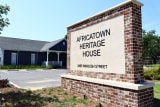
cultural · Mobile
Africatown Heritage House
The museum in Africatown that holds Clotilda: The Exhibition, telling the story of the 110 Africans brought on the last known slave ship and the town they founded.
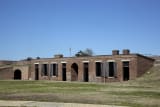
historical · Dauphin Island
Fort Gaines
The pentagonal brick fort on the east end of Dauphin Island that surrendered three days after the Battle of Mobile Bay and now fights the Gulf's erosion.
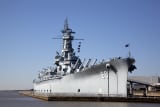
historical · Mobile
USS Alabama Battleship Memorial Park
The World War II battleship towed home to Mobile Bay in 1964 on money raised partly by schoolchildren, with the submarine Drum and an aircraft pavilion beside it.
Historical markers
Mobile
Andrew N. Johnson
Johnson's Mobile years ended in a crisis. In October 1906 a mob lynched two young Black men accused of rape at Magazine Point, the county's first lynchings since the…
Mobile · Erected 1950
Barton Academy
Mobile built its school with lottery money. The commissioners bought the block in 1830 but lacked funds until a lottery was allowed, and much of the rest came from the…
Mobile
Bettie Hunter House
Bettie Hunter's house holds its own against the best of its day. The two-story Italianate house of 1878 matches the scale and detail of white-owned houses of the period…
Mobile · Erected 1970
City Hall
The building exists because a court order was finally obeyed. Open-air markets had stood here since the early 1800s, with live fish sold from cypress tanks, and in 1842…
Le Moyne · Erected 1999
Ellicott's Stone
On April 10, 1799, Andrew Ellicott set up an observatory on a bluff above the Mobile River and fixed the 31st parallel by the stars.
Mobile
Finley's Drug Stores
James Finley's drugstore career ran straight into Mobile's civil rights fight. The Neighborhood Organized Workers turned to direct action after a march of 7,000 people…
Mobile · Erected 1951
Government Street Presbyterian Church
Three architects who came south from New York in 1834 to chase the cotton boom drew this church: James Gallier, who had practiced briefly with Minard Lafever, and the…
Grand Bay · Erected 2007
Grand Bay Elementary School for Colored
The families of the Fernland community raised part of the cost of this school, as every Rosenwald school required: the fund matched only what local people could give.
Mobile · Erected 2017
Home of Joe Cain
Joe Cain was buried outside Bayou La Batre in 1904 and might have stayed there. In 1966 the Mobile writer Julian Lee Rayford persuaded city officials to move Cain and…
Mobile · Erected 2010
John L. LeFlore
Two tests in the 1940s show how LeFlore worked. When a race riot broke out at the Alabama Drydock and Shipbuilding Company yard in 1943, he took depositions from injured…
Mobile
John L. LeFlore
The league that worked from this building had a signature weapon printed on pink paper.
Mobile · Erected 2021
Judge Virgil Pittman / Wiley L. Bolden, Sr.
The case changed federal law as well as Mobile. In 1980 the Supreme Court, in City of Mobile v.
Mobile · Erected 2025
Lewis Quarters
Lewis Quarters takes its name from Charlie Lewis, whose Yoruba name was Oluale, one of the West Africans carried to Mobile on the Clotilda, and from the household he…
Mobile · Erected 2018
Mobile Aeroplex at Brookley
In World War II Brookley Field trained glider pilots, supplied bases across the Southeast and the Caribbean as the Southeast Army Air Depot, and repaired and modified…
Mobile · Erected 2017
Mobile's First Mardi Gras Parade
The Order of Myths, founded in 1867, chose an emblem that still leads its parade: Folly, a jester, chasing Death, a skeleton, around a broken column.
Mobile
Most Pure Heart of Mary Catholic Church
This parish grew up inside a segregated church. Alabama's Catholic diocese built separate parishes, schools and hospitals for Black Catholics and invited religious…
Mount Vernon · Erected 1982
Mt. Vernon Arsenal and Barracks / Searcy Hospital
After the Army left in the 1890s, Alabama turned the old barracks into a mental hospital, and for most of its life it admitted only Black patients, under names such as…
Mobile
National African-American Archives and Museum
Built for Black Mobilians on the Avenue, the branch was underfunded by city and state from the start.
Mobile · Erected 1985
Oakleigh
Enslaved workers built Oakleigh, firing its bricks from clay dug on the grounds, and none of the quarters where they lived survive. James W.
Mobile · Erected 1959
Old Slave Markets
The schooner Clotilda was smuggled in more than 50 years after Congress outlawed bringing enslaved Africans into the country.
Mobile · Erected 2019
Restoring Justice / Lives Lost in The Segregation Era
These deaths came back to light through one newspaper clipping. In 2012 Northeastern law student Chelsea Schmitz began looking into Rayfield Davis's killing from a…
Axis · Erected 2001
Site of Old Mobile
For most of three centuries no one knew exactly where Old Mobile had stood. French maps pointed to Twenty-Seven Mile Bluff, but some locals argued otherwise.
Mobile · Erected 2010
St. Louis Street Missionary Baptist Church
The congregation was born of a quarrel over mission work. By 1854 the Stone Street Baptist Church was divided, and ten members left because they wanted to sponsor a…
Mobile
St. Martin de Porres Hospital
The hospital belonged to a statewide pattern. Shut out of white hospitals, Black Alabamians built their own, often with help from philanthropists or churches, and in…
Mobile · Erected 2007
Stone Street Baptist Church
The church you see was designed by its own members. By 1922 the congregation had outgrown its frame building, and under Rev. M. C. Cleveland Sr.
Mobile · Erected 2021
The Lynching of Richard Robertson
Richard Robertson was a Black carpenter in Mobile. On January 23, 1909, two white plumbers accused him of assault.
Mobile · Erected 2019
The UNESCO Slave Route: Resistance, Liberty, Heritage / Honoring the Memory of the Ancestors
Slavery reached Mobile with the French. A handful of enslaved Africans were brought from the Caribbean as early as 1706, and two years later officials asked leave to buy…
Mobile · Erected 2019
Tristan de Luna y Arellano
After a hurricane wrecked most of Luna's ships in September 1559, his hungry colony looked to a large town on the Alabama River called Nanipacana.
Mobile · Erected 1956
U.S. Marine Hospital
Congress created the Marine Hospital Service in 1798 to treat sick and disabled seamen, and Mobile's turn came with an 1837 act setting aside $15,000.
Mobile · Erected 2017
Vernon Z. Crawford Law Firm
Crawford came to the law by way of the sea. Born in Mobile in 1919, he served as a merchant seaman in World War II, graduated from Alabama State in 1951 and from…
Mobile · Erected 2017
Vivian Malone Jones
Her work after Tuscaloosa ran through voting rights and the environment. After the Justice Department she became director of civil rights and urban affairs at the…
Mobile · Erected 2009
Wallace Turnage
Turnage reached Mobile only after four failed escapes. Born near Snow Hill, North Carolina, to a 15-year-old enslaved woman named Courtney and a young white man, he was…