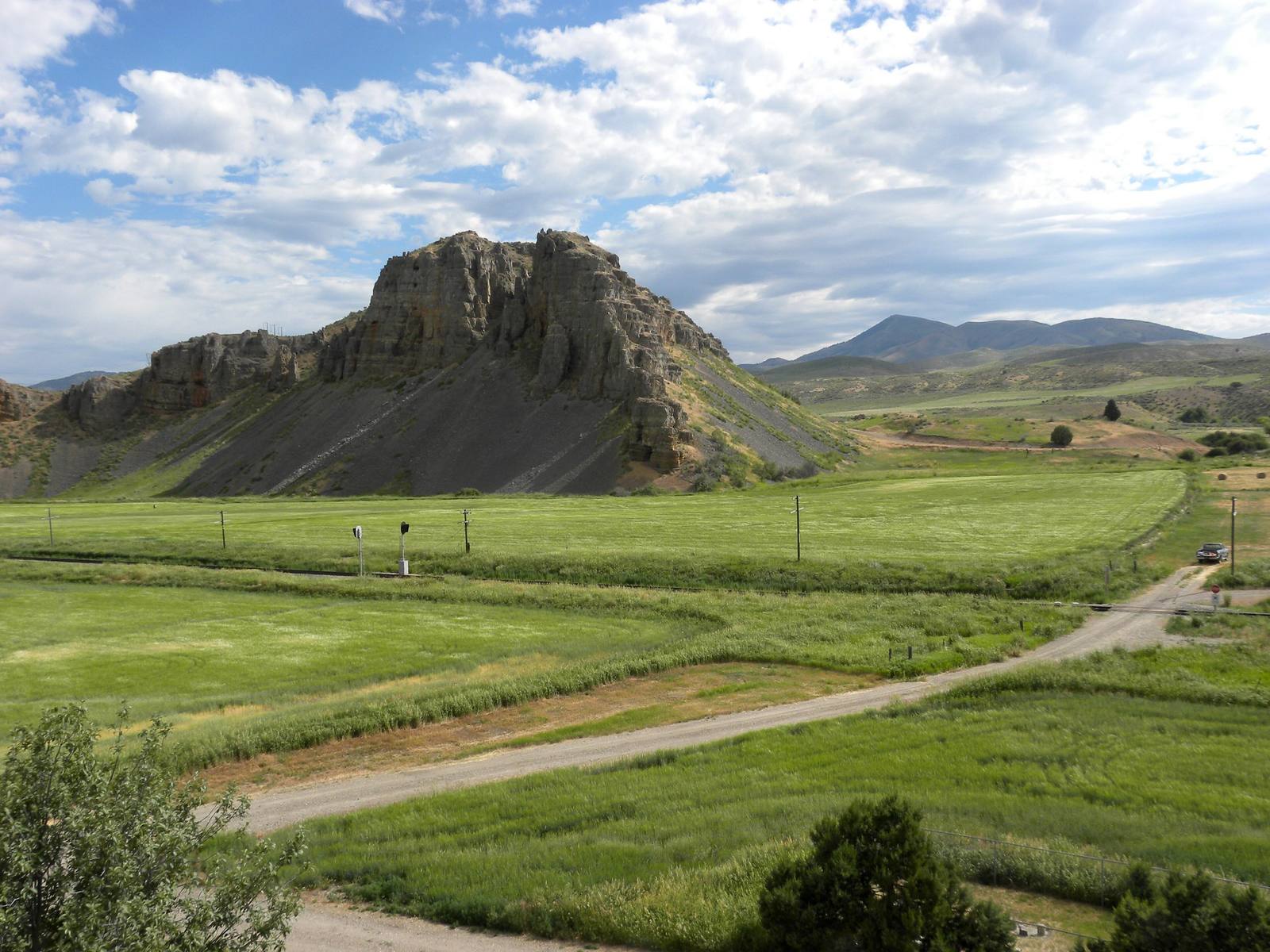
Red Rock Pass does not look like much. US-91 crosses it south of Downey, a low saddle between red limestone cliffs with a creek running north from it, Marsh Creek, bound for the Portneuf. Most drivers do not notice they have crossed a divide. For a few weeks, roughly eighteen thousand years ago, this was the outlet of one of the largest lakes in North America, and it was coming apart.
The rim
During the last ice age the closed basin that now holds the Great Salt Lake filled with water. Lake Bonneville grew until it covered more than fifty thousand square kilometers of what is now Utah, with arms reaching into Nevada and Idaho. A closed basin has no drain, so the lake rose until it found the lowest point on its rim. That point was here, at the head of Marsh Creek, where the rim was made not of bedrock but of loose alluvial fill.
Once water began to spill over the fill, it cut into it, and the deeper it cut the faster it flowed. The outlet incised something like 350 to 400 feet, down to the resistant rock that stops it today. The lake dropped with it. By the time the cutting stopped, Lake Bonneville had lost about half its water. The peak flow through the pass is estimated at about a million cubic meters a second, in the range of 33 million cubic feet, several hundred times the largest flood ever recorded on the upper Snake. The height of the flood lasted days to weeks, though the river ran high for a year or more afterward.
The road it took
The water went north down Marsh Creek and into the Portneuf, and at Portneuf Narrows, the gap south of Pocatello that I-15 and the railroad now share, it is estimated to have run about four hundred feet deep. Out on the Snake River Plain it turned west down the Snake, following a canyon the river had already cut but scouring it harder than the river ever had. It ran past what would become American Falls, down through the gorge at Twin Falls, along the canyon past Hagerman, and on through Hells Canyon to Lewiston and the Columbia.
Everywhere the current slowed, it dropped what it was carrying. The flood tore basalt from the canyon walls and rolled it into boulders, some the size of cars, rounded and pale, and left them in bars and fields downstream. In 1962 Harold Malde of the Geological Survey and a colleague gave these deposits a deliberately plain name: Melon Gravel. You can see them in the park at Massacre Rocks, scattered across the ground between the river and the interstate, and along the Snake canyon farther west.
The man who saw it first, and the forgetting
G. K. Gilbert, the great geologist of the Great Basin, rode to Red Rock Pass in 1876 and worked out the essential sequence: a lake that had overflowed here, cut its outlet down and dropped. He described it in the 1870s. Then, for most of a century, almost nobody followed the water downstream. It was Malde, working for the U.S. Geological Survey in the late 1950s, who connected the boulder fields and the scoured, channelled basalt of the Snake River Plain to Gilbert's overflow, and his 1968 report laid out the flood along its whole Idaho course. Estimates of when it happened have moved since. For years it was dated to about fourteen or fifteen thousand years ago; more recent work puts it at about eighteen thousand.
After the flood
When the cutting reached hard rock, the lake settled at the new, lower level and kept draining through the pass, a steady river instead of a flood, for about a thousand years. That long stand cut the shoreline Utah calls the Provo, one of the benches its cities are built on. As the climate dried, the lake fell below the outlet for good, and Red Rock Pass became a quiet divide again.
To follow it, start at the pass on US-91 and drive north down Marsh Creek to the Portneuf, then take I-15 through the Narrows and I-86 west along the Snake to Massacre Rocks. In the canyon at Shoshone Falls the rim stands hundreds of feet above the river, and much of that depth is the river's own long work. The flood is written in what lies on the canyon floor: the rounded rock nothing smaller than a flood could have moved.