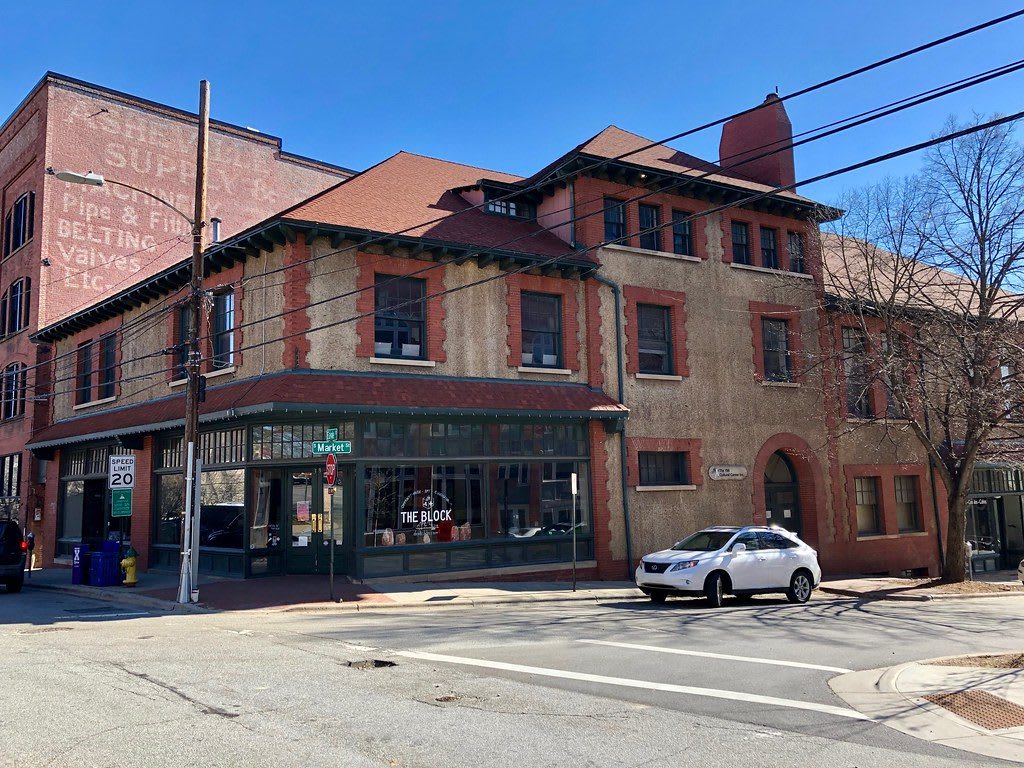
 Warren LeMay / CC0 via Flickr
The Story
In 1892 two leaders of Black Asheville, Isaac Dickson and Dr. Edward S. Stephens, went to George Vanderbilt and asked for a building for the Black men then at work on Biltmore. Vanderbilt and his estate superintendent, Charles McNamee, agreed to pay for it, framing it partly as a test of whether a Black institution could govern and support itself. The architect Richard Sharp Smith designed the two-and-a-half-story building of pebbledash, brick and stone at Eagle and Market Streets, and it was finished in 1893.
The Young Men's Institute held a library and reading room, a gymnasium and meeting rooms, formed its own chorus and orchestra, and brought performers such as the singer Flora Batson in 1895. Its ground-floor storefronts were rented to Black-owned businesses so the rent could carry the building, and in June 1906 the YMI's board bought it from the Vanderbilt estate for $10,000. Through the decades of segregation it housed at various times a kindergarten, a public library, a drugstore, a doctor's office and a funeral parlor, and gave congregations without a church a place to worship.
Use fell off in the 1960s and 1970s. The building went on the National Register in 1977, and in 1980 a coalition of nine Black churches bought it and reopened it as the YMI Cultural Center. Its galleries show African masks and sculpture, drawings by Charles W. White and photographs of the YMI and its ties to Biltmore, and a state marker stands nearby at Pack Square.
Visitor Info
On the Map
Nearby
The closest stops worth working into your route
Historical markers nearby
Roadside plaques and monuments within a short detour