Home / Mississippi / The Mississippi Delta / Winterville Mounds
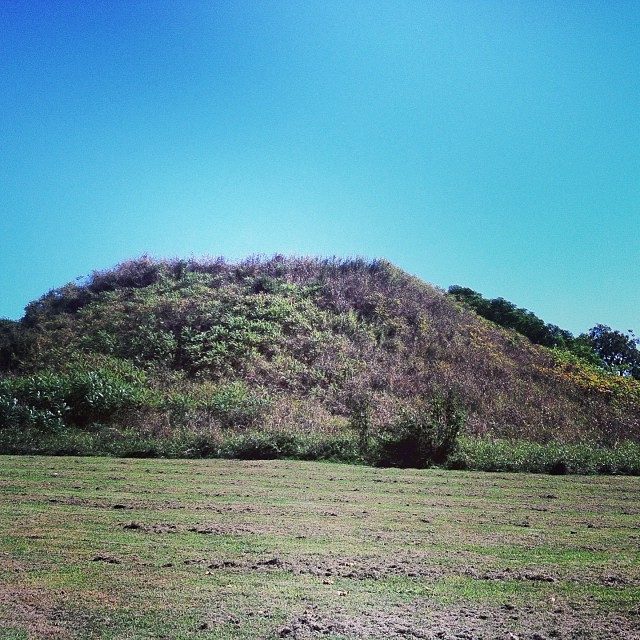
A grass-covered earthen mound rises above a mown field under a clear blue sky at Winterville Mounds.Farther Along / CC BY 2.0 via Flickr
🏛️Historical

Winterville Mounds

Part ofThe Mississippi Delta

A Mississippian ceremonial center north of Greenville, built by hand from about AD 1000, with a 55-foot Temple Mound and twelve of its original twenty-three mounds still standing.

⏱
Duration
One to two hours.
🎟
Admission
Check MDAH for current hours and any fee.
📅
Best Season
Year round; confirm hours with the Mississippi Department of Archives and History.

The Story

Winterville Mounds, about six miles north of Greenville, was a gathering place for the people of the Lower Mississippi Valley from about AD 1000 to 1450. They built it by hand, carrying soil in baskets, and at least twenty-three mounds once stood around two large plazas. Twelve mounds and both plazas survive. The tallest, Mound A, rises fifty-five feet and is among the ten tallest earthen structures in the United States.

Mound A was a platform for a temple. Chiefs lived on the mounds while most people farmed scattered homesteads and came in for feasts, trade and ceremony. Archaeologists find evidence that a great fire in the late 1300s destroyed the building on top, and mound building stopped. The site was abandoned by about 1450. The people who used it were most likely ancestors of the Natchez, whom French colonists met in the 1700s, and the Mississippi Department of Archives and History consults the federally recognized tribes with ancestral ties to the state about its care.

Plowing and grazing wore the mounds down, and in 1960 the Greenville Garden Club bought forty-two acres and gave them to the state. After storms and tornadoes eroded Mound A, the department and tribal partners rebuilt its ramp and stabilized it, finishing in October 2024. The site asks visitors not to walk on the mounds. Stay on the paths, look up at the shape of the thing, and remember that it is a sacred place to the descendants of the people who built it.

Visitor Info

⏱
Time Needed
One to two hours.
🎟
Admission
Check MDAH for current hours and any fee.
📅
Best Season
Year round; confirm hours with the Mississippi Department of Archives and History.
🛣️
Highway
US 1

On the Map

Nearby

The closest stops worth working into your route

historical5.2 mi away
Greenville Levee and the 1927 Flood
The Mississippi River levee at Greenville, where thousands of mostly Black refugees camped in the flood of April 1927 and where the Department of Archives and History has placed markers.
recreational11 mi away
Lake Chicot State Park
A state park on the largest natural lake in Arkansas, a 20-mile oxbow of the Mississippi River that was cleaned up and reopened after decades of silt.
historical17 mi away
Lakeport Plantation
Arkansas's grandest surviving Greek Revival plantation house, built about 1858 by a planter who held 155 enslaved people in 1860, now an Arkansas State University museum.
cultural22 mi away
Japanese American Internment Museum
A museum in the McGehee train depot on the two Arkansas camps, Rohwer and Jerome, where about 16,000 Japanese Americans were held from 1942 to 1945.
historical23 mi away
Rohwer Relocation Center Memorial Cemetery
A National Historic Landmark cemetery built by Japanese Americans incarcerated at Rohwer from 1942 to 1945, with monuments they made and audio panels narrated by George Takei.
cultural24 mi away
B.B. King Museum and Delta Interpretive Center
A museum built around the brick cotton gin in Indianola where B.B. King worked in the 1940s, with his grave in a memorial garden on the grounds.

Historical markers nearby

Roadside plaques and monuments within a short detour

Marker11 mi away
Columbia
Lake Village, Arkansas
Marker13 mi away
In Memoriam Hyner Cemetery
Lake Village, Arkansas
Marker17 mi away
Chicot County Seats
Lake Village, Arkansas
Marker17 mi away
Lakeport in the Civil War
Lake Village, Arkansas
Marker18 mi away
Saunders-Pettit-Chapman-Cook Plantation Home
Lake Village, Arkansas
Marker22 mi away
Early Railroads in Chicot County
Dermott, Arkansas