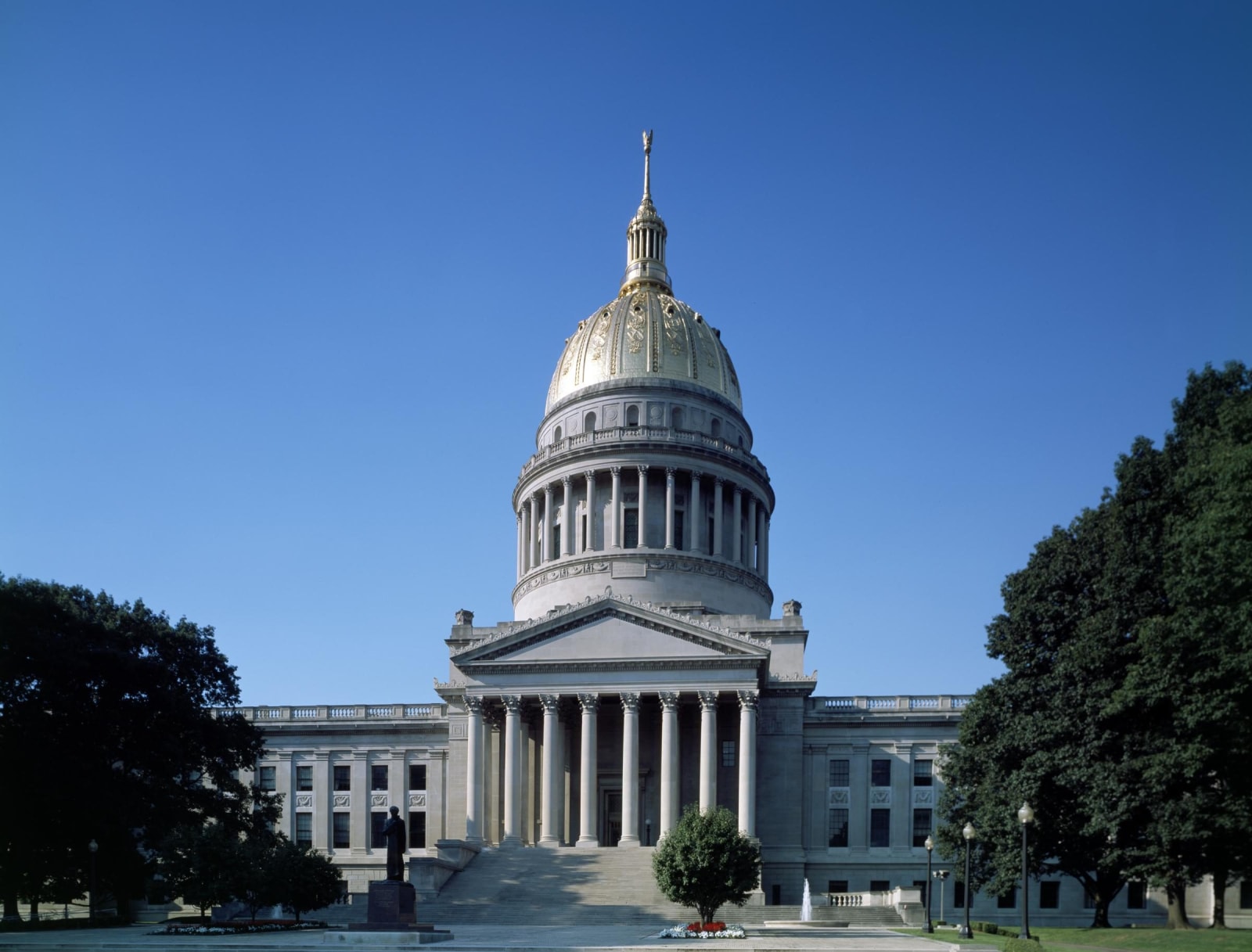
 Carol M. Highsmith / public domain via Library of Congress
The Story
West Virginia took a long time to settle where its government would sit. The first capitol was the Linsly Institute building in Wheeling in 1863. The capital moved to Charleston in 1870, back to Wheeling in 1875, and returned to stay in 1885 after an 1877 popular vote that Charleston won over Clarksburg and Martinsburg. When the Victorian capitol downtown burned on January 3, 1921, and its hastily built wooden stand-in, the "pasteboard capitol," burned in 1927, the state was already building here in the East End to designs by Cass Gilbert.
Gilbert's capitol went up in three pieces, each paid for and finished before the next began: the west wing in 1924-25, the east wing in 1926-27, and the domed main unit from 1930, dedicated on West Virginia Day, June 20, 1932. The walls are buff Indiana limestone; inside are Tennessee and Vermont marble and Italian travertine, quartered oak doors and Czechoslovakian crystal. The gilded dome rises 292 feet, taller though narrower than the one in Washington, and a 4,000-pound chandelier hangs about 180 feet above the floor beneath it.
The complex holds older history too. Holly Grove, the brick house on the grounds, was built in 1815 by the salt maker Daniel Ruffner as the center of a plantation that took in the present East End and much of downtown; Andrew Jackson stayed there in 1832, and work to restore it began in 2026. A monument to Booker T. Washington, who grew up upriver at Malden, stands on the grounds, and the Culture Center beside the west wing holds the state museum.
Visitor Info
On the Map
Nearby
The closest stops worth working into your route
Historical markers nearby
Roadside plaques and monuments within a short detour