Home / West Virginia / Charleston & the Kanawha Valley / Clay Center for the Arts & Sciences
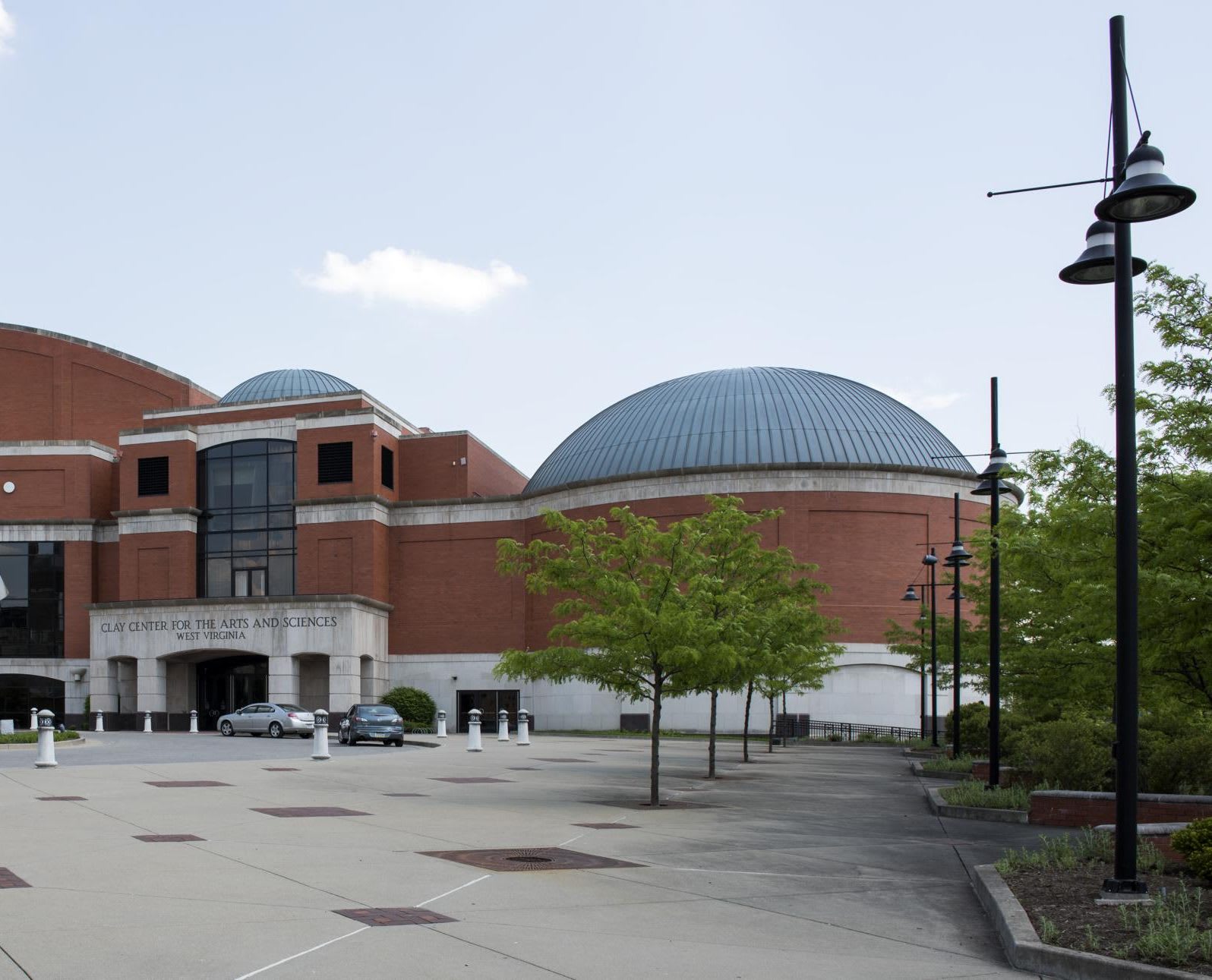
A red-brick arts center with two copper-green domes beside a wide paved plaza and young trees.Carol M. Highsmith / public domain via Library of Congress
🎭Cultural

Clay Center for the Arts & Sciences

Part ofCharleston & the Kanawha Valley

Charleston's 2003 performance hall, art museum, science museum and dome theater under one roof, home of the West Virginia Symphony.

⏱
Duration
Two to three hours.
🎟
Admission
Paid admission for the museums and dome theater; performances ticketed separately (2026).
📅
Best Season
Year round.

The Story

The Clay Center opened on July 12, 2003, after a decade of planning and four years of fund-raising, one of the few places in the country that puts a performing arts center, an art museum and a science center under one roof. Gifts from the Clay Foundation and the Clay family of Charleston and a $22.5 million state grant started it, and individuals, foundations and companies across West Virginia finished the money. It was part of a larger plan to bring back downtown Charleston and a historic residential neighborhood beside it, and it rose on its 240,000 square feet from 1999.

The 1,883-seat Maier Foundation Performance Hall is the home of the West Virginia Symphony Orchestra, which first played as the Charleston Symphony at the city's new Municipal Auditorium in November 1939, and it takes touring concerts, dance, comedy and Broadway shows through the year. The smaller Walker Theater is a black box for plays and gatherings.

For a day with children, or a rainy one, the Avampato Discovery Museum fills three floors with hands-on exhibits on the earth, physical and health sciences. The Juliet Museum of Art shows its permanent collection alongside traveling exhibitions, and the Electric Sky Theater projects large-format films and planetarium shows its own staff produce on a 61-foot dome. The Culture Center and the capitol are about a mile east, enough for a full Charleston day.

Visitor Info

⏱
Time Needed
Two to three hours.
🎟
Admission
Paid admission for the museums and dome theater; performances ticketed separately (2026).
📅
Best Season
Year round.
🛣️
Highway
I-64/I-77

On the Map

Nearby

The closest stops worth working into your route

historical0.2 mi away
Garnet High School
Charleston's Black high school from 1900 to 1956, in its 1927 building on the edge of the old Triangle District.
cultural1.1 mi away
West Virginia State Museum and Culture Center
The state's museum, archives and theater beside the capitol, home of the Mountain Stage radio show and the Vandalia Gathering.
architectural1.2 mi away
West Virginia State Capitol
Cass Gilbert's gilded-dome capitol on the Kanawha, built in three stages from 1924 and dedicated on West Virginia Day, 1932.
natural4.7 mi away
Kanawha State Forest
Nine thousand acres of wildflower woods on the headwaters of Davis Creek, seven miles south of Charleston, built out by the CCC.
historical5.2 mi away
African Zion Baptist Church
The one-room 1872 church at Malden, mother church of West Virginia's Black Baptists, where Booker T. Washington taught Sunday school.
industrial5.5 mi away
J.Q. Dickinson Salt-Works
A family salt works at Malden reviving the Kanawha Salines trade, on land where enslaved people made salt for half a century.

Historical markers nearby

Roadside plaques and monuments within a short detour

Marker0.1 mi away
The Block
Charleston
Marker0.2 mi away
Charleston Baptist Temple
Charleston
Marker0.2 mi away
Mattie V. Lee Home
Charleston
Marker0.3 mi away
First Gas Well
Charleston
Marker0.3 mi away
Fort Lee
Charleston
Marker0.4 mi away
William Blizzard
Charleston