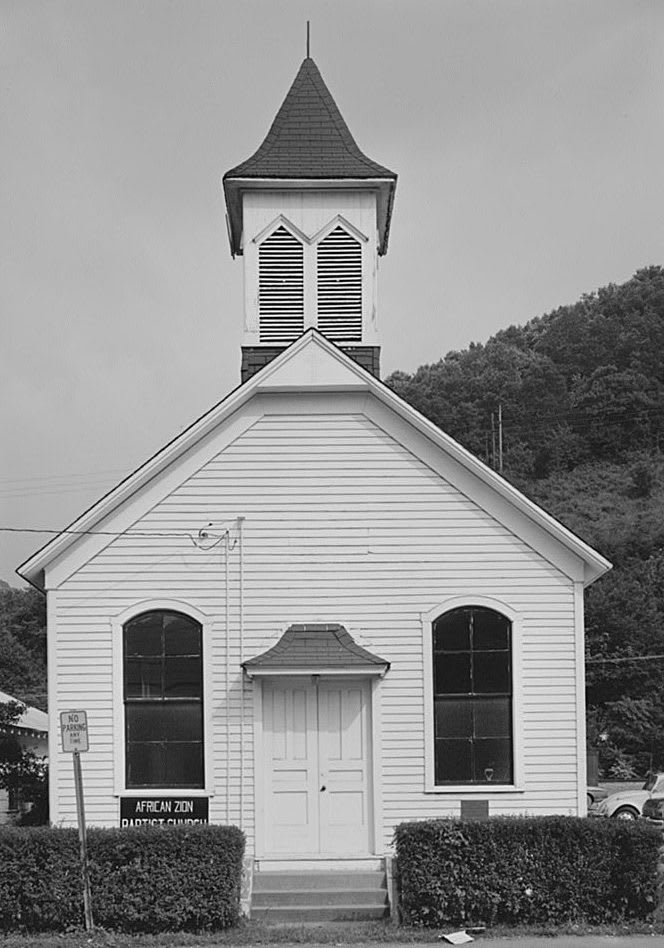
 Historic American Buildings Survey / public domain via Library of Congress
The Story
Malden was the heart of the Kanawha Salines, the stretch of river where, in the decades before the Civil War, up to 1,500 enslaved people worked the salt furnaces and the coal mines that fed them, the largest concentration of enslaved people in what became West Virginia. Black families in the town formally organized a Baptist congregation in 1852. In December 1872 they began this one-room church on land, with money and materials, given by Lewis Ruffner of the salt-making family. It is the oldest Black Baptist church in the state and is counted the mother church of West Virginia's Black Baptists.
Booker T. Washington came to Malden in 1865, aged nine and newly freed, with his family to join his stepfather, Washington Ferguson, who had escaped slavery in Franklin County, Virginia, during the war. The boy worked in the salt furnaces and the coal mines and went to a one-room school for Black children. After Hampton Institute he came back to teach in Malden and taught Sunday school here, served as the church's clerk, and kept his membership for life, long after he left in 1881 to open Tuskegee.
The frame church, front-gabled, with two tall arched windows on each side and a short steeple over the door, is little changed since the 1870s and was listed on the National Register in 1974. Beside it stands a reproduction of Washington's boyhood cabin, about 50 yards from where the original stood, with a schoolhouse-church and a small museum. The salt makers' brick Kanawha Salines Presbyterian Church of 1840 stands in the same historic district.
Visitor Info
On the Map
Nearby
The closest stops worth working into your route
Historical markers nearby
Roadside plaques and monuments within a short detour