Home / Arkansas / Fort Smith & the Arkansas River Valley / Subiaco Abbey
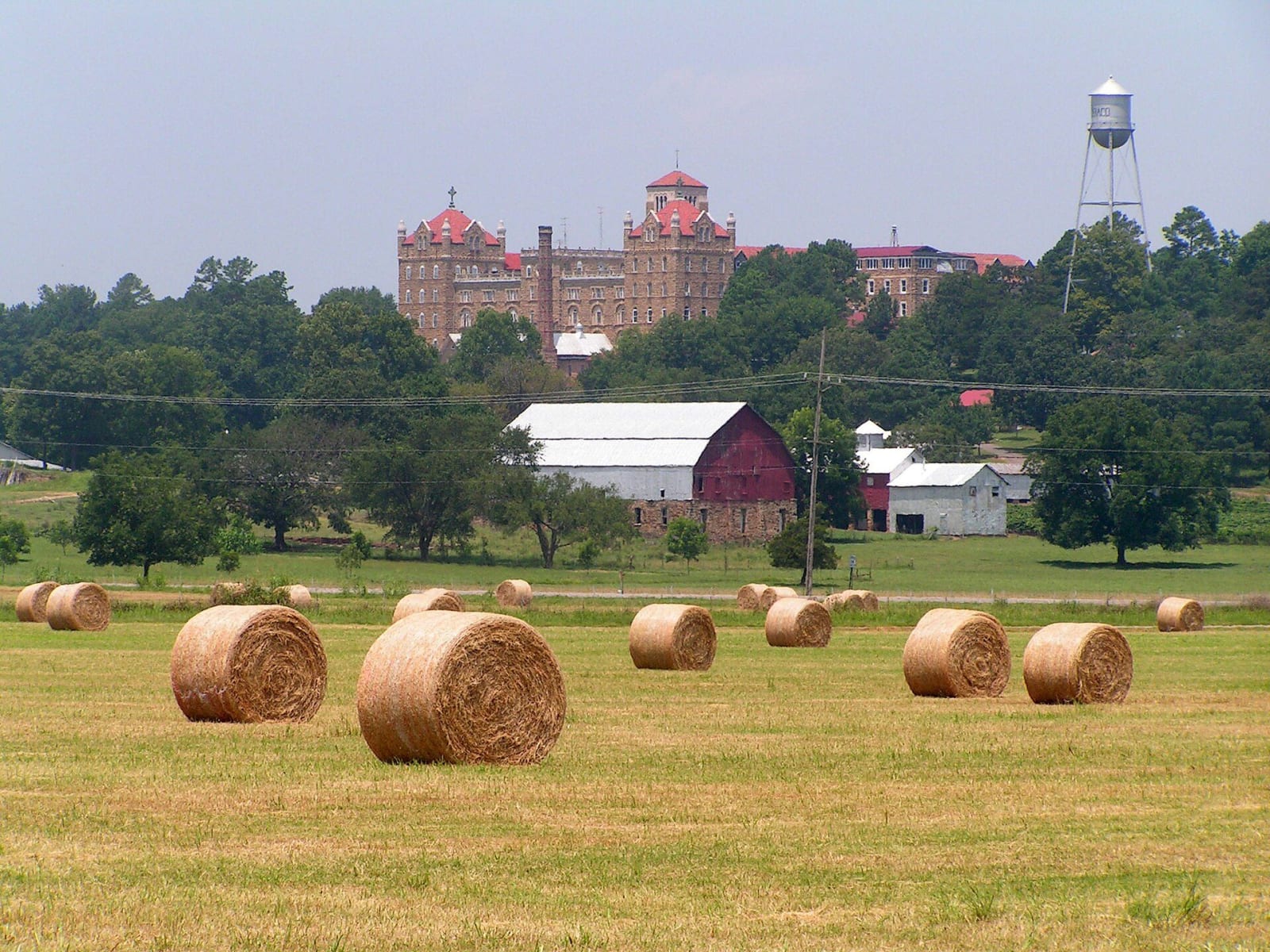
Subiaco Abbey on its hill above a barn and hay bales, with the town water tower at rightElijahOwens, CC BY-SA 4.0, via Wikimedia Commons
🎭Cultural

Subiaco Abbey

Part ofFort Smith & the Arkansas River Valley

A Benedictine monastery on a hilltop in Logan County, founded in 1878 for German-speaking Catholic settlers, with a 1959 abbey church and a boarding school for boys.

⏱
Duration
One to two hours.
🎟
Admission
No admission is listed; the Saturday guided tour is free but needs a reservation 24 hours ahead.
📅
Best Season
Year round; call ahead because the monastery is a working one and some areas close. The abbey church is unlocked during the day, and guided tours are offered Saturdays at 1 p.m. (abbey site, November 2026).

The Story

Subiaco Abbey began as a colony. In November 1877 the Little Rock and Fort Smith Railroad Company offered land to Abbot Martin Marty of St. Meinrad Abbey in Indiana, for a Benedictine foundation to serve German-Catholic settlers coming to the western Arkansas River Valley. Three monks arrived in Logan County in March 1878, and by the end of that year nearly 150 families had settled in St. Benedict's Colony. Monks from Einsiedeln Abbey in Switzerland came to help. In 1891 Pope Leo XIII raised the priory to an abbey named Subiaco, and in 1892 it elected its first abbot, Ignatius Conrad.

Fire shaped the buildings. The original frame monastery about a mile away burned on December 15, 1901, by which time part of a new stone abbey of local Subiaco sandstone, begun in 1898, was almost ready. On December 20, 1927, fire destroyed three quarters of that building, and recovery was slow. The abbey church, in a modified Romanesque style, was begun in 1953 and consecrated by 1959, and its 125-foot bell tower rings every fifteen minutes. The Coury House Retreat Center opened in 1963.

Subiaco is also a boys' boarding school, so visitors are asked to show identification for a quick screening before they walk the grounds, and the church can be visited without it. Follow the signs to Coury House, register for a self-guided tour and take a brochure. The monks pray five times a day, and visitors may sit in the unlocked church to listen. A free guided tour runs Saturdays at 1 p.m. with 24 hours' notice.

Visitor Info

⏱
Time Needed
One to two hours.
🎟
Admission
No admission is listed; the Saturday guided tour is free but needs a reservation 24 hours ahead.
📅
Best Season
Year round; call ahead because the monastery is a working one and some areas close. The abbey church is unlocked during the day, and guided tours are offered Saturdays at 1 p.m. (abbey site, November 2026).
🛣️
Highway
AR 22

On the Map

Nearby

The closest stops worth working into your route

natural8.5 mi away
Mount Magazine State Park
Arkansas's highest point at 2,753 feet: a sandstone-rimmed plateau above the river valley with a lodge, overlooks and hang-glider launches.
culinary13 mi away
Wiederkehr Wine Cellars
The oldest operating winery in Arkansas, begun in 1880 in a hand-dug cellar on St. Mary's Mountain by a Swiss shoemaker, in the village that grew around it.
recreational22 mi away
Mount Nebo State Park
Arkansas's second state park, on a flat-topped mesa above Dardanelle: a Victorian summer town, a town run by women in 1924, CCC cabins and a Trail of Tears view.
recreational24 mi away
Lake Dardanelle State Park
A park on a 34,300-acre Arkansas River reservoir at Russellville, with aquarium exhibits and the story of the Norristown ferry crossing used in the removal of five nations.
natural32 mi away
Holla Bend National Wildlife Refuge
A 7,000-acre refuge on an island of former farmland made when the Corps cut off a bend of the Arkansas River in 1954, with winter ducks, geese and eagles and a 14-mile auto tour.
historical42 mi away
Van Buren Historic District
Eight blocks of Main Street on the Arkansas River, from Phillips Landing, with 1889 banks, a beer depot and a railroad depot, on the National Register since 1976.