Home / Nebraska / North Platte & the Great Platte River Road / Stuhr Museum of the Prairie Pioneer
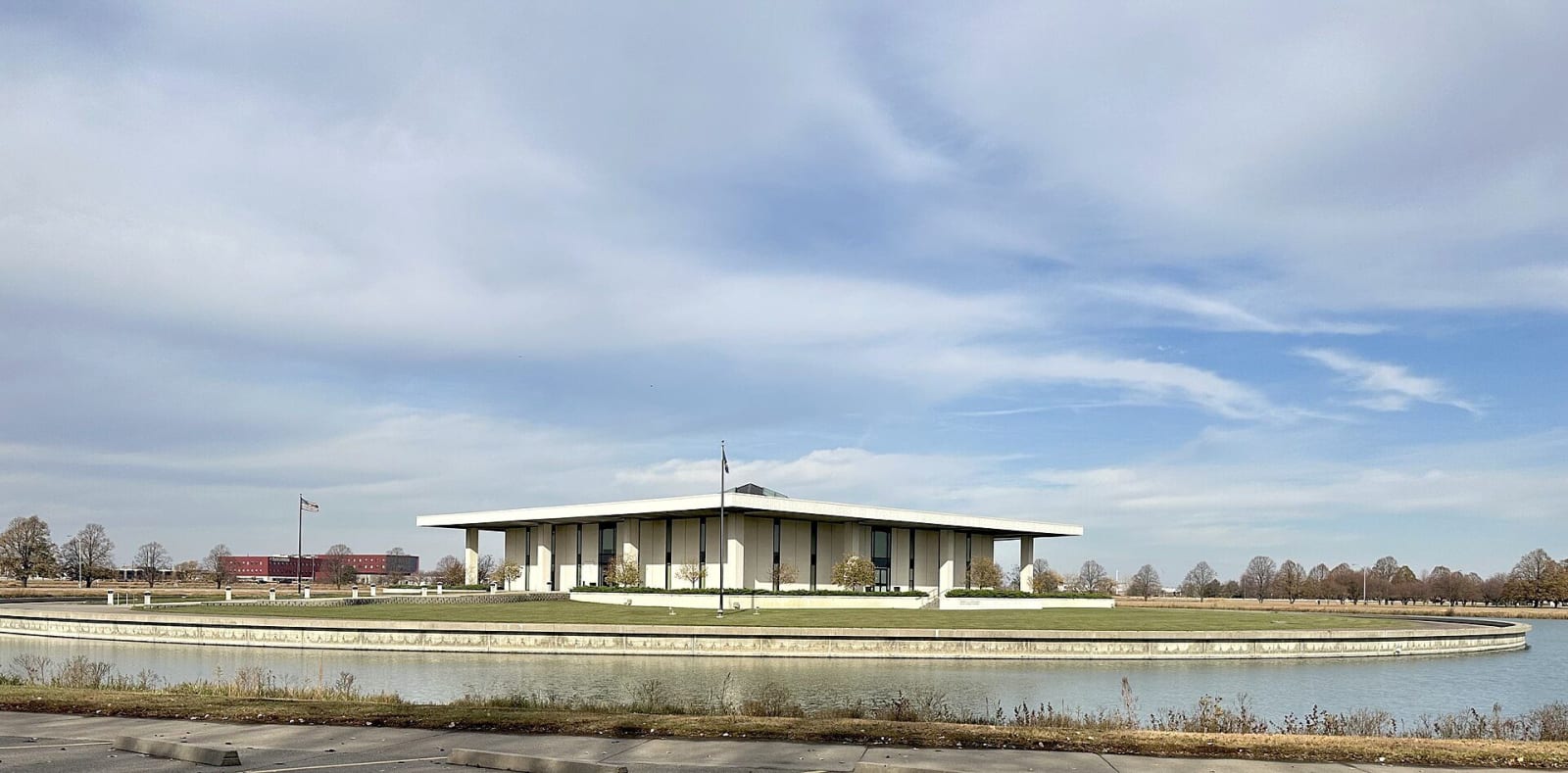
The white colonnaded Stuhr Museum pavilion sits on its island inside a circular moat in Grand Island.Myotus / CC BY-SA 4.0 via Wikimedia Commons
🎭Cultural

Stuhr Museum of the Prairie Pioneer

Part ofNorth Platte & the Great Platte River Road
On this driveNE-2: The Sandhills Journey, Grand Island to Alliance

Edward Durell Stone's island pavilion in Grand Island and an 1890s railroad town of moved buildings, among them the cottage where Henry Fonda was born in 1905.

⏱
Duration
About two hours in spring and summer.
🎟
Admission
March to October: $18 adults 16 to 54, $15 seniors 55 and up, $12 ages 5 to 15, free 4 and under.
📅
Best Season
Spring through fall, when Railroad Town is staffed; open daily March to October, 9 a.m. to 4 p.m., and Tuesday through Sunday, 10 a.m. to 4 p.m., November to February.

The Story

Leo Stuhr was the son of Peter and Anna Stuhr, early settlers of Hall County. He studied chemistry at the University of Nebraska, sat in the state House in 1917 and 1918, became Nebraska's first secretary of agriculture in 1918, and was appointed to the Federal Farm Board in 1930. In 1961, the year he died, the Hall County Board of Supervisors created a museum board in his name, and a temporary museum opened downtown in May 1962.

The county hired Edward Durell Stone, the architect of the Kennedy Center, for the permanent building, and it was dedicated in July 1967 after a flood delayed the work. It is a square, two-story modernist pavilion with porticoes on all four sides and a pyramidal skylight over a central gallery with four square fountain pools, finished in Granulux, a plaster with marble chips, and set on a round island in a man-made lake. It holds art and history galleries.

Beyond it, on 208 acres of prairie, Railroad Town gathers original buildings moved from around the region into an 1890s prairie village: shops, a school, a church, a farmstead and houses, among them the cottage where Henry Fonda was born in 1905. From spring through fall, costumed interpreters work the buildings and talk with visitors about how a town like this kept itself going; in winter the streets are open to walk, and the buildings open only for programs. The museum also has a replica Pawnee earth lodge and has been widening its telling of the Pawnee, on whose homeland it stands.

Visitor Info

⏱
Time Needed
About two hours in spring and summer.
🎟
Admission
March to October: $18 adults 16 to 54, $15 seniors 55 and up, $12 ages 5 to 15, free 4 and under.
📅
Best Season
Spring through fall, when Railroad Town is staffed; open daily March to October, 9 a.m. to 4 p.m., and Tuesday through Sunday, 10 a.m. to 4 p.m., November to February.
🛣️
Highway
US-281

On the Map

Nearby

The closest stops worth working into your route

natural31 mi away
Rowe Sanctuary
Audubon's sanctuary on the Platte near Gibbon, where the river's sandbars are kept bare so that sandhill cranes, more than a million in the valley each spring, can roost safely at night.
historical37 mi away
Fort Kearny State Historical Park
The 1848 army post on the Platte, built on a strip of Pawnee land bought for $2,000 in goods, where emigrant wagons passed by the thousand and only the cottonwoods outlasted the fort.
historical52 mi away
Genoa U.S. Indian School Museum
The surviving trades building of a federal boarding school that ran from 1884 to 1934 on the Pawnee Nation's last Nebraska land, where at least 86 children died and the cemetery is still lost.
cultural55 mi away
National Willa Cather Center
The restored Moon Block on Red Cloud's Webster Street, home of the Willa Cather Foundation, with the town she grew up in and wrote about laid out around it.
natural61 mi away
Willa Cather Memorial Prairie
Six hundred and twelve acres of never-plowed mixed-grass prairie south of Red Cloud, once Kitkehahki Pawnee country, named for the writer who said the grass was the country.
historical67 mi away
Fort Hartsuff State Historical Park
A small infantry post of 1874 in the North Loup valley, built of local lime concrete on the raiding road between Lakota and Pawnee country, and kept nearly whole by eighty years of farming.