Home / Nebraska / North Platte & the Great Platte River Road / Rowe Sanctuary
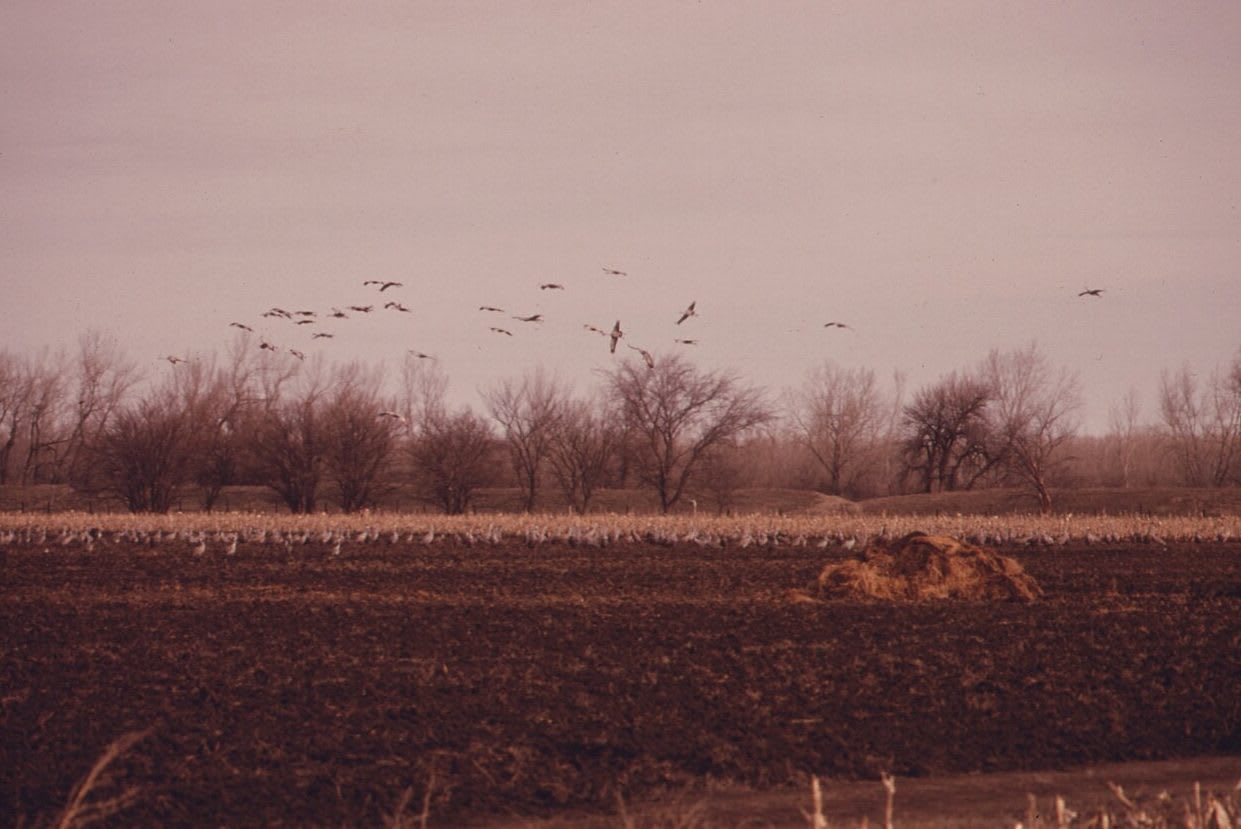
Sandhill cranes fly over bare trees and gather in a field at the Rowe bird sanctuary in the early 1970s.Patricia D. Duncan, EPA Documerica / public domain via Wikimedia Commons
๐ŸŒฒNatural

Rowe Sanctuary

Part ofNorth Platte & the Great Platte River Road

Audubon's sanctuary on the Platte near Gibbon, where the river's sandbars are kept bare so that sandhill cranes, more than a million in the valley each spring, can roost safely at night.

โฑ
Duration
Two to three hours for a dawn or dusk viewing.
๐ŸŽŸ
Admission
Visitor center needs no reservation during business hours; guided crane experiences and viewing blinds require advance reservations.
๐Ÿ“…
Best Season
Mid-February to mid-April, peaking in mid to late March.

The Story

Every spring, from about Valentine's Day to Tax Day, more than a million sandhill cranes gather in the central Platte valley to fuel up on their way north to nest. They spend the days in the fields and the nights standing in the river, on wide, open channels and bare sandbars where they can see anything coming. Rowe Sanctuary exists to keep that river open.

The money came from Lillian Annette Rowe, a psychologist with a doctorate who had served in the Army in the Second World War. In 1967 she left much of her estate to the National Audubon Society to found a bird sanctuary somewhere in the United States, and in 1974 Audubon bought land here. The sanctuary now protects about five miles of river channel. Altered flows and fewer scouring floods let plants take hold on the sandbars, and left alone they become dense, wooded islands within a few years. So each fall, before the cranes come back, Rowe and the Platte River Recovery Implementation Program disk chosen sandbars back to bare sand. Whooping cranes are part of the sanctuary's work too.

The Iain Nicolson Audubon Center, finished in January 2003, is named for the late husband of a volunteer and donor. About 30,000 people come in crane season, and the numbers usually peak in mid to late March. Guided viewing from blinds near the old roosts at dawn and dusk needs a reservation, and registration opens in January; the visitor center and two roadside viewing lots need none.

Visitor Info

โฑ
Time Needed
Two to three hours for a dawn or dusk viewing.
๐ŸŽŸ
Admission
Visitor center needs no reservation during business hours; guided crane experiences and viewing blinds require advance reservations.
๐Ÿ“…
Best Season
Mid-February to mid-April, peaking in mid to late March.
๐Ÿ›ฃ๏ธ
Highway
I-80

On the Map

Stories

A story featuring this place

Go deeper into the history and character of this stop

Nature
The Birds of the Gravel Pits
Open Road Guide ยท 3 min read

Nearby

The closest stops worth working into your route

historical6.6 mi away
Fort Kearny State Historical Park
The 1848 army post on the Platte, built on a strip of Pawnee land bought for $2,000 in goods, where emigrant wagons passed by the thousand and only the cottonwoods outlasted the fort.
cultural31 mi away
Stuhr Museum of the Prairie Pioneer
Edward Durell Stone's island pavilion in Grand Island and an 1890s railroad town of moved buildings, among them the cottage where Henry Fonda was born in 1905.
cultural45 mi away
National Willa Cather Center
The restored Moon Block on Red Cloud's Webster Street, home of the Willa Cather Foundation, with the town she grew up in and wrote about laid out around it.
recreational46 mi away
Harlan County Lake
Nebraska's second-largest lake, held behind an Army Corps dam on the Republican between Alma and Republican City, built after the flood of 1935 ran bluff to bluff.
natural50 mi away
Willa Cather Memorial Prairie
Six hundred and twelve acres of never-plowed mixed-grass prairie south of Red Cloud, once Kitkehahki Pawnee country, named for the writer who said the grass was the country.
historical73 mi away
Fort Hartsuff State Historical Park
A small infantry post of 1874 in the North Loup valley, built of local lime concrete on the raiding road between Lakota and Pawnee country, and kept nearly whole by eighty years of farming.