Home / Nebraska / Lincoln & the Southeast / Rock Creek Station State Historical Park
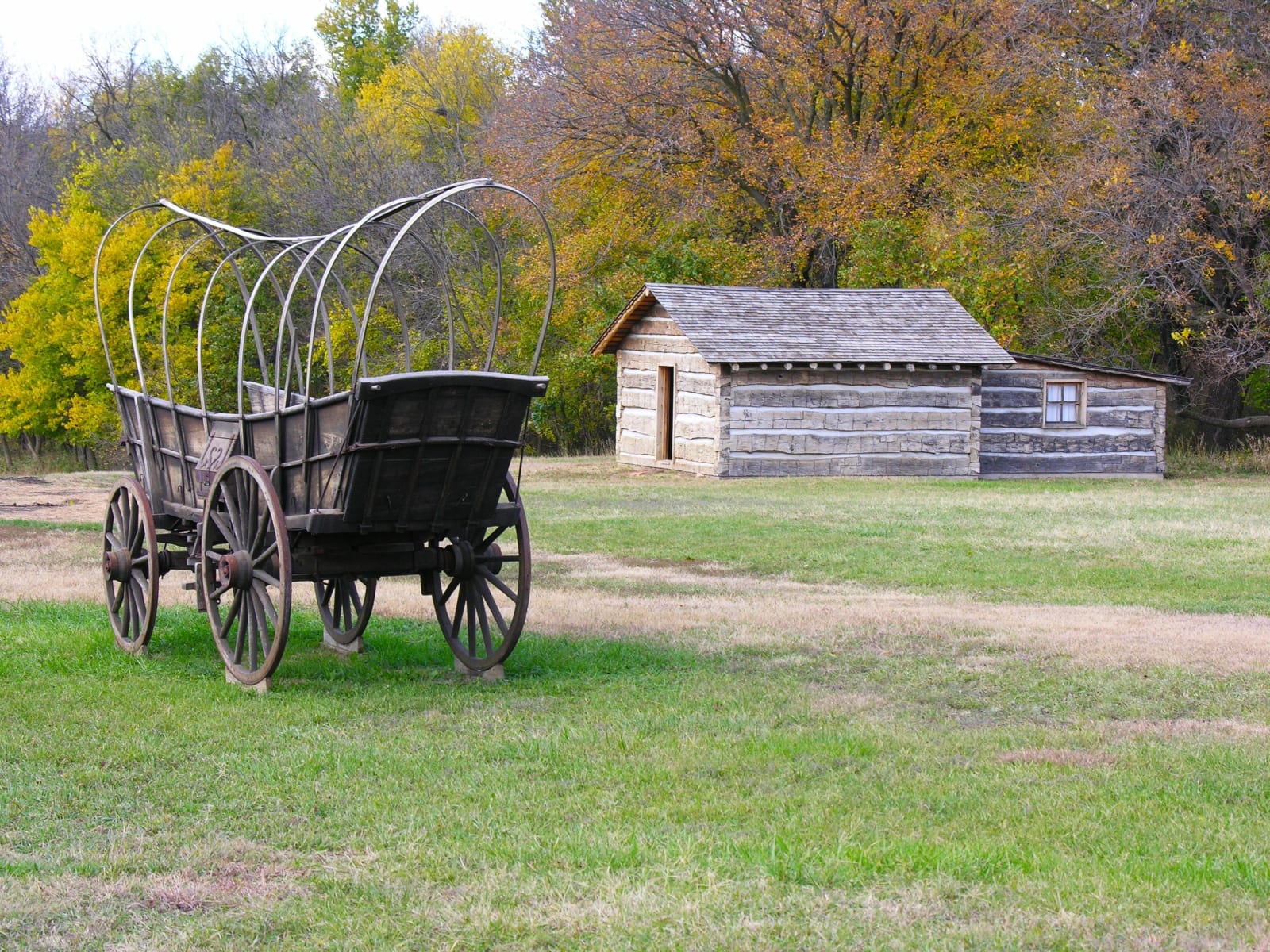
A wooden wagon with bare bows stands on the grass in front of a log building at Rock Creek Station, with autumn trees behind.NPS / public domain
🏛️Historical

Rock Creek Station State Historical Park

Part ofLincoln & the Southeast

A stage and Pony Express station on the trail southeast of Fairbury where James Hickok killed David McCanles in July 1861, with the court papers that cleared him, and deep wagon ruts.

⏱
Duration
One to two hours.
🎟
Admission
Adults 13 and older $5, children 3 to 12 $1, plus a Nebraska park entry permit.
📅
Best Season
April to mid-October, when the visitor center opens on a seasonal schedule; grounds open year-round.

The Story

Rock Creek Station began in 1857 as a stage stop where the Oregon and California trail crossed Rock Creek, and by 1861 David McCanles owned it. Russell, Majors and Waddell, the firm behind the Pony Express, used the east ranch as a station in 1860 and 1861 and had agreed to buy the place from him, with Horace Wellman in charge. A young stock hand there was James Butler Hickok.

On July 12, 1861, McCanles came to collect a payment the company owed. With him were his twelve-year-old son Monroe, his cousin James Woods and a hired man, James Gordon. Hickok shot McCanles from behind a curtain, and station men killed Woods and Gordon. Monroe ran. The next day Leroy McCanles swore out a complaint before Justice of the Peace T. M. Coulter in Gage County against Dutch Bill, Dock and Wellman, and over three days of hearings at Beatrice in July the charge of murder against W. B. Hickok, J. W. Brink and Horace G. Wellman was found not sustained. Monroe was not allowed to testify; he said later that his father had been unarmed. Harper's Monthly turned the fight into Wild Bill alone against nine men.

Park development began in 1980 after archaeologists excavated the building sites, and the ranch cabins, bunkhouse, barn, post office and toll bridge have been rebuilt. The wagon ruts are still deep, and the 1861 court papers survive at History Nebraska in Lincoln.

Visitor Info

⏱
Time Needed
One to two hours.
🎟
Admission
Adults 13 and older $5, children 3 to 12 $1, plus a Nebraska park entry permit.
📅
Best Season
April to mid-October, when the visitor center opens on a seasonal schedule; grounds open year-round.
🛣️
Highway
US-136

On the Map

Nearby

The closest stops worth working into your route

historical17 mi away
Homestead National Historical Park
Daniel Freeman's claim on Cub Creek near Beatrice, one of the first filed under the Homestead Act, with a one-room school, a homesteader's cabin, restored prairie and the land's earlier owners.
architectural52 mi away
Nebraska State Capitol
Bertram Goodhue's 400-foot tower on the prairie, built in four phases from 1922 to 1932 and paid off on completion, home of the only one-house legislature in the country.
historical73 mi away
Arbor Lodge State Historical Park
J. Sterling Morton's estate in Nebraska City, a four-room house of 1855 grown to 52 rooms among the trees he planted, home of the man who proposed Arbor Day in 1872.
attraction73 mi away
Strategic Air Command & Aerospace Museum
Two hangar-sized halls beside I-80 near Ashland holding the bombers and reconnaissance planes of the command that ran America's nuclear force from Offutt, south of Omaha, from 1948 to 1992.
historical76 mi away
Brownville
A Missouri River town of 1854 that bet on a railroad and lost, kept its arts through the decline, and now has Nebraska's oldest repertory theatre and a 1932 steam dredge on the bank.
cultural77 mi away
National Willa Cather Center
The restored Moon Block on Red Cloud's Webster Street, home of the Willa Cather Foundation, with the town she grew up in and wrote about laid out around it.