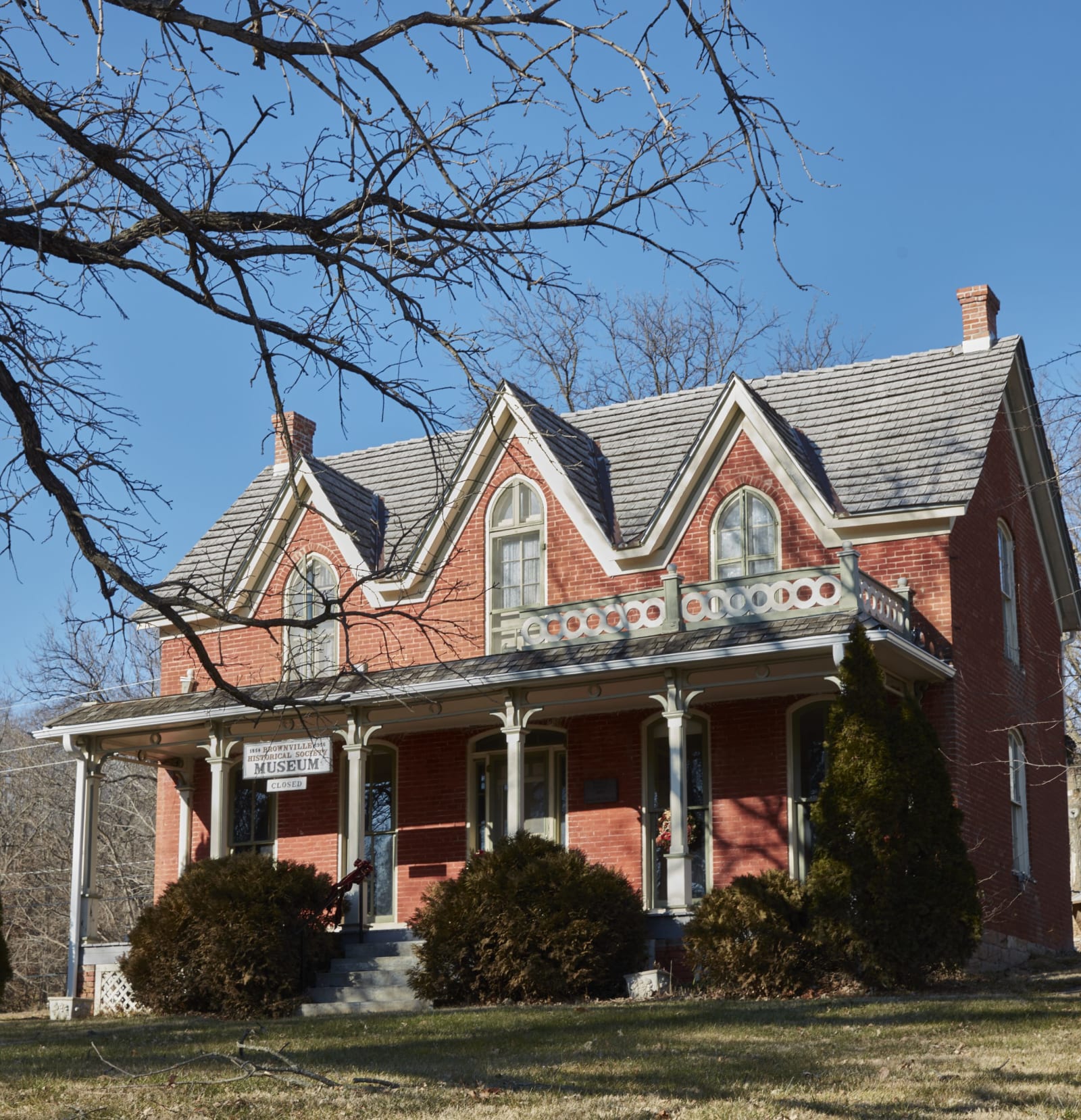
 Carol M. Highsmith / public domain via the Library of Congress
The Story
Richard Brown, a young man from Holt County, Missouri, crossed the Missouri by canoe and reached this site on August 29, 1854, weeks after the Kansas-Nebraska Act opened the territory. For a few years it was a river port and a transfer point for wagon caravans heading west, with Nebraska's first telegraph office and the land office where Daniel Freeman filed his homestead claim. In 1872 both major candidates for governor came from Brownville, and Robert W. Furnas, who had founded one of the first newspapers in the territory, won. T. W. Tipton sat in the U.S. Senate from 1867 to 1875.
Then the town bet on a railroad and lost. In the late 1860s it voted a large bond issue to bring in a line; the contractor built about ten miles of track, the town was left deeply in debt, and many of its people left. What remained is a small village, listed on the National Register in 1970.
Brownville kept its arts going through the decline. The Brownville Village Theatre, the oldest repertory theatre in Nebraska, plays its summer season in a converted church on Water Street, and the Brownville Concert Hall on Atlantic Street runs shows one weekend a month from spring into December. In Riverside Park, just south of US-136, sits the Captain Meriwether Lewis, a 269-foot steam side-wheel dredge the Corps of Engineers worked from 1932 to 1976 to channel and maintain the Missouri for navigation. It has been a National Historic Landmark since 1989 and holds the Museum of Missouri River History.
Visitor Info
On the Map
Nearby
The closest stops worth working into your route