 Boston Public Library / CC BY 2.0 via Flickr
The Story
Six local men chartered Riverside Cotton Mills in 1882, and by 1896 its mills lined the Dan through downtown, Nos. 2, 3, 5 and 7 joined into the Long Mill. In 1903 the company built a mill village upstream at Schoolfield, which went without a sewer system until Danville annexed it in 1951. After a 1909 merger as Riverside and Dan River Cotton Mills it was the largest textile maker in the South, and by 1942 it ran twelve mills with 14,000 workers in a city of about 40,000.
In the 1920s the company's president, H. R. Fitzgerald, set up "industrial democracy," a workers' House of Representatives that could bring grievances. The company ended it in 1930 after cutting wages. Workers joined the United Textile Workers and walked out on September 29, 1930. The strike was bitter, strikers were evicted from company houses, and after about four months it collapsed as the union ran out of money. Only after the Civil Rights Act of 1964 did the company hire more Black workers and slowly move them into jobs that had been reserved for white workers. Imports wore the industry down, and in 2006 new owners closed the main mill.
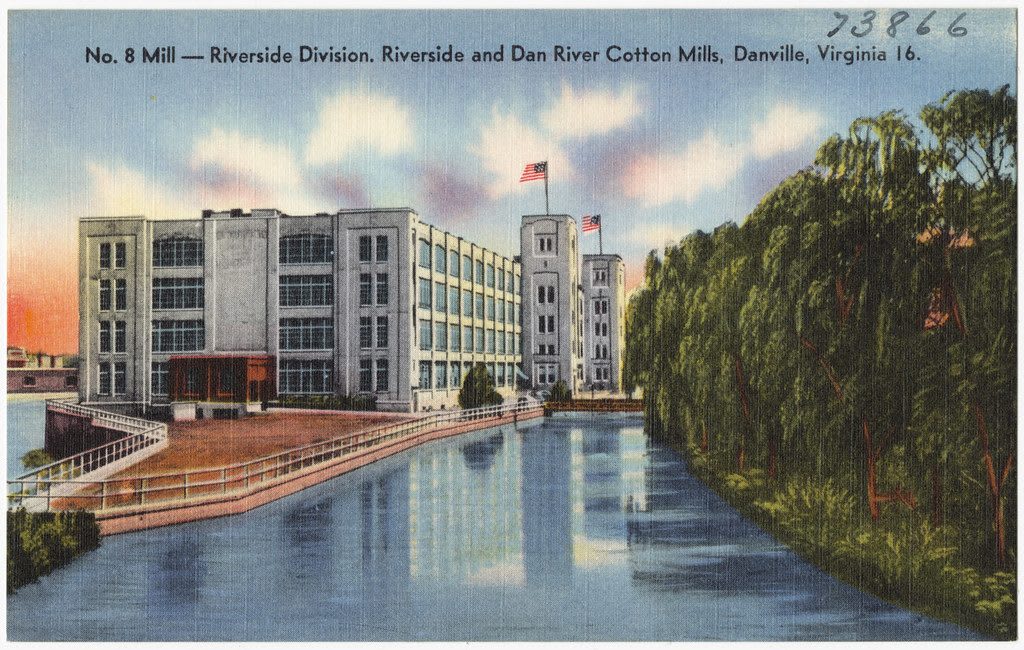
Most of the Riverside buildings were torn down in the 2000s. Mill No. 8, the five-story White Mill of 1920 on the south bank, survives as apartments. The Riverwalk Trail, nearly 12 paved miles, starts at the Crossing at the Dan beside the Science Center and crosses the river on a restored 1856 railroad bridge.
Visitor Info
On the Map
Nearby
The closest stops worth working into your route
Historical markers nearby
Roadside plaques and monuments within a short detour