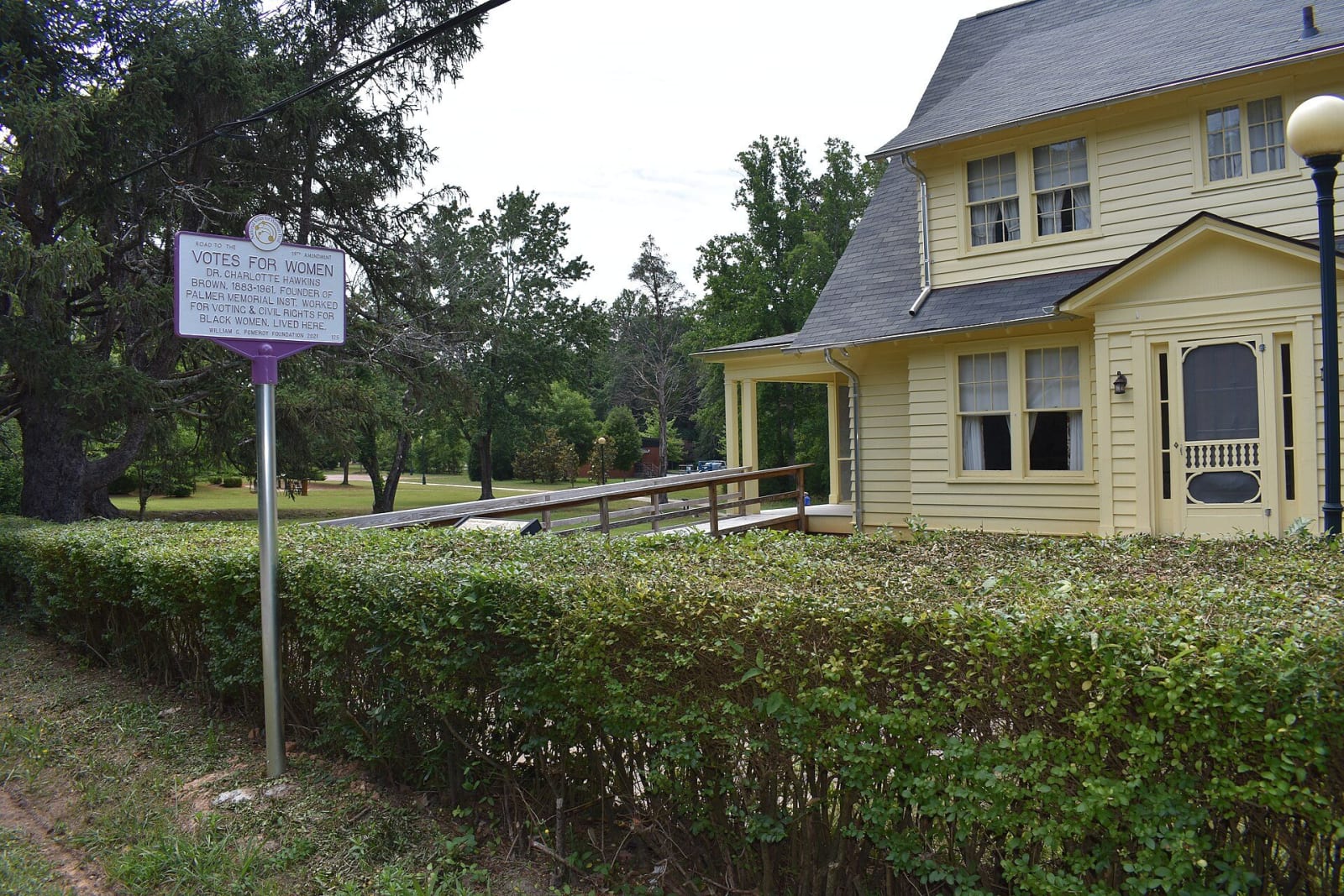
 CharlotteHawkinsBrownMuseum / CC BY-SA 4.0 via Wikimedia Commons
The Story
Charlotte Hawkins was born in Henderson in 1883, the granddaughter of people who had been enslaved, and grew up in Cambridge, Massachusetts. Alice Freeman Palmer, a former Wellesley president she met by chance, paid for her schooling at Salem State Normal School. In 1901, at eighteen, she came south to teach at Bethany Institute, a small American Missionary Association school for Black children at Sedalia, east of Greensboro. When the association closed it a year later, she stayed and started her own, naming it for her patron and opening it on October 10, 1902, in a blacksmith's cabin.
Over the next fifty years she raised the money for 200 acres and a campus of brick halls, and turned a farm and trade school into an accredited college preparatory boarding school with a Black board of trustees, drawing students from across the country. More than a thousand graduated under her. She lectured widely, was the first Black woman on the YWCA's national board, and wrote a book of manners, The Correct Thing to Do, to Say, to Wear. She retired in 1952 and died in 1961; the school closed in 1971.
Palmer graduates, led by her niece Maria Cole and Marie Gibbs, pushed the state to save the campus, and in 1987 it opened as North Carolina's first state historic site honoring African American history. The visitor center has the exhibit, guided tours take in Canary Cottage, her home, and the grounds hold the dormitories, the bell tower, the teahouse and her grave.
Visitor Info
On the Map
Nearby
The closest stops worth working into your route
Historical markers nearby
Roadside plaques and monuments within a short detour