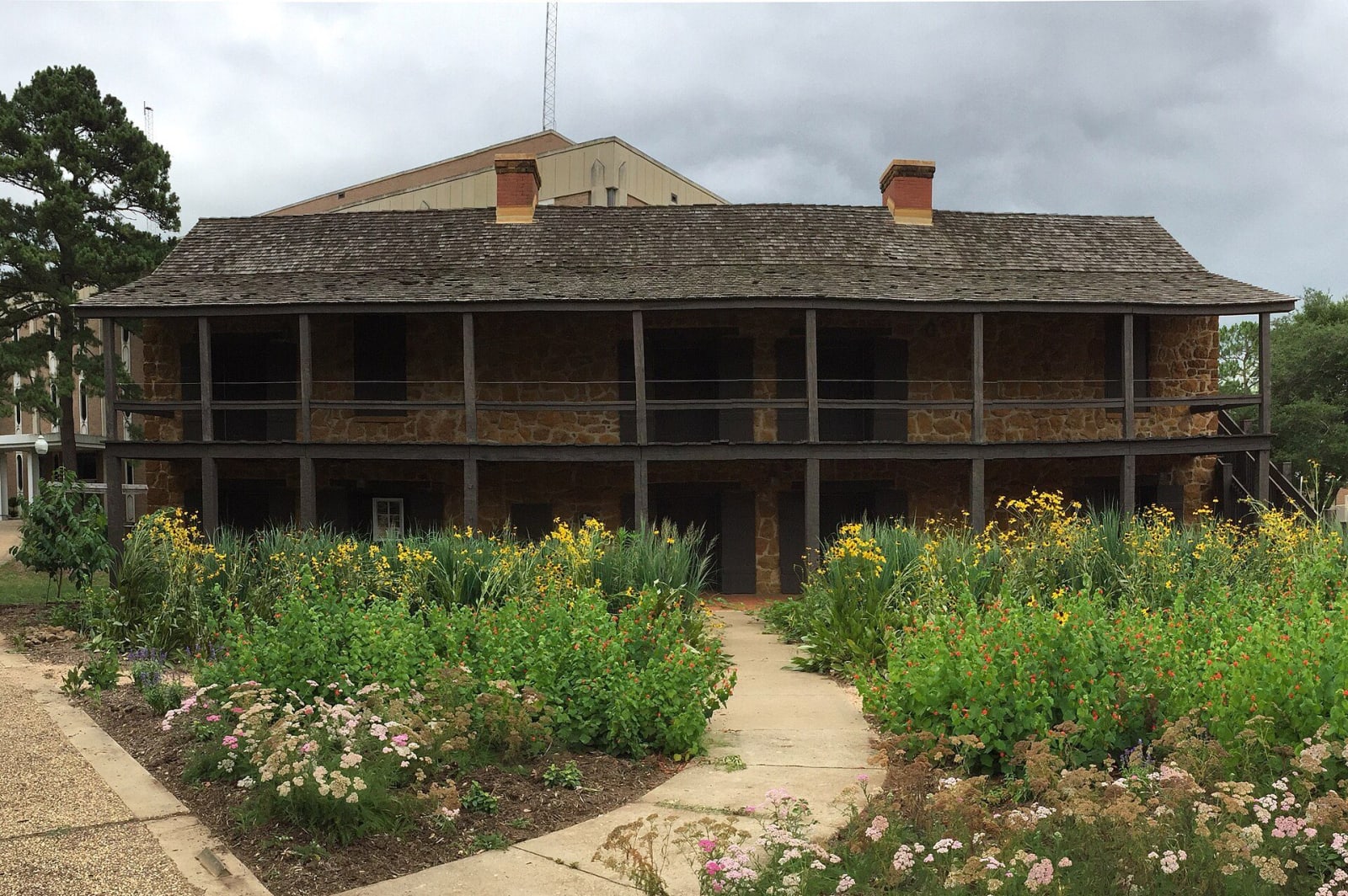
 StoneFortMuseum / CC BY-SA 4.0 via Wikimedia Commons
The Story
The Old Stone Fort is not a fort, and Stephen F. Austin State University says so plainly. The museum is a replica of the grand Spanish Colonial house Antonio Gil Y'Barbo built on the Camino Real. Wikipedia dates the original to about 1779 and says it was a mercantile house of local iron ore, which is why it was called the Stone House. The university's page puts the building between 1788 and 1791. The Handbook of Texas names Antonio Gil Ibarvo as the leader who brought settlers to the old mission site at Nacogdoches in 1779.
The original served as a trading post, private home, church, jail and saloon, according to the university, and it was demolished in 1902 at the end of its saloon days. The Texas Centennial Commission rebuilt it in 1936. The university credits the Cum Concilio Club, a women's literary group founded in 1894, with driving the effort, which it calls one of the first historic preservation efforts in Texas. Wikipedia gives the dedication as October 16, 1936.
The museum is on the SFA campus at the circle where Griffith and Clark boulevards meet, entered from Starr Avenue on Clark Boulevard. It collects and interprets artifacts from pre-1900 East Texas. It is open Tuesday through Saturday, 9 a.m. to 5 p.m., and Sunday from 1 to 5 p.m., and admission is free.
Visitor Info
On the Map
Nearby
The closest stops worth working into your route
Historical markers nearby
Roadside plaques and monuments within a short detour