Home / Tennessee / Knoxville & the Great Smoky Mountains / Museum of Appalachia
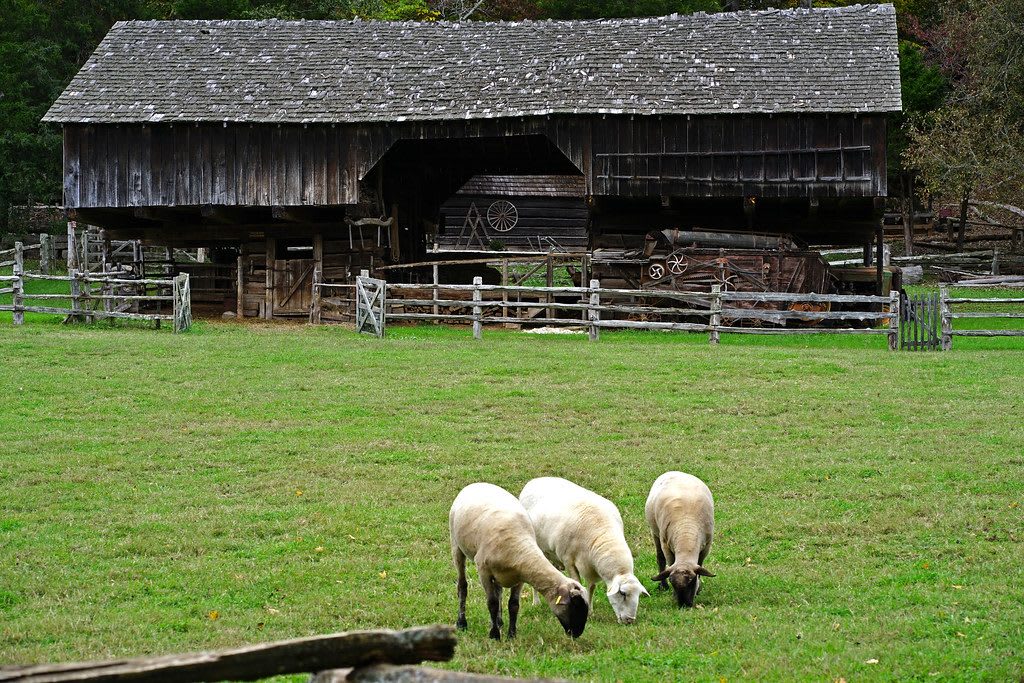
Three sheep graze on a lawn in front of a weathered log cantilever barn with a shingle roof and split-rail fences.Alan Kyker / public domain mark via Flickr
🎭Cultural

Museum of Appalachia

Part ofKnoxville & the Great Smoky Mountains

John Rice Irwin's 65-acre collection of moved log cabins and mountain objects north of Knoxville, opened in 1969, with a cabin believed to be Mark Twain's father's.

⏱
Duration
Two to three hours.
🎟
Admission
Ticketed; see the museum for current prices and hours.
📅
Best Season
Year round; most of the buildings are outdoors, so spring and fall are most comfortable.

The Story

John Rice Irwin, an East Tennessee educator and businessman born in 1930, started the museum in the 1960s and opened it to the public in 1969. It now covers about 65 acres a short drive north of Knoxville, with some 35 log cabins, barns, churches and schools, and more than 250,000 artifacts in three buildings: folk art, musical instruments, baskets, quilts and Native American objects. It is a nonprofit and a Smithsonian Affiliate.

Many of the buildings were moved here from across the region. The Arnwine Cabin, built of hewn poplar logs between 1795 and 1820, came in 1964 and is on the National Register of Historic Places. A cabin believed to have belonged to John Clemens, the father of Mark Twain, arrived in 1995 from Fentress County. The Peters Homestead house, dating from about 1790 to 1838, came from near Luttrell. Look for the Knight Family Chair, a rocking chair charred in a 1943 plane crash in Greensboro, North Carolina, that killed five people in the household and the pilot.

Read it as one man's collection, built from one point of view. The cabins and tools belonged to families who farmed these ridges, and the museum lets them speak through objects rather than a timeline, so bring your own questions about who is not in the rows of cabins. A restaurant on the grounds serves Southern Appalachian cooking, and Norris Dam and the Lenoir Museum are a few miles up the road.

Visitor Info

⏱
Time Needed
Two to three hours.
🎟
Admission
Ticketed; see the museum for current prices and hours.
📅
Best Season
Year round; most of the buildings are outdoors, so spring and fall are most comfortable.
🛣️
Highway
Andersonville Highway (TN-61)

On the Map

Nearby

The closest stops worth working into your route

industrial3.2 mi away
Norris Dam and Norris Dam State Park
TVA's first dam, finished in 1936 on the Clinch River, and the state park beside it with the 1798 Rice Grist Mill, built for a valley whose families were moved out.
cultural6.8 mi away
Green McAdoo Cultural Center
The 1935 school in Clinton that sent twelve Black students down Foley Hill to desegregate Clinton High School in August 1956, now a museum with bronze statues of the Clinton 12.
historical16 mi away
American Museum of Science and Energy
The Oak Ridge museum that opened in 1949, when the Manhattan Project city's gates opened, in a town whose Black workers were housed in the Gamble Valley hutments.
cultural17 mi away
Beck Cultural Exchange Center
Knoxville's Black history museum and archive, opened in 1975 in the 1912 Dandridge Avenue house the community bought for $22,500.
historical17 mi away
Blount Mansion
The 1792 frame house of William Blount, governor of the Southwest Territory, Knoxville's only National Historic Landmark, where the people he enslaved are named.
historical22 mi away
Historic Brushy Mountain State Penitentiary
The coal-mining prison opened in 1896 after the Coal Creek War ended convict leasing, where James Earl Ray escaped in 1977, now a tourist site and distillery.

Historical markers nearby

Roadside plaques and monuments within a short detour

Marker6.4 mi away
The Coal Creek War
Briceville
Marker6.5 mi away
The Market Place of Pearls
Clinton
Marker6.6 mi away
The Rev. Paul W. Turner
Clinton
Marker6.7 mi away
Clinton High School
Clinton
Marker9.1 mi away
First Integrated Public Schools in the Southeast
Oak Ridge
Marker10 mi away
Norris Freeway
Knoxville