Home / Mississippi / Natchez & Southwest Mississippi / Mount Locust
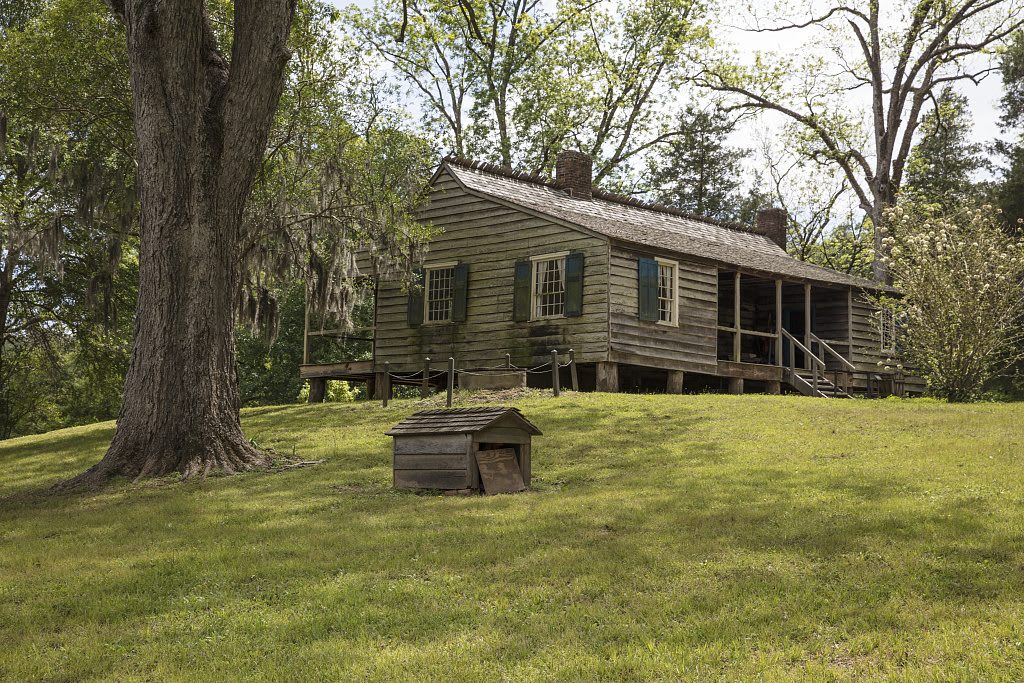
A weathered wooden house with a shingled roof, two brick chimneys, green shutters and a front porch sits on a grassy rise beneath a large oak, with a small wooden shed in the foreground.Carol M. Highsmith / public domain via Library of Congress
🏛️Historical

Mount Locust

Part ofNatchez & Southwest Mississippi
On this driveThe Natchez Trace Parkway in Mississippi: Natchez to the Alabama Line

A 1780s Natchez Trace inn and cotton farm at milepost 15.5, with an enslaved people's cemetery of 43 graves and a brick kiln behind the house.

⏱
Duration
Forty-five minutes to an hour.
🎟
Admission
Free (NPS).
📅
Best Season
Year round; check the Parkway for house hours.

The Story

The Natchez Trace Parkway starts in Natchez at milepost 0, and Mount Locust, at milepost 15.5, is the first historic stand a driver reaches going north. People lived here long before the inn. The Park Service reports two American Indian occupations: Coles Creek families between 600 and 800 CE, and a Plaquemine village of at least seven mostly round structures between 1000 and 1350. John Blommart began the farm around 1780, and William and Paulina Ferguson bought it in 1784 and built the house that stands now, one of the oldest buildings still standing in the region.

The Trace was a walking road. Between 1785 and 1820 boatmen called Kaintucks floated flatboats of goods down the Mississippi, sold them in Natchez and New Orleans, and walked home north. The Fergusons turned their house into a stand, a crude inn, and charged 25 cents for corn mush and milk and a place to sleep on the porch. The Parkway also describes the Trace as a road used by slave traders.

The cotton years are the longer story. Archaeologists believe twelve to sixteen cabins once stood here, with four or five people in each. A cemetery on the west side of the house holds the remains of 43 enslaved people, and the brick kiln site marks where enslaved workers made bricks for parts of the Ferguson-Chamberlain house. The family lived here for five generations, and the last Chamberlain left in 1944. Walk behind the house to the kiln and both cemeteries.

Visitor Info

⏱
Time Needed
Forty-five minutes to an hour.
🎟
Admission
Free (NPS).
📅
Best Season
Year round; check the Parkway for house hours.
🛣️
Highway
Natchez Trace Parkway

On the Map

Nearby

The closest stops worth working into your route

historical4.8 mi away
Emerald Mound
The second-largest Mississippian ceremonial mound in the country, beside the Natchez Trace Parkway, built by ancestors of the Natchez and kept from climbing at the request of tribes.
historical13 mi away
Alcorn State University and Oakland Memorial Chapel
The 1871 Reconstruction college on the old Oakland College campus, first led by Hiram Revels, with the 1838 chapel built by Black craftsmen.
historical15 mi away
Forks of the Road
The 1832-1863 slave market a mile east of downtown Natchez, the second busiest in the Deep South, now a Natchez National Historical Park site with exhibit panels.
historical15 mi away
Melrose Estate
A Greek Revival estate in Natchez, now a National Park Service site, interpreted through the people who were enslaved there as well as the McMurran family.
cultural15 mi away
Natchez Museum of African American History and Culture
A museum in the old 1904 post office on Main Street, opened in 1991, covering slavery, Reconstruction and the Natchez civil rights movement.
historical15 mi away
William Johnson House
The brick home and shop block of a free Black barber and diarist in Natchez, who enslaved others himself and was shot by a neighbor in 1851.

Historical markers nearby

Roadside plaques and monuments within a short detour

Marker16 mi away
Great Mississippi River Flood of 1927
Vidalia, Louisiana
Marker16 mi away
St. Joseph
St. Joseph, Louisiana
Marker17 mi away
Don José Vidal
Vidalia, Louisiana
Marker18 mi away
Mound Plantation
St. Joseph, Louisiana
Marker22 mi away
Haney's Big House
Ferriday, Louisiana
Marker22 mi away
Frank Morris
Ferriday, Louisiana