Home / Mississippi / Natchez & Southwest Mississippi / Melrose Estate
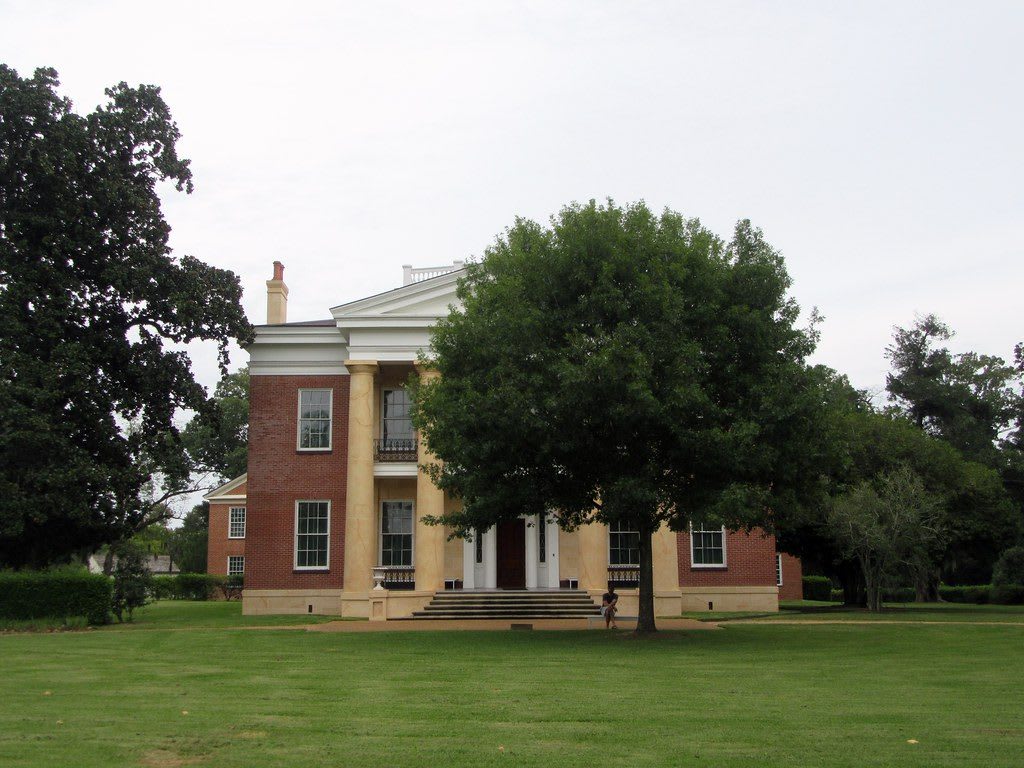
A two-story red brick Greek Revival house with tall pale columns and a pediment stands behind a wide green lawn and large trees.amanderson2 / Public Domain Mark via Flickr
🏛️Historical

Melrose Estate

Part ofNatchez & Southwest Mississippi

A Greek Revival estate in Natchez, now a National Park Service site, interpreted through the people who were enslaved there as well as the McMurran family.

⏱
Duration
One to two hours.
🎟
Admission
Grounds free; house tours are ticketed through Recreation.gov (NPS, 2026).
📅
Best Season
Year round; spring is the busiest season in Natchez. Closed Thanksgiving, Christmas and New Year's Day.

The Story

Melrose was never a working plantation. John T. McMurran, a Pennsylvania-born lawyer, built it as a suburban estate in the 1840s, and the house was finished in 1848. He paid for it with cotton: he owned or held an interest in five plantations that used the labor of more than 350 enslaved people, and in 1833 his wife's parents had given the couple a 645-acre plantation and 24 enslaved people. Irish master masons laid the brick beside skilled enslaved laborers.

The people who lived and worked here are the reason the National Park Service runs the place. The 1860 census counted twenty-two enslaved people at Melrose. William and Eliza Jones served as the McMurrans' valet and maid, and William traveled with the family to Niagara Falls and, in 1854, on the family's Grand Tour of Europe. The laundry and dairy building still stands, and its upstairs rooms housed household servants who answered the bells on the back porch. After the war, Alice Sims, who had been enslaved by the Davis family at Vaucluse in Louisiana, came to Melrose with her family in 1866 and lived upstairs in that building.

The estate became a National Historic Landmark in 1974, and the Park Service acquired it in 1990. Walk the grounds and outbuildings first, then take the house tour.

Visitor Info

⏱
Time Needed
One to two hours.
🎟
Admission
Grounds free; house tours are ticketed through Recreation.gov (NPS, 2026).
📅
Best Season
Year round; spring is the busiest season in Natchez. Closed Thanksgiving, Christmas and New Year's Day.
🛣️
Highway
US-61

On the Map

Nearby

The closest stops worth working into your route

historical0.7 mi away
Forks of the Road
The 1832-1863 slave market a mile east of downtown Natchez, the second busiest in the Deep South, now a Natchez National Historical Park site with exhibit panels.
historical1.5 mi away
Grand Village of the Natchez Indians
The Natchez capital on St. Catherine Creek, where the Great Sun lived, with two mounds rebuilt to the shape the French recorded in 1723.
cultural1.5 mi away
Natchez Museum of African American History and Culture
A museum in the old 1904 post office on Main Street, opened in 1991, covering slavery, Reconstruction and the Natchez civil rights movement.
historical1.6 mi away
William Johnson House
The brick home and shop block of a free Black barber and diarist in Natchez, who enslaved others himself and was shot by a neighbor in 1851.
historical1.6 mi away
Fort Rosalie
The bluff where the French built Fort Rosalie in 1716 and the Natchez attacked it in 1729, now a free Natchez National Historical Park site beside the southern end of the Natchez Trace.
attraction2.5 mi away
Vidalia Landing Riverfront
A riverwalk on the Mississippi at Vidalia, built on the site of the old town that moved west in 1938 when the river was cut off.

Historical markers nearby

Roadside plaques and monuments within a short detour

Marker2.4 mi away
Great Mississippi River Flood of 1927
Vidalia, Louisiana
Marker3.6 mi away
Don José Vidal
Vidalia, Louisiana
Marker11 mi away
Haney's Big House
Ferriday, Louisiana
Marker11 mi away
Frank Morris
Ferriday, Louisiana
Marker11 mi away
Jerry Lee Lewis
Ferriday, Louisiana
Marker25 mi away
Peck Village
Sicily Island, Louisiana