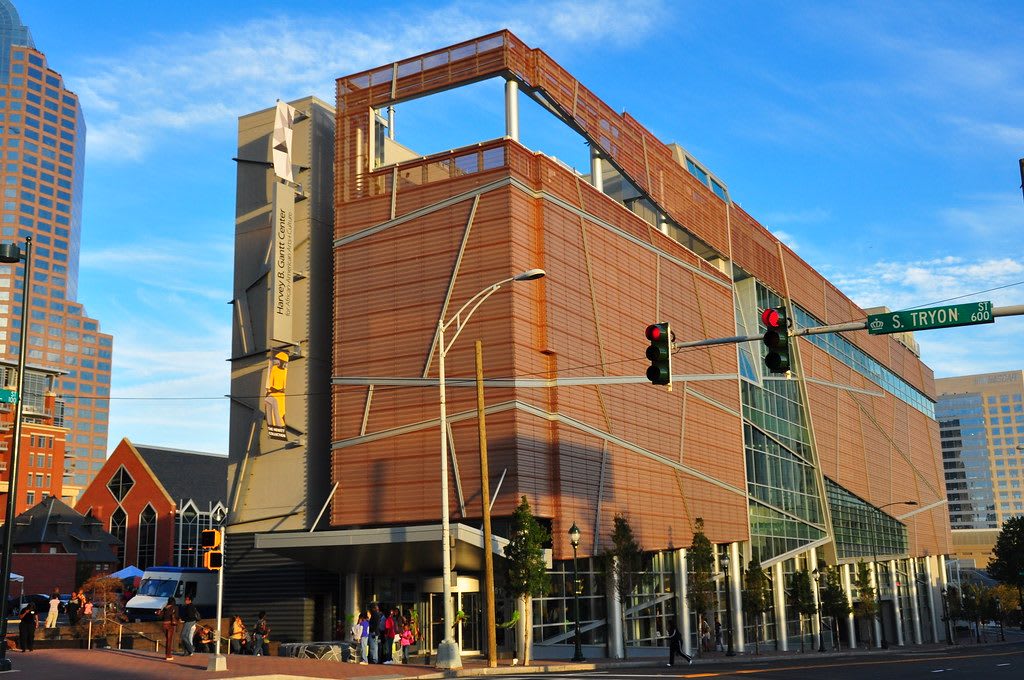
 WashuOtaku / CC BY-SA 2.0 via Flickr
The Story
Brooklyn grew up here in Second Ward after the Civil War, as freed people settled the ground once called Logtown. By the twentieth century it was a 238-acre city within a city for Black Charlotte: churches and businesses, the A.M.E. Zion Publishing House, a YMCA, the Brevard Street Library, opened in 1905 as the first library for African Americans in the state, and Second Ward High School, for years the only high school in Charlotte open to Black students.
Federal urban renewal money brought the bulldozers. Between 1961 and 1970, 216 businesses, 13 churches, 2 schools and 1,480 homes were destroyed, displacing more than 7,000 people in 1,007 families. Many were promised they could return; they could not. Government buildings, offices and Marshall Park rose on the cleared land. Old Grace A.M.E. Zion Church and the Second Ward gym are among the few buildings left, and in 2022 Stonewall Street, named for a Confederate general, became Brooklyn Village Avenue.
The Harvey B. Gantt Center stands at Tryon Street and that renamed avenue. It began in 1974, when Mary Harper and Bertha Maxwell-Roddey of UNC Charlotte proposed a Black cultural center and held its first festivals in Marshall Park, on Brooklyn's own ground. It opened in 1986 in the old Little Rock A.M.E. Zion Church on Myers Street and moved here in 2009, named for Charlotte's first Black mayor. The Freelon Group's building takes the climbing stairs of its atrium from Brooklyn's Myers Street School. Inside are the John and Vivian Hewitt collection of African American art and changing exhibitions.
Visitor Info
On the Map
Nearby
The closest stops worth working into your route
Historical markers nearby
Roadside plaques and monuments within a short detour