Home / Georgia / Andersonville, Plains & Southwest Georgia / Jimmy Carter National Historical Park
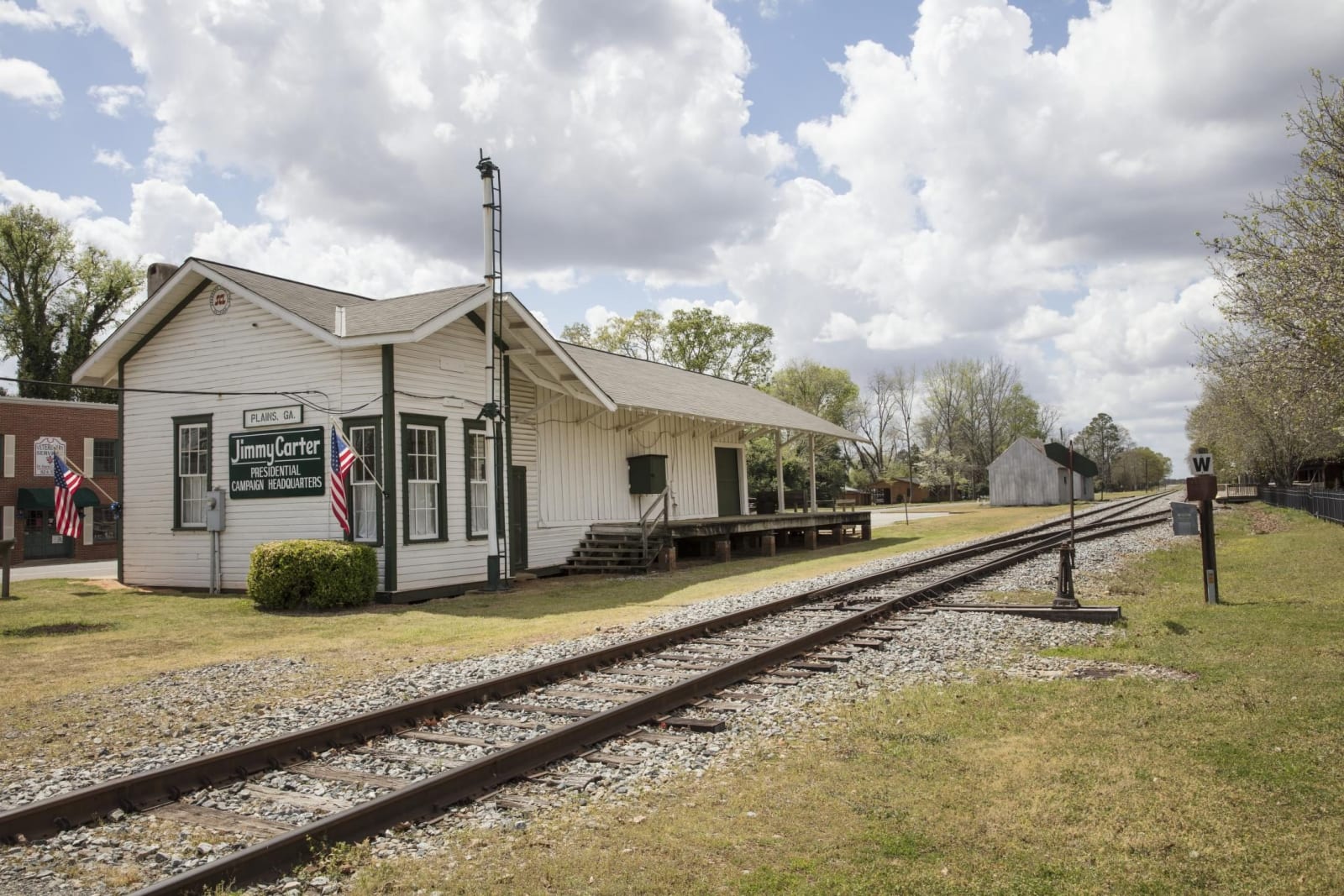
The white frame Plains railroad depot beside the tracks, with a sign for Jimmy Carter presidential campaign headquarters and American flags by the door.Carol M. Highsmith / public domain via Library of Congress
🏛️Historical

Jimmy Carter National Historical Park

Part ofAndersonville, Plains & Southwest Georgia
On this driveAndersonville to Plains: GA 49 and US 280 through Americus

Plains High School, the 1888 depot that ran the 1976 campaign, the boyhood farm at Archery with the Clark family's house, and the garden where Jimmy and Rosalynn Carter are buried.

⏱
Duration
Two to four hours for the school, depot, farm and gardens.
🎟
Admission
Free (NPS, 2026).
📅
Best Season
Year round; spring and fall are coolest. Visitor center, depot and boyhood farm open daily 9:30 a.m. to 4:30 p.m.; the Carter Gardens 10 a.m. to 4 p.m.; closed Thanksgiving, Christmas and New Year's Day (NPS, 2026).

The Story

Plains was founded in 1827, after the Treaty of Washington forced the Muscogee (Creek) people out, as the Plains of Dura. In 1885 the town moved a mile south to meet the new railroad, and its 1888 depot is the oldest building in town. Jimmy Carter was born in 1924 at the Wise Sanitarium, where his mother, Lillian, worked as a nurse. In 1928 his father, Earl, bought a farm west of town at Archery, a whistle-stop settlement made up mostly of Black families, some of whom worked the Carter land.

The farm is the heart of the park, put back as it looked before electricity came in 1938, with the house, barn, mules and the commissary where Earl sold tobacco, sugar and castor oil to his workers on credit and collected on payday. The Clark house stands nearby. Jack Clark ran the barn; his wife, Rachel, a field hand known for her skill, took the boy fishing, taught him the woods, and kept him when his parents were away. Carter wrote that his childhood world was theirs. His father accepted segregation without question and his mother taught him otherwise; in 1971 the son's inaugural address as governor declared that its time was over.

Begin at Plains High School of 1921, where Jimmy graduated in 1941 and Rosalynn Smith was valedictorian in 1944, now the visitor center. In 1976 the depot served as his campaign headquarters, and some 10,000 people a day came to town. The Carters lie in the memorial garden she designed beside their home on Woodland Drive, now open to visitors.

Visitor Info

⏱
Time Needed
Two to four hours for the school, depot, farm and gardens.
🎟
Admission
Free (NPS, 2026).
📅
Best Season
Year round; spring and fall are coolest. Visitor center, depot and boyhood farm open daily 9:30 a.m. to 4:30 p.m.; the Carter Gardens 10 a.m. to 4 p.m.; closed Thanksgiving, Christmas and New Year's Day (NPS, 2026).
🛣️
Highway
US 280

On the Map

Nearby

The closest stops worth working into your route

historical6.7 mi away
Koinonia Farm
The interracial Christian farm Clarence and Florence Jordan founded near Americus in 1942, boycotted, shot at and bombed in the 1950s, and the birthplace of Habitat for Humanity.
architectural9.7 mi away
Americus Historic District
The Sumter County seat of 1832, with the towering 1892 Windsor Hotel, the Rylander Theatre and the streets of the 1963-65 Americus Movement.
historical19 mi away
Andersonville National Historic Site
The ground of Camp Sumter, the Confederate prison where nearly 13,000 of 45,000 Union prisoners died in fourteen months, with the national cemetery and the National Prisoner of War Museum.
cultural24 mi away
Pasaquan
Seven acres of painted temples, pagodas and concrete walls near Buena Vista, built from 1957 by the fortune-teller and artist Eddie Owens Martin, who called himself St. EOM.
historical24 mi away
Leesburg Stockade
The Lee County public works building where some thirty Black girls arrested in the 1963 Americus marches were held for weeks without charges, until SNCC photographs forced their release.
geological31 mi away
Providence Canyon State Park
Sixteen gullies up to 150 feet deep west of Lumpkin, cut not by a river but by rain running off cotton fields cleared in the early 1800s, with walls in dozens of colors.

Historical markers nearby

Roadside plaques and monuments within a short detour

Marker8.7 mi away
Walter F. George (1878 - 1957)
Preston
Marker8.7 mi away
Webster County
Preston
Marker9.4 mi away
Sumter County
Americus
Marker9.7 mi away
Americus Colored Hospital
Americus
Marker9.8 mi away
Calvary Episcopal Church
Americus
Marker9.8 mi away
Speaker Crisp
Americus