Home / Georgia / Andersonville, Plains & Southwest Georgia / Andersonville National Historic Site
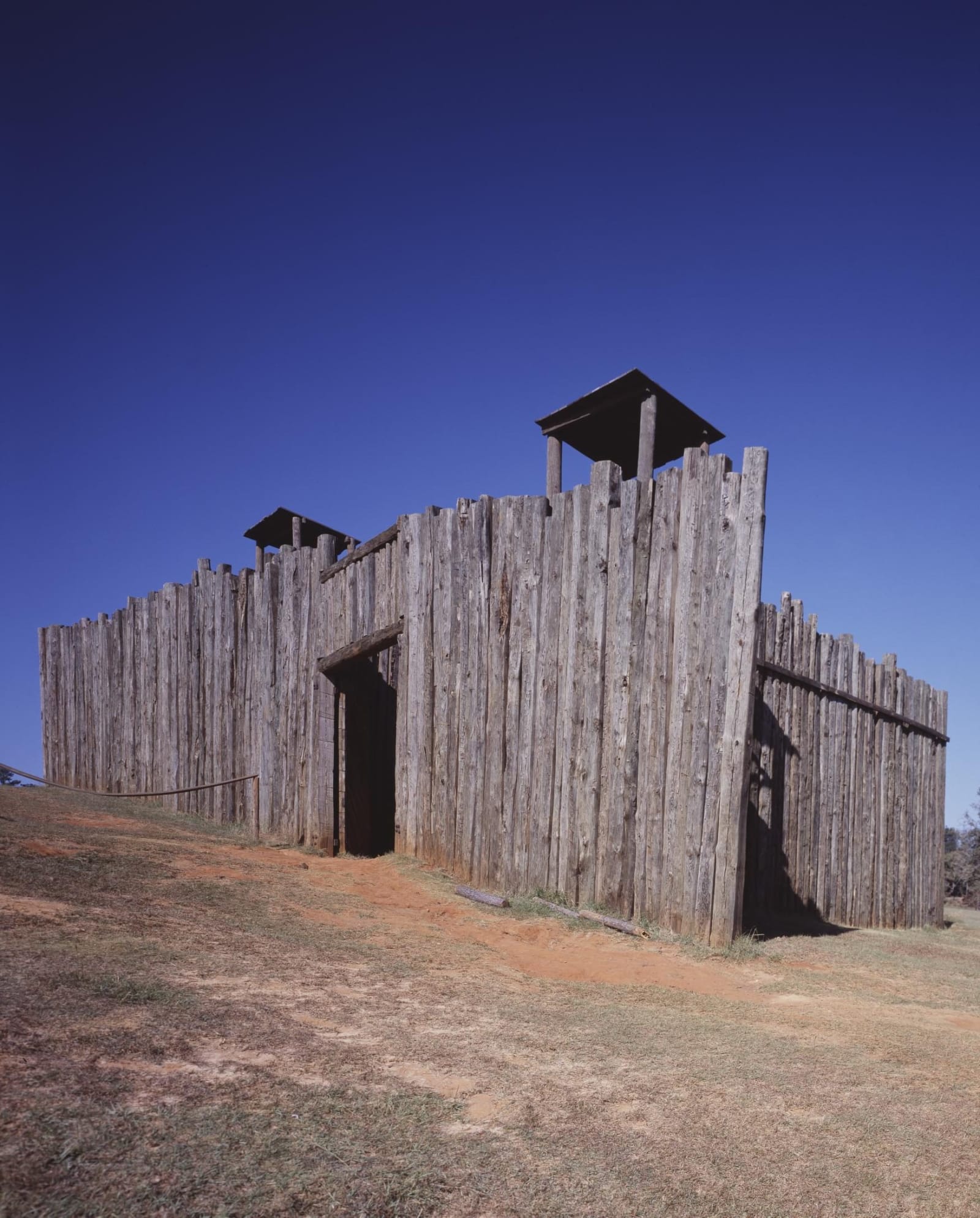
A reconstructed section of the Andersonville prison stockade, a wall of weathered upright logs with two roofed guard posts above an open gate, under a deep blue sky.Carol M. Highsmith / public domain via Library of Congress
🏛️Historical

Andersonville National Historic Site

Part ofAndersonville, Plains & Southwest Georgia
On this driveAndersonville to Plains: GA 49 and US 280 through Americus

The ground of Camp Sumter, the Confederate prison where nearly 13,000 of 45,000 Union prisoners died in fourteen months, with the national cemetery and the National Prisoner of War Museum.

⏱
Duration
Two to three hours.
🎟
Admission
Free; no entrance fee for the grounds, the museum or programs (NPS, 2026).
📅
Best Season
Year round; spring and fall are kindest, as summers are hot and humid. Grounds and cemetery open daily 8 a.m. to 5 p.m.; the museum 9:30 a.m. to 4:30 p.m.; closed Thanksgiving, Christmas and New Year's Day (NPS, 2026).

The Story

In February 1864 the Confederacy opened Camp Sumter beside the Andersonville railroad station, far from the coast and from raids. Black men from the surrounding farms, enslaved and free, were forced to build the fifteen-foot log stockade around sixteen and a half acres, with a creek running through the middle. It was meant for 10,000 men. By August 1864 it held 33,000. Of about 45,000 prisoners who passed through, nearly 13,000 died, chiefly of malnutrition, disease and exposure, the highest death rate of any Civil War prison.

The prisoners' own accounts carry the place. Men could hardly find room to lie down, drank from a creek fouled by sewage, and knew that a man who crossed the deadline, a strip about nineteen feet inside the wall, could be shot from the guard posts. Gangs of raiders robbed new arrivals until the prisoners hanged six of their leaders on July 11, 1864. On August 9 a spring burst out during a storm, and many called it providence; the Providence Spring House of 1901 marks it. Dorence Atwater, a paroled prisoner keeping the death register, made his own copy, and in 1865 he returned with Clara Barton to mark the graves. Only 460 are unknown.

Start at the National Prisoner of War Museum, then walk the open prison ground and the national cemetery, where the burial trenches became long rows of headstones. The monument in town to the commandant, Henry Wirz, hanged for war crimes in 1865, was raised by the United Daughters of the Confederacy and belongs to the Lost Cause, not to this history.

Visitor Info

⏱
Time Needed
Two to three hours.
🎟
Admission
Free; no entrance fee for the grounds, the museum or programs (NPS, 2026).
📅
Best Season
Year round; spring and fall are kindest, as summers are hot and humid. Grounds and cemetery open daily 8 a.m. to 5 p.m.; the museum 9:30 a.m. to 4:30 p.m.; closed Thanksgiving, Christmas and New Year's Day (NPS, 2026).
🛣️
Highway
GA 49

On the Map

Nearby

The closest stops worth working into your route

architectural11 mi away
Americus Historic District
The Sumter County seat of 1832, with the towering 1892 Windsor Hotel, the Rylander Theatre and the streets of the 1963-65 Americus Movement.
historical17 mi away
Koinonia Farm
The interracial Christian farm Clarence and Florence Jordan founded near Americus in 1942, boycotted, shot at and bombed in the 1950s, and the birthplace of Habitat for Humanity.
historical19 mi away
Jimmy Carter National Historical Park
Plains High School, the 1888 depot that ran the 1976 campaign, the boyhood farm at Archery with the Clark family's house, and the garden where Jimmy and Rosalynn Carter are buried.
cultural28 mi away
Pasaquan
Seven acres of painted temples, pagodas and concrete walls near Buena Vista, built from 1957 by the fortune-teller and artist Eddie Owens Martin, who called himself St. EOM.
historical32 mi away
Leesburg Stockade
The Lee County public works building where some thirty Black girls arrested in the 1963 Americus marches were held for weeks without charges, until SNCC photographs forced their release.
cultural39 mi away
Hawkinsville Opera House
The 1908 city hall and auditorium of Hawkinsville, an Ocmulgee River steamboat town named for the Muscogee agent Benjamin Hawkins and known for its harness horses.

Historical markers nearby

Roadside plaques and monuments within a short detour

Marker0.2 mi away
Camp Sumter: Confederate Prison Site
Andersonville
Marker6.8 mi away
Lindbergh's Solo Flight
Americus
Marker9.7 mi away
Macon County Training School: A Rosenwald School
Montezuma
Marker10 mi away
Americus Colored Hospital
Americus
Marker11 mi away
Schley County
Ellaville
Marker11 mi away
Sumter County
Americus