Home / North Carolina / Asheville & the Blue Ridge / Hot Springs
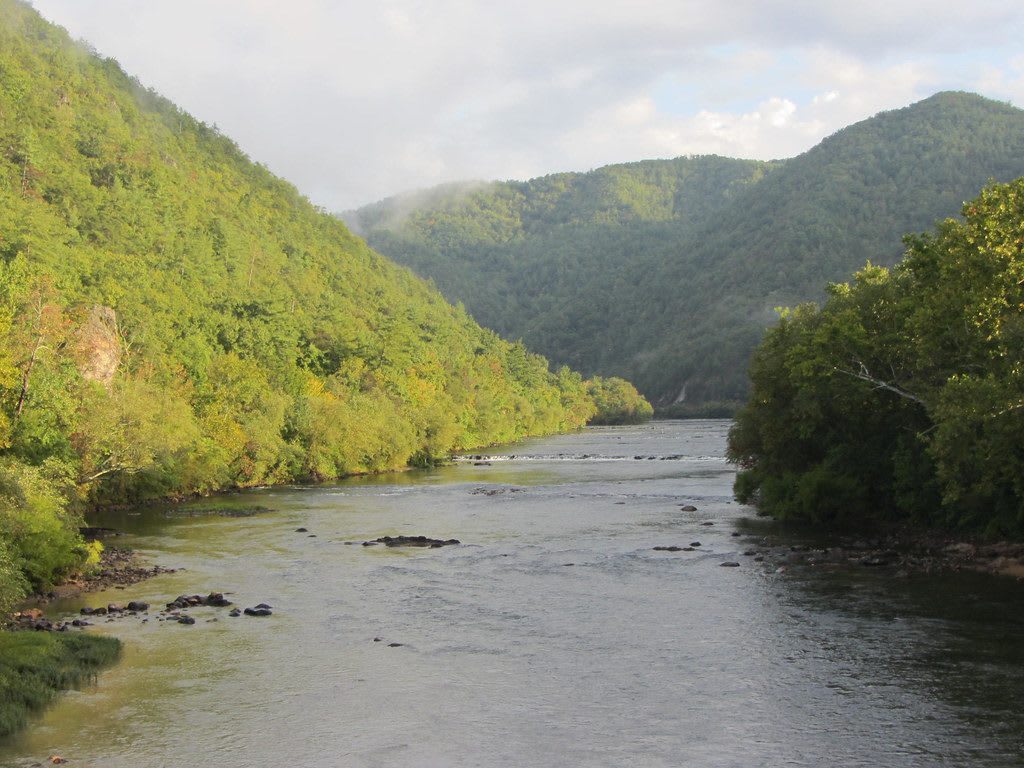
The French Broad River running wide and shallow over rocks between steep wooded mountainsides near Hot Springs.David Wilson / CC BY 2.0 via Flickr
⭐Attraction

Hot Springs

Part ofAsheville & the Blue Ridge

A French Broad River town on the Appalachian Trail with the state's only hot springs, a World War I internment camp and a long recovery from Helene.

⏱
Duration
Half a day.
🎟
Admission
Free to visit the town; the resort charges for private mineral-water tubs (Hot Springs Resort & Spa, 2026).
📅
Best Season
Spring through fall for the river and the trail; the tubs are open year round.

The Story

Hot Springs sits where Spring Creek meets the French Broad River, and the warm mineral water rising there, the only hot spring known in North Carolina, was used by Native people long before settlers came. By 1778 the sick were crossing the mountains to bathe, and an inn was open by the 1790s. The Buncombe Turnpike, finished along the river in 1828, brought drovers and their herds past the springs, and in 1837 James Patton of Asheville opened the 350-room Warm Springs Hotel, its porch carried on thirteen columns for the thirteen colonies. It burned in 1884, and the Mountain Park Hotel took its place in 1886, the year a hotter spring was found and Warm Springs became Hot Springs.

In May 1917 the federal government leased the Mountain Park Hotel and grounds as an internment camp for German merchant sailors seized in American harbors when the United States entered the First World War. Townspeople befriended many of them, and some stayed in the mountains after the war or came back to visit. The hotel burned in 1920.

On September 27, 2024, Helene sent Spring Creek and the French Broad through downtown. The resort on the old spring grounds lost three-quarters of its mineral baths and two-thirds of its lodging, and has since rebuilt its creekside tubs, open daily, in water near 102 degrees. Most businesses have reopened, a new bridge crosses the river, and the Appalachian Trail still runs down Bridge Street.

Visitor Info

⏱
Time Needed
Half a day.
🎟
Admission
Free to visit the town; the resort charges for private mineral-water tubs (Hot Springs Resort & Spa, 2026).
📅
Best Season
Spring through fall for the river and the trail; the tubs are open year round.
🛣️
Highway
US 25/70 (Bridge Street)

On the Map

Nearby

The closest stops worth working into your route

historical18 mi away
Andrew Johnson National Historic Site
The tailor shop, homestead and grave of the seventeenth president in Greeneville, where the people he enslaved are named and where the Eighth of August emancipation celebration took root.
historical26 mi away
Thomas Wolfe Memorial
Julia Wolfe's boardinghouse on Market Street in Asheville, the Old Kentucky Home her son turned into Dixieland in Look Homeward, Angel.
cultural26 mi away
YMI Cultural Center
The 1893 Young Men's Institute on Eagle Street in Asheville, built for the Black men who worked on Biltmore and kept by Black Asheville ever since.
historical28 mi away
Biltmore Estate
George Vanderbilt's 1895 house south of Asheville, built by about a thousand workers on land bought from Shiloh, a Black community the estate moved a mile away.
natural28 mi away
Craggy Gardens
Rhododendron balds and wind-bent trees on the Great Craggy Mountains, along the Blue Ridge Parkway northeast of Asheville.
cultural31 mi away
Unicoi County Heritage Museum and the Erwin Rail Yard
A museum in the old fish hatchery superintendent's house in Erwin, a Clinchfield railroad town where the elephant Mary was hanged in 1916 and Black residents were driven out in 1918.

Historical markers nearby

Roadside plaques and monuments within a short detour

Marker0.4 mi away
Balladry
Hot Springs
Marker5.3 mi away
Shelton Laurel Massacre
Shelton Laurel
Marker6.4 mi away
Frances Goodrich
Allanstand
Marker9.9 mi away
Grace Moore
Del Rio, Tennessee
Marker16 mi away
Swaggerty Fort
Parrottsville, Tennessee
Marker16 mi away
Mars Hill College
Mars Hill