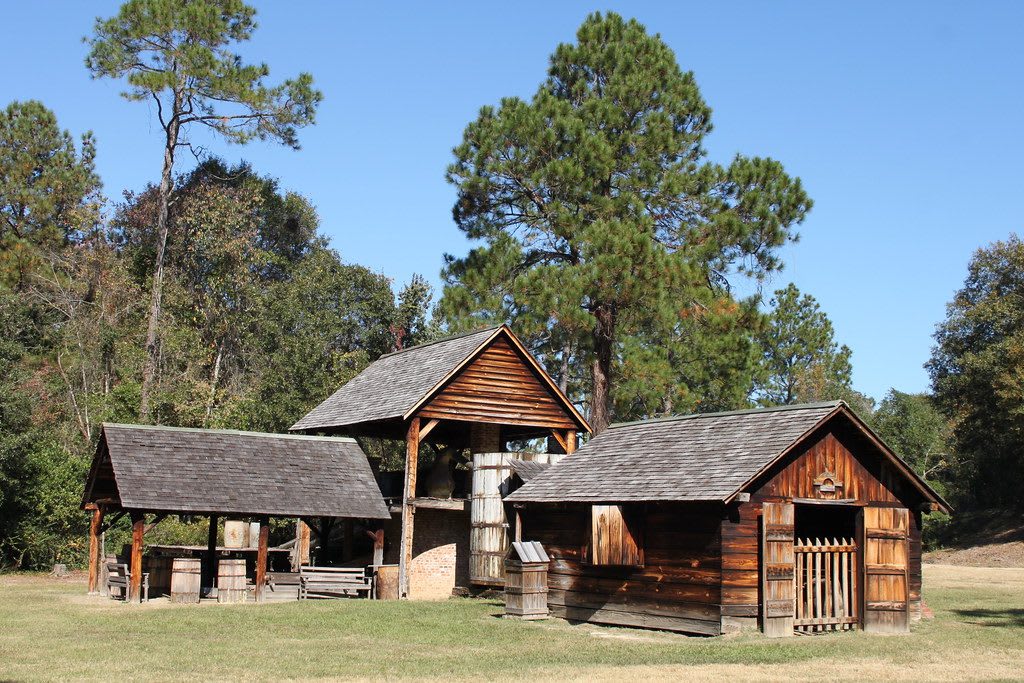
 Mike Finn (muffinn) / CC BY 2.0 via Flickr
The Story
The museum grew from a peanut combine. James L. Shepherd of the Coastal Plain Experiment Station in Tifton built the first mobile peanut combine, and when no place could be found to keep it, his widow, Rosalie, and former state senator Ford Spinks set out to build a museum of Georgia farming. It opened as the Agrirama in July 1976, and Abraham Baldwin Agricultural College took it over in 2010.
The 95-acre village moves through time. The traditional farmstead shows a self-sufficient wiregrass farm of the 1870s, before the railroads, with log cabins from the 1840s and 1850s, a cane mill and syrup kettle and the Sand Hill School House built near Ty Ty about 1895. The progressive farmstead shows the middle-class farm family that came after, and Main Street and the industrial complex hold a feed store, a Montezuma railroad depot, a sawmill, a gristmill and a cotton gin of the 1890s. The turpentine still recalls the industry that brought North Carolina operators and their Black workers into south Georgia's pine woods from the 1870s; the woodsmen who chipped the trees and dipped the gum were mostly African American, under white superintendents and woodsriders, and the camps moved on every few years as the trees gave out.
The still runs at the spring Folklife Festival, and the Vulcan steam locomotive of 1917 pulls open cars on Saturdays when it is in service. The exhibit hall tells the story of Georgia's crops.
Visitor Info
On the Map
Nearby
The closest stops worth working into your route
Historical markers nearby
Roadside plaques and monuments within a short detour