Home / South Carolina / Greenville & the Upstate Mountains / Fort Hill
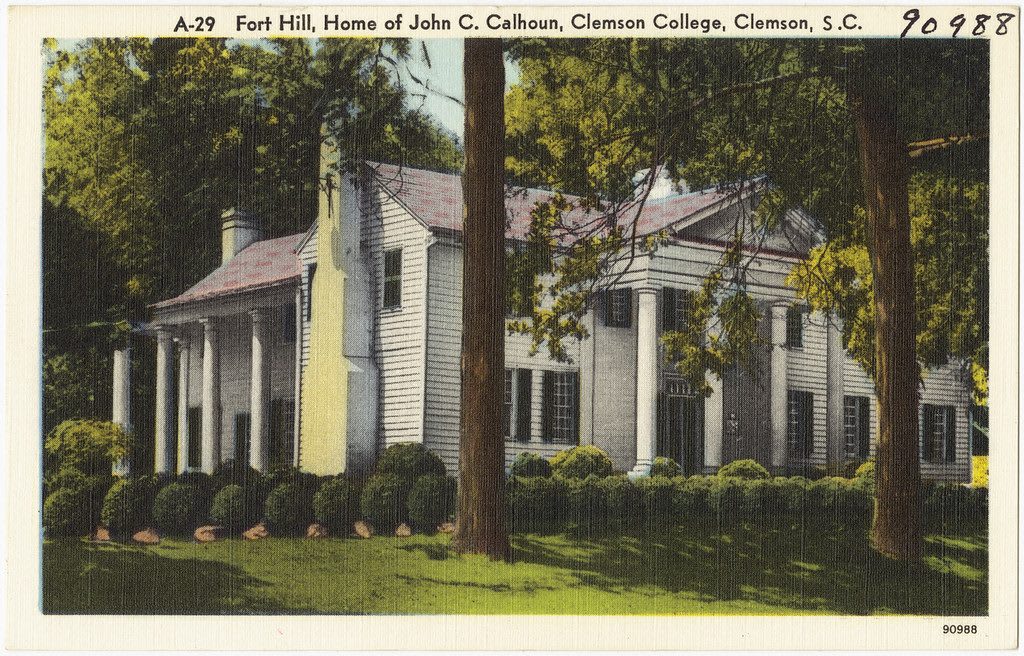
A mid-century color postcard of a white columned plantation house among tall trees, captioned Fort Hill, Home of John C. Calhoun.Boston Public Library / CC BY 2.0 via Flickr
🏛️Historical

Fort Hill

Part ofGreenville & the Upstate Mountains

John C. Calhoun's plantation house on the Clemson campus, kept with the names of the enslaved people who built and worked Fort Hill.

⏱
Duration
About an hour.
🎟
Admission
Guided tours; times and fees from Clemson University Historic Properties.
📅
Best Season
Year round; campus parking is easiest when classes are out.

The Story

Before the Revolution the Cherokee town of Esseneca stood on this ground by the Keowee River. The house began in 1803 as Clergy Hall, a four-room parsonage for the nearby Hopewell-Keowee church, and by 1810 twenty-five enslaved people labored for the minister's household. Calhoun's mother-in-law bought it, the family enlarged it to fourteen rooms and from 1830 called it Fort Hill, after a Revolutionary fort, and Calhoun himself owned it from 1836. He wrote the 1828 Exposition and Protest and the 1831 Fort Hill Address on nullification here, and in his last years led the South's political defense of slavery.

Everything on the plantation was built and run by enslaved people, and their numbers grew from 37 to 75 between 1830 and 1850. The oldest in the 1850 count, listed as 110, was most likely Mennemin, who may have been born in Africa. In 1851 Floride Calhoun sold a thirteen-year-old boy, Stepheney, to her son Andrew Pickens Calhoun, who bought fifty more people from her in 1854: Sawney and Tilla, Ned, Nicholas, Rosanna, Phebe and others whose first names survive. By 1865 there were 139 people enslaved here.

Thomas Green Clemson, Calhoun's son-in-law, signed labor contracts with freedpeople from 1868 and in 1888 left the land for a college, with the condition that the house always be open to visitors. The tour covers the house, Calhoun's office, the kitchen and springhouse.

Visitor Info

⏱
Time Needed
About an hour.
🎟
Admission
Guided tours; times and fees from Clemson University Historic Properties.
📅
Best Season
Year round; campus parking is easiest when classes are out.
🛣️
Highway
US 76

On the Map

Nearby

The closest stops worth working into your route

historical3.6 mi away
Pendleton Historic District
The 1790 seat of old Pendleton District around its village green and Farmers Hall, with Woodburn, where Jane Edna Hunter was born to sharecroppers in 1882.
cultural14 mi away
Museum of the Cherokee in South Carolina
A small Walhalla museum of the Cherokee Lower Towns, Keowee, Seneca, Jocassee, Tamassee and the rest, built from what came out of this county's ground.
historical18 mi away
Oconee Station State Historic Site
A 1792 militia blockhouse and William Richards's 1805 trading-post house on what was South Carolina's western edge, with a trail to Station Cove Falls.
historical18 mi away
Keowee-Toxaway State Park
A foothills park on Lake Keowee, whose water covers the Cherokee town of Keowee and the site of Fort Prince George.
industrial19 mi away
Stumphouse Tunnel Park
The unfinished 1850s railroad tunnel Irish laborers drove into Stumphouse Mountain to link Charleston with the Midwest, beside Issaqueena Falls.
natural20 mi away
Devils Fork State Park
The only public way onto Lake Jocassee, a clear, cold reservoir over the Jocassee valley, where Oconee bells bloom along the trail each March.

Historical markers nearby

Roadside plaques and monuments within a short detour

Marker0.2 mi away
Integration With Dignity, 1963
Clemson
Marker0.3 mi away
Asbury F. Lever (1875-1940)
Clemson
Marker0.8 mi away
Clemson University
Clemson
Marker1.2 mi away
Hanover House
Clemson
Marker1.7 mi away
Old Stone Church
Clemson
Marker2.3 mi away
Littlejohn's Grill
Clemson