Home / Texas / Laredo, Zapata & the Brush Country / Duval County Courthouse
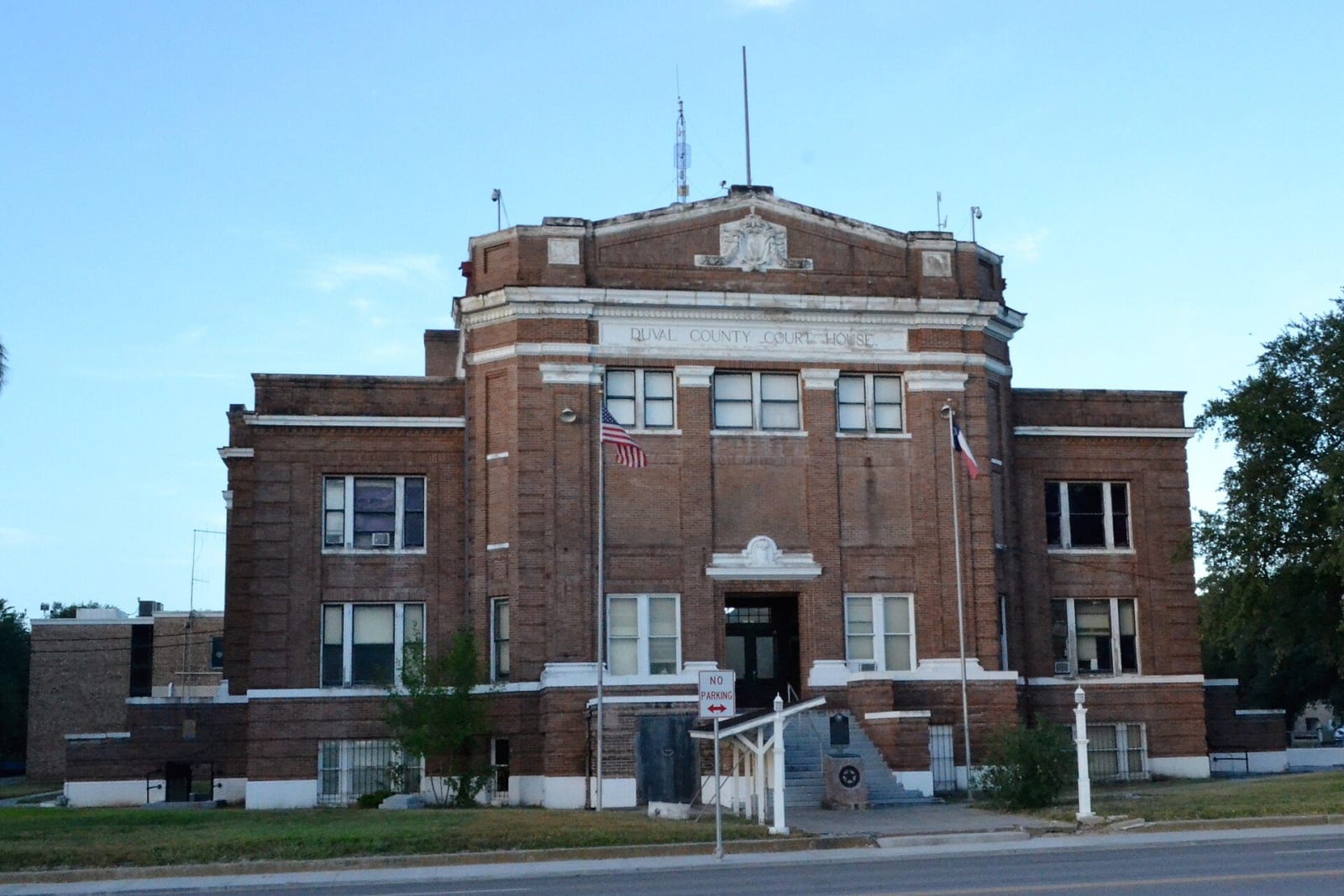
The red-brick front of the Duval County Courthouse in San Diego, with white trim, a pedimented top and the words Duval County Court House over a central entrance.25or6to4 / CC BY-SA 4.0 via Wikimedia Commons
🏗️Architectural

Duval County Courthouse

Part ofLaredo, Zapata & the Brush Country

A red-brick Classical Revival courthouse of 1916 in San Diego, the seat of a county governed for decades by the Parr family machine.

⏱
Duration
Thirty minutes.
🎟
Admission
Free to view from the street; a working county building.
📅
Best Season
Year round; summers are very hot, so mornings are best.

The Story

The Venado, a Coahuiltecan hunting and gathering people, roamed this brush country in the 1700s until Apache and Comanche pressure from the north and Spanish ranching from the south broke up their world. Duval County was organized in 1876, and San Diego became its seat. A fire on August 11, 1914 burned the earlier courthouse. The present one, a Classical Revival building of red brick designed by a Fort Worth firm, was finished in 1916. The Austin firm of Page Brothers designed a rear addition in 1938.

The building is the stage for one of Texas's longest-running political machines. Archer Parr, who came to Duval County in 1882, won a seat on the commissioners' court in 1898, and after the 1907 assassination of the Democratic chief John Cleary he took command. On May 18, 1912, amid a challenge from the party chairman C. M. Robinson, three Anglo men shot dead three Mexican American county officials on the courthouse grounds: Candelario Sáenz, Antonio Anguiano and Pedro Eznal. Parr was in the state senate from 1914 to 1934. Voters who were Mexican American received county jobs and small payments, and the Handbook of Texas describes the system as paternalism, corruption and coercion.

His son George Parr, called the Duke of Duval, held the machine until it ended in 1975. The courthouse is a working county building, so view it from the street and respect its business hours. A historical marker stands beside the steps.

Visitor Info

⏱
Time Needed
Thirty minutes.
🎟
Admission
Free to view from the street; a working county building.
📅
Best Season
Year round; summers are very hot, so mornings are best.
🛣️
Highway
TX-44 / TX-359

On the Map

Nearby

The closest stops worth working into your route

historical27 mi away
King Ranch Visitor Center
The bus-tour gate to a working ranch of about 825,000 acres, founded on Santa Gertrudis Creek in 1853 and worked from the start by the Kineños, families from Cruillas in Tamaulipas.
historical29 mi away
Lipantitlán State Historic Site
Five undeveloped acres on the Nueces named for the Lipan Apaches who camped here, where Mexico built an earth-and-rail fort that Texans took early in the Revolution.
recreational30 mi away
Lake Corpus Christi State Park
A lake park in the South Texas brush country above Mathis, on a reservoir of the Nueces, with a Civilian Conservation Corps refectory and more than 200 bird species.
cultural36 mi away
Don Pedrito Jaramillo Shrine
The grave and shrine of the folk healer of Los Olmos, a place of prayer where South Texans still leave candles and letters for the curandero who took no fee.
cultural37 mi away
Heritage Museum at Falfurrias
A free town museum of ranch gear, a Texas Ranger room and 99,000 photo negatives, in the town Edward Lasater built around his railroad and his Jersey cows.
cultural46 mi away
Kenedy Ranch Museum of South Texas
A museum in the Kenedy Pasture Company's 1927 office in Sarita, telling how Mifflin Kenedy and three generations of his family shaped the Wild Horse Desert, with murals and an audio guide.

Historical markers nearby

Roadside plaques and monuments within a short detour

Marker0 mi away
Duval County
San Diego
Marker0.2 mi away
El Plan de San Diego
San Diego
Marker0.2 mi away
St. Francis de Paula Catholic Church
San Diego
Marker9.3 mi away
Jim Wells County
Alice
Marker10 mi away
Alice
Alice
Marker10 mi away
Jim Wells County Courthouse
Alice