Home / Kentucky / Red River Gorge & the Eastern Hills / Cora Wilson Stewart Moonlight School
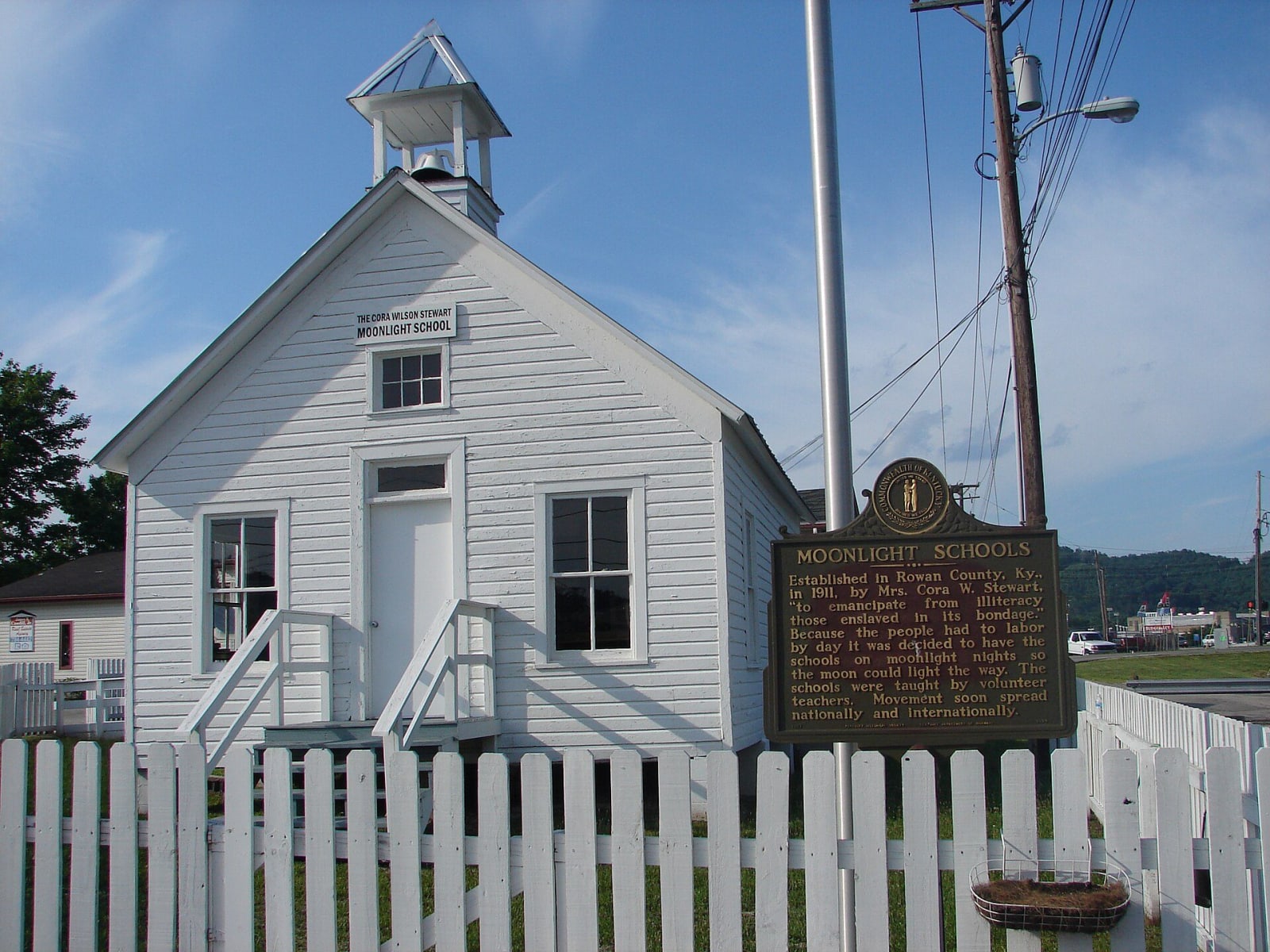
The white one-room Moonlight School with its bell cupola behind a picket fence, a state historical marker beside it.Carldaniel / CC BY-SA 3.0 via Wikimedia Commons
🏛️Historical

Cora Wilson Stewart Moonlight School

Part ofRed River Gorge & the Eastern Hills

A Rowan County schoolhouse kept in downtown Morehead in honor of the 1911 Moonlight Schools, which taught grown men and women to read by night.

⏱
Duration
Fifteen to thirty minutes; the Kentucky Folk Art Center is a short walk away.
🎟
Admission
Free to see the schoolhouse and marker from the street.
📅
Best Season
Year round.

The Story

This small schoolhouse on East First Street in downtown Morehead was one of the Moonlight Schools, and it stands now as a historic site named for the woman who started them. Cora Wilson was born in Rowan County in 1875, trained at Morehead Normal School and the University of Kentucky and began teaching at twenty. As Rowan County's school superintendent she became, in 1911, the first woman elected president of the Kentucky Education Association.

Her plan was practical. Grown men and women who had never learned to read worked all day, so in September 1911 she opened the county's schoolhouses to them at night, with volunteer teachers who went through their own districts to find students. The classes met on moonlit nights so the moon could light the way to the schoolhouse and home. The second session enrolled 1,600 people. In 1914 Governor James B. McCreary created the Kentucky Illiteracy Commission to take the schools into every county, and over the next two years about 40,000 Kentuckians learned to read and write. Under segregation the state ran separate Colored Moonlight Schools, 15 of them by 1915, and by 1916 eighteen states had schools of their own.

Stewart wrote readers for her adult students, the Country Life Readers of 1915 and 1916, and when the World War I draft found some 700,000 men who could not read, she wrote The Soldier's First Book. She went on to chair the National Education Association's illiteracy commission and died in 1958. The state historical marker stands at the schoolhouse.

Visitor Info

⏱
Time Needed
Fifteen to thirty minutes; the Kentucky Folk Art Center is a short walk away.
🎟
Admission
Free to see the schoolhouse and marker from the street.
📅
Best Season
Year round.
🛣️
Highway
US 60

On the Map

Nearby

The closest stops worth working into your route

cultural0.2 mi away
Kentucky Folk Art Center
Morehead State University's folk art museum in the old Union Grocery on First Street, with about 1,400 works by Kentucky self-taught artists.
recreational7.6 mi away
Cave Run Lake
An 8,270-acre Corps of Engineers lake on the Licking River south of Morehead, finished in 1973 and nearly all inside the Daniel Boone National Forest.
historical16 mi away
Goddard White Covered Bridge
A 63-foot Town lattice covered bridge in Fleming County, the only one of its kind left in Kentucky, framing a white country church.
geological21 mi away
Carter Caves State Resort Park
More than 20 caves along Tygarts Creek, with year-round tours of Cascade and X Cave, a War of 1812 saltpeter cave and seven natural bridges.
natural22 mi away
Grayson Lake State Park
A narrow Corps of Engineers lake in the sandstone canyon of the Little Sandy River, filled in 1968, with cliff-top trails and a seasonal waterfall.
natural26 mi away
Red Wild and Scenic River
The stretch of the Red River that a 1960s Corps of Engineers dam would have flooded, saved by a 1967 protest hike, a book and a 1993 act of Congress.

Historical markers nearby

Roadside plaques and monuments within a short detour

Marker0.1 mi away
Courthouse Burned
Morehead
Marker0.1 mi away
Rowan County "War," 1884-1887
Morehead
Marker0.2 mi away
National Register Historic District
Morehead
Marker16 mi away
Beckham County
Olive Hill
Marker18 mi away
Home of Gov. Fields
Olive Hill
Marker18 mi away
Bourbon Iron Works
Owingsville