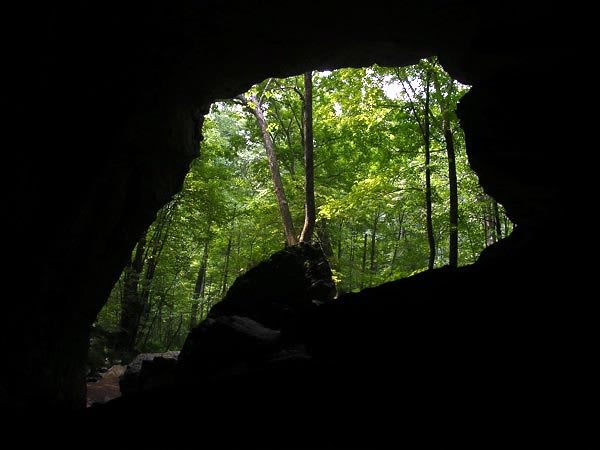
 Molly Des Jardin / CC BY 2.0 via Flickr
The Story
Carter Caves lies in the hollows along Tygarts Creek off I-64, and the ground beneath its forest holds more than 20 caverns, four of them shown on guided tours. Cascade Cave, really three caves together and the largest in the park, has an underground lake room and a 30-foot waterfall. X Cave is named for the crossing pattern of its two passages and holds the park's largest formations. Seven natural bridges stand on the surface; Smoky Bridge, the biggest, is on the Three Bridges Trail, and the park road crosses Cave Branch on top of another.
Saltpetre Cave was mined during the War of 1812 for the potassium nitrate in its earth, the main ingredient of gunpowder, and its summer tour shows the old works. Bat Cave is a wild cave, toured only in summer: in winter some 40,000 bats hibernate there, endangered Indiana bats among them, and it closes to protect them from white-nose syndrome. Since 1981 Bat Cave and Cascade Caverns have been state nature preserves, which also protect mountain maple and Canada yew.
The caves were in private hands for almost two centuries. The last owners, the Lewis family, lit them with a gasoline generator and rented cabins to visitors. After J. F. Lewis died in 1937, the Grayson and Olive Hill Rotary Clubs and the Lewis family gave about 945 acres to the state, a purchase driven by Governor William J. Fields, a Carter County native, and the park was created in 1946. Cascade Cave was added in 1959, and the fieldstone Lewis Caveland Lodge opened in 1962.
Visitor Info
On the Map
Nearby
The closest stops worth working into your route
Historical markers nearby
Roadside plaques and monuments within a short detour