Home / Oklahoma / The Wichita Mountains & the Southwest / Comanche National Museum and Cultural Center
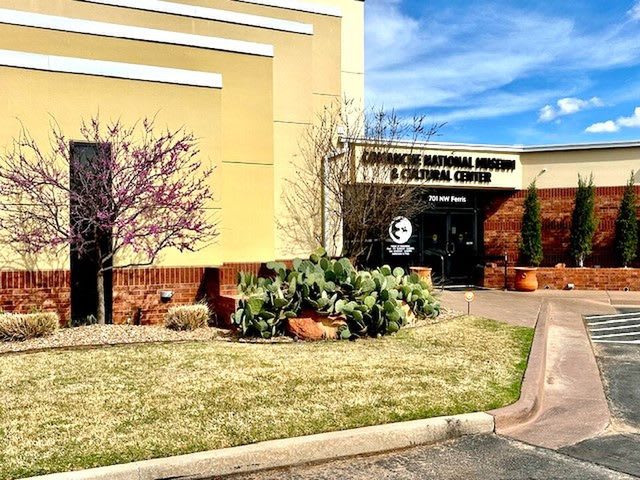
The entrance of the Comanche National Museum and Cultural Center in Lawton.TulGuy / CC0 via Wikimedia Commons
🎭Cultural

Comanche National Museum and Cultural Center

Part ofThe Wichita Mountains & the Southwest

The Comanche Nation's own museum in Lawton, built so that the history, art and lifeways of the Nʉmʉnʉʉ, The People, are told from a Comanche perspective.

⏱
Duration
One to two hours.
🎟
Admission
No admission charge is stated on the Nation's museum page; call (580) 360-0683.
📅
Best Season
Year round: Monday to Friday 8 a.m. to 5 p.m., Saturday 10 a.m. to 2 p.m.

The Story

Comanche people call themselves Nʉmʉnʉʉ, The People. In the Nation's own account they were once part of the Shoshone, and in the late 1600s and early 1700s they moved onto the plains and then south, through what are now Wyoming, Nebraska, Colorado, Kansas, New Mexico and Texas, before settling in southwest Oklahoma. The horse made them the riders and horse breeders of the southern plains, and the bison gave them food, clothing and lodge covers. The 1867 Medicine Lodge treaty held them, with the Kiowa and Plains Apache, to a reservation here; most Comanche lived on it only after Quanah Parker's Kwahada band came in in 1875, and it was allotted and opened in 1901.

The museum on NW Ferris Avenue states its purpose plainly: a place where the Nation's story is told from a Comanche perspective, and a place of pride for its citizens. The collections run from paintings, textiles and jewelry to regalia, musical instruments, military uniforms and an archive of film, photographs and recordings. The military history is close to home. In December 1940 the Army recruited seventeen Comanche men as code talkers. They built coded terms in their language for about 250 military words, a turtle for a tank among them; thirteen landed at Utah Beach, and the code was never broken.

The Nation has about 17,000 enrolled citizens, about 7,000 of them living around Lawton and Fort Sill, and runs a language program whose greeting, in Comanche, reads: let's all speak Comanche together.

Visitor Info

⏱
Time Needed
One to two hours.
🎟
Admission
No admission charge is stated on the Nation's museum page; call (580) 360-0683.
📅
Best Season
Year round: Monday to Friday 8 a.m. to 5 p.m., Saturday 10 a.m. to 2 p.m.
🛣️
Highway
I-44

On the Map

Nearby

The closest stops worth working into your route

natural14 mi away
Wichita Mountains Wildlife Refuge
Worn granite peaks and mixed-grass prairie in Comanche and Kiowa homeland, set aside in 1901 and restocked in 1907 with fifteen bison sent by train from the New York Zoological Park.
historical25 mi away
Chisholm Trail Heritage Center
Duncan's museum of the cattle trail on US-81, with an 18-minute drive film, a western art gallery and the route through the Chickasaw Nation to Silver City and the Canadian.
cultural33 mi away
Southern Plains Indian Museum
A free federal museum in Anadarko, open since the late 1940s, showing the clothing, shields, cradleboards and art of the Kiowa, Comanche, Wichita, Caddo, Cheyenne, Arapaho, Delaware and Apache nations.
historical53 mi away
Museum of the Western Prairie
The Oklahoma Historical Society's museum in Altus, telling southwest Oklahoma from the granite uplift through the Western Trail, Texas's Greer County, dugouts, irrigation and the air base.
natural55 mi away
Quartz Mountain State Park
The granite Quartz Mountains, the low western range of the Wichitas, rising from Lake Altus-Lugert, with a CCC-built park of 1937, a rebuilt lodge and the climbing rock of Baldy Point.
historical68 mi away
Historic Fort Reno
The Army post beside the Cheyenne and Arapaho agency at Darlington, from which troops chased the Northern Cheyenne north in 1878, later a remount station and a prisoner-of-war camp.

Historical markers nearby

Roadside plaques and monuments within a short detour

Marker13 mi away
Craterville Park
Marker18 mi away
Walters, Oklahoma
Marker28 mi away
Battle of the Wichita Village
Marker30 mi away
Cutthroat Gap Massacre