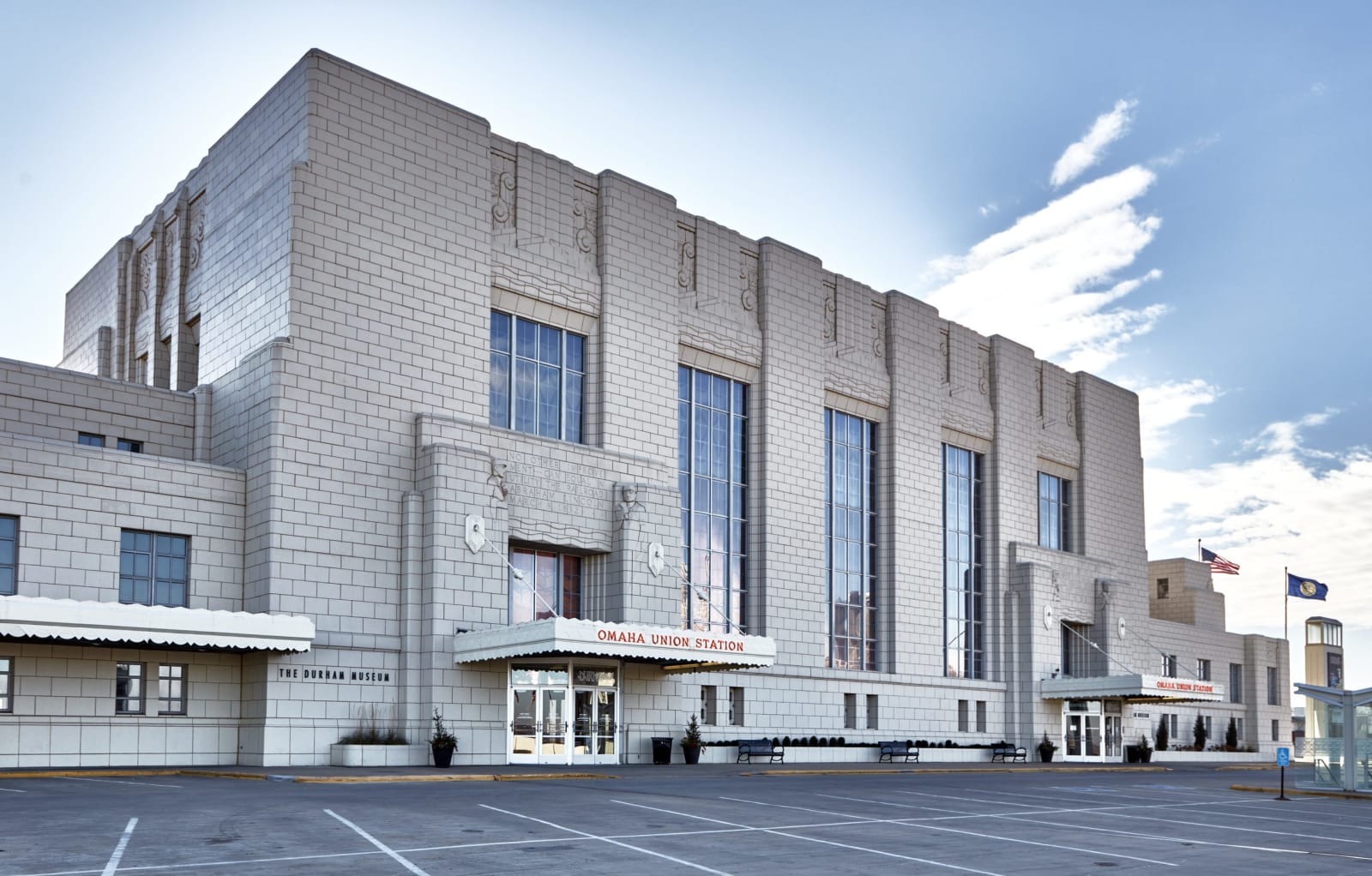
 Carol M. Highsmith / public domain via the Library of Congress
The Story
Union Station opened on January 15, 1931, on the site of the 1899 depot. Gilbert Stanley Underwood of Los Angeles designed it as the last of seventeen stations he drew as the Union Pacific's consulting architect, and Peter Kiewit Sons' of Omaha built the steel frame in twenty months for about $3.5 million. The frame is clad in cream glazed terra cotta, stepped back in Art Deco planes, and figures of a brakeman, a locomotive engineer, a civil engineer and a mechanic stand over the entrances.
The main waiting room, now the Suzanne and Walter Scott Great Hall, is 160 feet long and 72 wide under a sixty-foot plaster ceiling trimmed in gold and silver leaf, with ten tall windows, a terrazzo floor and Belgian marble. At its busiest the station handled up to 64 passenger trains and about 10,000 passengers a day, and during the Second World War a USO center gave soldiers a place to write letters, sleep and bathe. The last passenger train left in 1971. The Union Pacific gave the building to the city in 1973, volunteers opened the Western Heritage Museum there in 1975, and Charles and Margre Durham led the restoration of the 1990s.
John Lajba's six groups of bronze travelers stand about the hall. The soda fountain still serves. On the track level stand a Pullman car, a lounge car, a caboose and a steam engine, and the galleries hold Byron Reed's coin collection, with his 1804 silver dollar, and an earth lodge and tipi in the gallery on the Omaha people.
Visitor Info
On the Map
Nearby
The closest stops worth working into your route