 cm195902 / CC BY 2.0 via Flickr
The Story
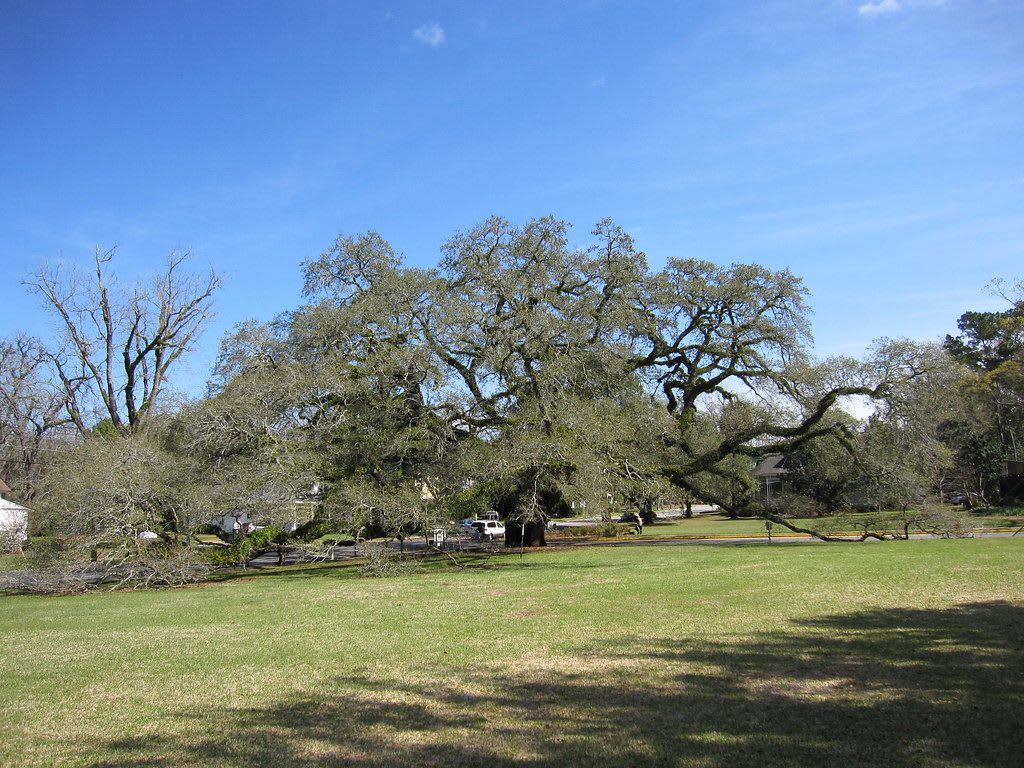
The Big Oak has stood at the corner of North Crawford and East Monroe streets since about 1680, when this was Apalachee and Lower Muscogee (Creek) country. It was registered with the Live Oak Society in 1936 as the 49th tree on the list, and its limbs now spread more than 160 feet over the corner, held up by cables and watered by buried lines. The Chastain family lived in a house beneath it from 1906 until the 1960s; in 1966 Elisabeth Ireland Poe of Pebble Hill and the city bought the lot and made it a park. Dwight Eisenhower, a regular at the hunting plantations, had his driver stop in 1958 so he could photograph it.
The town around it grew from an 1826 county seat. By 1860 Thomas County held 6,244 people in bondage, more than its white population, and in December 1864 Thomasville briefly held 5,000 Union prisoners of war. Henry O. Flipper was born here in 1856 to enslaved parents, Isabella and Festus Flipper; in 1877 he became the first Black graduate of West Point. Framed by white officers at Fort Davis, Texas, in 1881 and dismissed, he was given an honorable discharge in 1976, reburied in Thomasville in 1978 and pardoned in 1999.
From the 1880s northern visitors filled hotels like the Mitchell House and the Piney Woods on Broad Street and built winter cottages along Dawson Street. Downtown, a short walk from the oak, became one of Georgia's first Main Street towns in 1981, and its brick streets and storefronts were restored.
Visitor Info
On the Map
Nearby
The closest stops worth working into your route
Historical markers nearby
Roadside plaques and monuments within a short detour