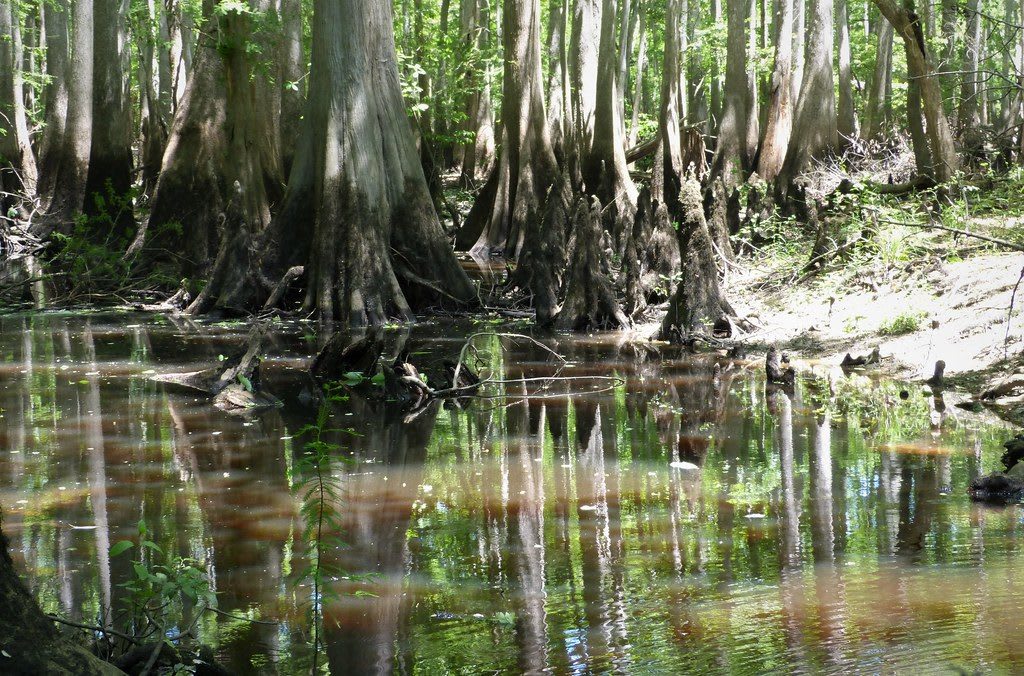
 gailhampshire / CC BY 2.0 via Flickr
The Story
Georgia's largest river is born a few dozen miles upstream, where the Ocmulgee and Oconee meet near Lumber City, and it is joined here by its biggest tributary, the Ohoopee. No dam stands anywhere on its course, and it drains about a quarter of the state on the way to the sea near Darien. William Bartram traveled it in the 1770s, describing a large, majestic river winding through a vast plain forest, and in 1773 he collected a small white-flowered tree whose pressed specimen lay unnoticed in London for decades.
That tree, the Georgia plume, grows wild only in a few South Georgia counties, and its largest population is here. Big Hammock is an 800-acre sand ridge built of sand the Altamaha laid down, rising out of the floodplain with habitats that run from cypress and gum swamp to turkey oak, sand live oak and longleaf pine. The National Park Service named it a National Natural Landmark in 1976 for its rare plants and animals. Around it, the 6,177-acre wildlife management area is bottomland hardwood forest laced with oxbow lakes and sloughs, where the river's swallow-tailed kites, alligators and gopher tortoises live.
The area lies on both sides of GA 144, about twelve miles south of Glennville. Three boat ramps reach the Altamaha and the Ohoopee, primitive camping is allowed in designated sites, and the trails are mostly unmaintained roads, so bring a map. Hunting seasons apply.
Visitor Info
On the Map
Nearby
The closest stops worth working into your route
Historical markers nearby
Roadside plaques and monuments within a short detour