 Ammodramus / CC0 via Wikimedia Commons
The Story
About twelve million years ago the Bruneau-Jarbidge supervolcano, in what is now Idaho, erupted and sent ash nearly a thousand miles east. Across this part of Nebraska it fell up to a foot deep, but at a watering hole here it collected in the low ground eight to ten feet thick. The animals that lived around the water breathed the powder and died of lung failure, and the ash closed over them.
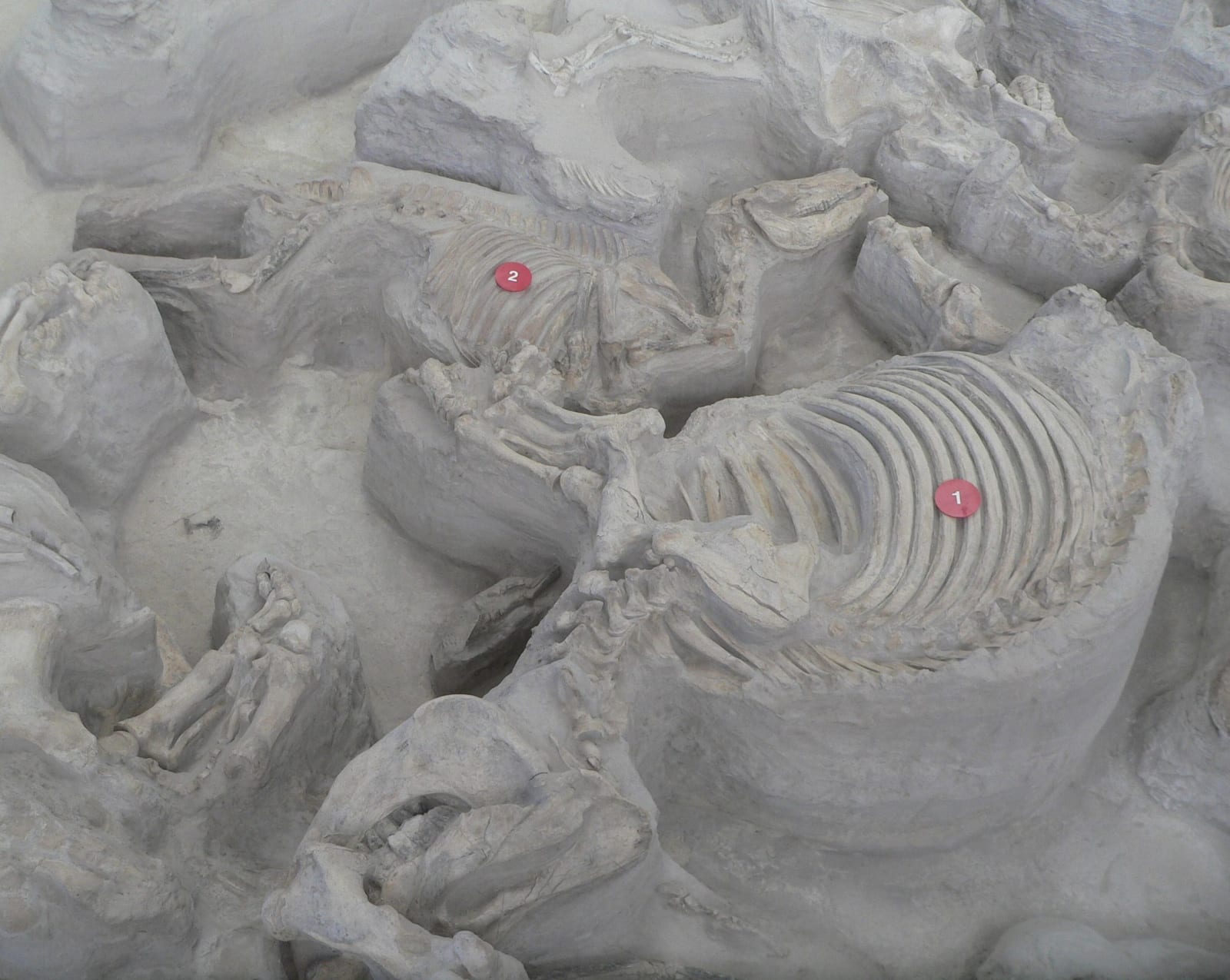
In 1971 the paleontologist Michael Voorhies found the skull of a young rhinoceros eroding out of a gully on a farm here. Digging since has turned up more than 200 complete skeletons. Rhinoceroses are so many and so close together that the main excavation is called the Rhino Barn, and horses of five genera lie with them. Some bones carry the bite marks of Aelurodon, a scavenging dog, but no predator has been found among the dead.
The state acquired the site in 1987 and opened the park in 1991, a joint project of Game and Parks and the University of Nebraska State Museum. It became a National Natural Landmark in 2006. The Hubbard Rhino Barn, opened in 2009, roofs over the skeletons where they lie, and from its boardwalk you can watch researchers and student interns at work and talk with them. The visitor center has exhibits on the eruption and a lab where interns prepare specimens in view, and trails loop through the surrounding prairie.
Visitor Info
On the Map
Nearby
The closest stops worth working into your route