County guide · New Mexico
Taos County
3 places to stop and 16 historical markers in Taos County, New Mexico.
Towns: Taos (9), Ranchos de Taos (3), Trampas (1), San Cristobal (1), Picuris Pueblo (1), Pilar (1), Rio Lucio (1), Tres Piedras (1), Carson (1)
Places to stop

architectural · Taos
Rio Grande Gorge Bridge
A steel truss strung across a slot in the basalt west of Taos, 565 feet above the river by the careful measure and 650 by the signs, built when the road beyond it did not yet exist.
architectural · Ranchos de Taos
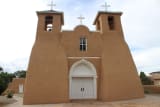
San Francisco de Asís Church, Ranchos de Taos
The adobe church at Ranchos de Taos that artists always paint from behind, kept standing by the mud its parish spreads over it every June.
cultural · Taos
Taos Pueblo
Two terraced adobe houses facing each other across Red Willow Creek, lived in for something like a thousand years, with no electricity or running water inside the old walls.
Historical markers
Taos
"The Three Fates"
Taos called the three women the Three Fates long before Brett painted them under that name in 1958.
Ranchos de Taos
Captive Women and Children of Taos County
Most writers spell her Villalpando, after the family whose fortified house at Ranchos de Taos the Comanche overran in August 1760, taking some fifty-six women and…
Taos
Jack M. Campbell
The commission named this road for Jack Campbell before it carried the number on the panel.
Taos
Kit Carson Memorial Cemetery
The ground was first the American Cemetery. Teodora Martínez Romero gave it in 1847 to bury the American soldiers and civilians killed in the January rising, and it took…
Trampas
Las Trampas
Juan de Argüello was seventy-four when he led the twelve families north in 1751, and is said to have been Diego de Vargas's drummer boy.
San Cristobal
Lawrence Ranch
The panel calls the ranch a gift, and Lawrence would not take it as one. Mabel Dodge Luhan offered the 160-acre Kiowa Ranch on Lobo Mountain in 1924; he refused, Frieda…
Picuris Pueblo
Maria Ramita Simbola Martinez, Cora Durand and Virginia Duran
Three women from one small pueblo kept a cooking pot alive. Potters at Picuris have worked mica-flecked clay from the nearby mountains since about 1600, a tradition…
Taos
Palo Flechado Pass
The band the panel offers for the name comes from the record of a rescue. Juan de Ulibarrí, who names the Flecha de Palo Apaches in 1706, was marching from Taos onto the…
Pilar
Pilar
The panel has Utes and Jicarilla inflicting losses, and leaves out who attacked whom. Lieutenant John W.
Rio Lucio
Pueblo of Picuris
The panel gives a meaning for Picuris, not the name its people use. Picuris is the Spanish rendering of a word glossed as those who paint; in Tiwa the pueblo is…
Tres Piedras
Rio Grande Gorge Bridge
Exceptional importance, the panel's last phrase, is a term of art. The National Register normally waits fifty years; the bridge was entered on July 15, 1997, at…
Carson
Rio Grande Gorge State Park
This panel advertises a state park that no longer appears on New Mexico's list. The river corridor it describes is run today by the Bureau of Land Management, with…
Ranchos de Taos
San Francisco de Asis Church
The panel's 1813 to 1815 rests on two documents. The village received permission to build a church in 1813, and late in 1815 Fray José Benito Pereyro asked the bishop at…
Taos
Taos
The panel's anti-U.S. insurrection was a rising by Hispano Taoseños and Taos Pueblo men against an army that had taken the province five months before.
Taos
Taos
The panel's population, 3,369, was overtaken by the 1990 census, which counted 4,065; the town held about 6,500 in 2020.
Taos
Taos Canyon
The panel folds this fight into the reconquest. It belonged to a second rising: on June 4, 1696, the people of fourteen pueblos rose again, and at Taos they killed their…