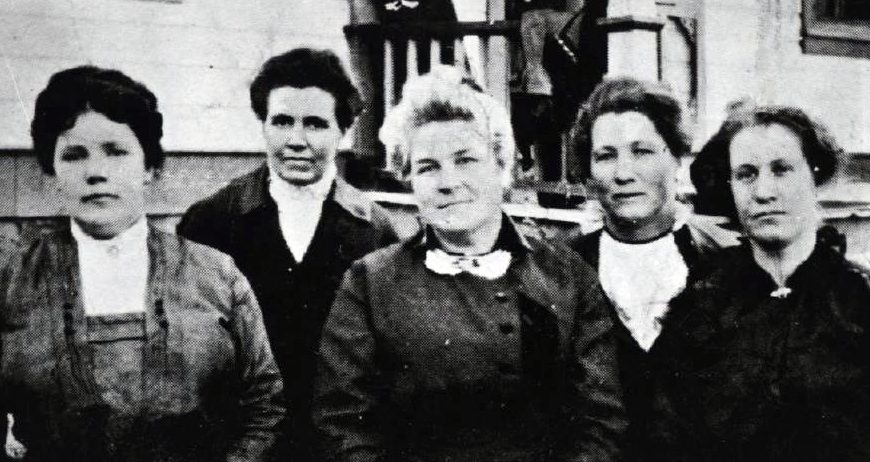
The plaque in Kanab tells it as a charming municipal curiosity. Five pioneer mothers, aged twenty-six to forty-one, elected to run the town in 1912, working tirelessly for safety, sanitation, and beautification, earning themselves a place in history. Every word of that is true. It is also the smooth-stone version, worn down by a century of retelling into something you can read in fifteen seconds on the way to the ice cream shop.
The version with the edges still on is better.
On the seventh of November, 1911, five women appeared on the ballot in a town of about nine hundred people, put there as a joke. The joke had a premise: Utah women could vote, and had been able to since 1870, when the territorial legislature handed them the franchise decades ahead of almost everywhere else. Congress took it back in 1887 — the Edmunds-Tucker Act stripped the vote from every woman in the territory, Mormon or not, polygamous or not, as a weapon against plural marriage. It came back in 1896 with statehood, and this time the state constitution added the part the 1870 law had left out: the right not just to vote but to hold office. So the joke was legally possible in Kanab in a way it was not possible in most of the country. That was the whole of the humor. Nobody expected the ballot to mean anything.
Kanab elected all five.
Mary Chamberlain took the chair, which doubled as mayor. Around her sat Tamar Hamblin, Blanche Hamblin, Luella McAllister, and — after Vinnie Jepson resigned at the first meeting — Ada Seegmiller. Between them they were raising thirty-six children. Three of them gave birth while in office. Luella McAllister was twenty-six. It is usually described as the first all-woman town board in the United States, a claim the sources hedge with a careful reportedly, and which nobody has managed to disprove in the century since.
The mayor was governing under a false name.
Every ordinance Mary Chamberlain signed went out as Mary Howard, and Howard was not a misspelling or a maiden name. It was an alias. She was the sixth wife of Thomas Chamberlain, and she had spent years living under an assumed identity to stay out of reach of federal prosecution for polygamy. This is the detail the plaque has no room for, and it is the one that makes the rest cohere: the same federal campaign against plural marriage that had taken the vote away from every woman in Utah in 1887 was the reason the first woman to preside over an American town board could not safely use her own name while doing it. She had been elected Utah's first female county clerk in 1896, the year the vote came back. She had given a commencement address in Salt Lake City in 1891 on the subject of woman's mission. Twenty years later she was carrying one out under cover.
They governed like people who had been handed something and meant to use it. Eight ordinances in two years. They raised the license fee on peddlers and traveling salesmen to protect the merchants who actually lived in town. They regulated stray stock, dogs, and slingshots. They bought lumber and had bridges built over the irrigation ditches that ran down both sides of every street. They joined with the irrigation company to throw up a dike against the floods. They had the cemetery surveyed and platted, which no one had troubled to do. They named the twelfth of September, 1912, Stink Weed Day, and put up cash prizes — ten dollars, five, and two-fifty — for the best cleanup in town.
And when they found that liquor was arriving in Kanab through the United States Mail, they wrote to the Postmaster General in Washington and explained the situation. The practice stopped. It kept coming by freight, and the town marshal seized twelve gallons in one haul, some of which was released to men who convinced a justice of the peace it was medicinal — to the justice's satisfaction, Mary noted drily, though not to theirs. The remaining six gallons were poured out on the ground.
The opposition was not abstract. Indignant over a fine of a dollar and fifty cents for letting cattle run loose, the men of Kanab simply refused to pay, and the council had to hire a marshal to make them. Mary wrote that the women had more than their share of opposition, and that some of them met it every day in their own homes. Tamar Hamblin put it in verse: all they got was fault-finding, never an encouraging word. One admirer later wrote that not a soul in town ever found it in his heart to criticize those remarkable women. Tamar's poem is the better source.
Their supporters urged them to run again. Tamar answered for the group. When everyone else in town has had a trial, she said, we will take another turn.
On the second of January, 1914, they handed the town back to the men. Ada Seegmiller alone stood for re-election, won, and resigned at the first meeting. Mary said she hoped the town would go on electing women to fill the vacancies — that women were perfectly able to carry the work, and arguably better placed for it than men who were off looking after their sheep and cattle and leaving the town without supervision. Kanab did not take her up on it. The board went back to being male, and stayed that way.
What lingers is not that they were first. Firsts are an accident of paperwork and geography, and the sources argue about this one. What lingers is the arithmetic of it: five women with thirty-six children between them, three of them pregnant during the term, running a cow town on the Arizona line for two years because a prank ballot came back serious — and the one at the head of the table doing it under a name that was not hers, because the government whose Postmaster General she was writing to would have prosecuted her if it knew who she was.
The plaque says they earned a place in history. They did. But the sentence that belongs on it is Tamar Hamblin's, and it is not a tribute. It is a door closing, politely, on a town that got exactly two years of something it had not asked for and did not ask to keep.