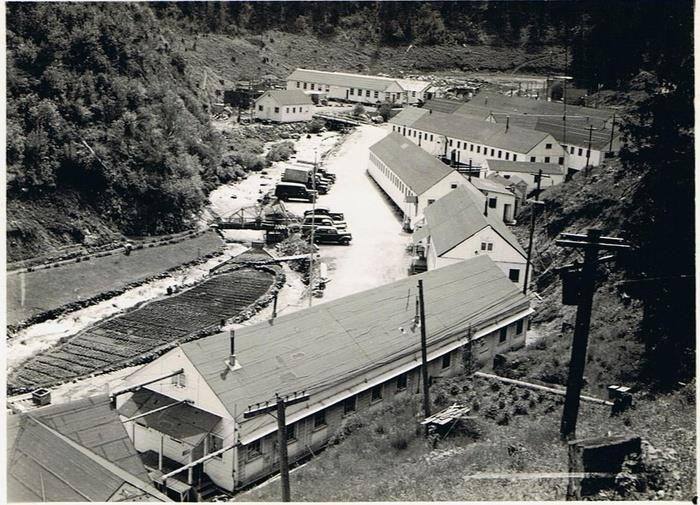
Where Canyon Creek comes into the Lochsa, about six miles above Lowell on US-12, there is a level bench beside the river with a concrete slab on it. The slab was a handball court. For two years during the Second World War it belonged to a camp that held men the government called enemy aliens, and the highway you drove in on is partly their work.
A camp for building a road
The road up the Lochsa to Lolo Pass had been under construction since 1920 and was still unfinished. From 1935 the bench at Canyon Creek held a federal prison camp of about two hundred men, trusties serving time for crimes such as mail robbery and selling liquor on reservations, who worked on the grade. By early 1943 the war had cut the prison budget and the camp closed. The route had been declared a first-priority military highway, though, and the camp reopened almost at once under the Immigration and Naturalization Service as the Kooskia Internment Camp.
Its new workforce was Japanese. The men held there were immigrants, most of them long-time residents of the United States who could not have become citizens if they had wanted to, because the law of the time barred Japanese immigrants from naturalizing. After Pearl Harbor the FBI had picked them up and the Justice Department had held them in internment camps as enemy aliens. That set them apart from the Japanese American families held at Minidoka, four hundred miles south, most of whom were citizens and who were held by a different agency under a different order.
At Kooskia nobody was sent. The men volunteered. The first 104 came in May 1943 from the internment camp at Santa Fe, New Mexico, and others followed from Fort Meade in Maryland, Camp Livingston in Louisiana and Fort Missoula in Montana. Over two years about 265 passed through, never more than two hundred at once. They ranged from their early twenties to their mid-sixties. They came from both coasts and from Alaska and Hawaii, and some had been taken from Mexico, Panama and Peru. Among them were a Buddhist minister from New York and a man who had worked for Charlie Chaplin. They spoke Japanese, English or Spanish, and they were paid for the road work, $55 to $65 a month.
Paradise, and then no man's land
The first letters home were glowing. One internee, a landscape gardener from California, wrote that the canyon reminded him of Yosemite. After the New Mexico desert the cedars and the river must have looked like a reprieve. By July the tone had changed. The men had realized, as one letter put it, that they were cut off from the rest of the world, living in a no man's land, and that the camp was not what they had been promised.
What they did next is what makes Kooskia matter. Enemy aliens held by the Justice Department were covered by the 1929 Geneva Convention on prisoners of war, applied to them through an INS directive, and these men knew it. With their mail censored, they could not complain to anyone outside. So they wrote a long petition setting out their grievances and sent it to the officer in charge of the Fort Missoula camp, which oversaw theirs.
They had leverage, and they understood that too. The road could not be built without them. The INS moved quickly. Over the next few months medical and dental care improved, recreation improved, procedures changed, and the first superintendent, known for treating the internees as convicts, resigned. His replacement, Merrill Scott, arrived in November 1943. An official visitor the next year noted that Scott seemed to know every internee by name and that the men held him in high respect.
Priscilla Wegars, the University of Idaho historian who rescued the camp's story from obscurity, counts the Kooskia men as one of only two groups of internees who used the convention to its full effect. The other, at Lordsburg, New Mexico, had struck in 1942 over being forced to work outside their camp, and some of the Kooskia men had been at Lordsburg.
What is left
The camp closed in May 1945. Paroles had thinned it out and spare parts for the machinery were hard to get, and on May 2 the last 104 men left for Santa Fe. The buildings came down over the next few years, the road was finished in 1962, and the site went quiet. The Forest Service owns it. When its archaeologists surveyed the bench in 1978 they picked up the base of a rice bowl marked Made in Japan; University of Idaho crews dug there again in 2010 and 2013.
There is not much to see. The handball court, the leveled ground where the barracks and the ball field stood, the river going by. Drive the Lochsa road with the camp in mind and the long miles of cut and fill read differently. They were built, in part, by men who were not allowed to become Americans, who chose the work, and who read the rules closely enough to make their jailers keep them.