Within a few years of Sequoyah's demonstration to the Cherokee Council in 1821, most Cherokees could read and write their own language. The syllabary's eighty-five characters, each standing for a syllable of spoken Cherokee, could be learned in weeks. Albert Gallatin, a politician who was also a student of languages, judged that literacy came faster with it than with the English alphabet. What it needed next was machinery.
Type
In 1828 the Cherokee editor Elias Boudinot reshaped the characters and reordered the chart for the printing press, dropping the eighty-sixth, and the syllabary went into type for the Cherokee Phoenix, the Nation's newspaper. In 1834 the missionary Samuel Worcester turned the character for do upside down so it could not be mistaken for go. In Indian Territory the Cherokee Advocate and the bilingual Cherokee Messenger were printed in it. For more than a century after that, the letterforms barely changed.
Machines
Each new machine had to be taught. The Cherokee Phoenix Press began printing literature in the syllabary again in the 1960s, and in the late 1970s a syllabary typing ball was made for the IBM Selectric. In September 1999 Cherokee entered the Unicode standard, the code that lets computers everywhere show the same text, and in 2015 Unicode added lowercase forms. In 2010 Apple put the syllabary on the iPhone, and Roy Boney Jr. and Joseph Erb designed a keyboard cover for typing it. In 2012 the Nation finished translating Gmail, the first email service in a Native American language, and the same year Windows 8 became the first computer operating system in one. The Nation's language technology program still works with Microsoft, Google and Facebook.
Speakers
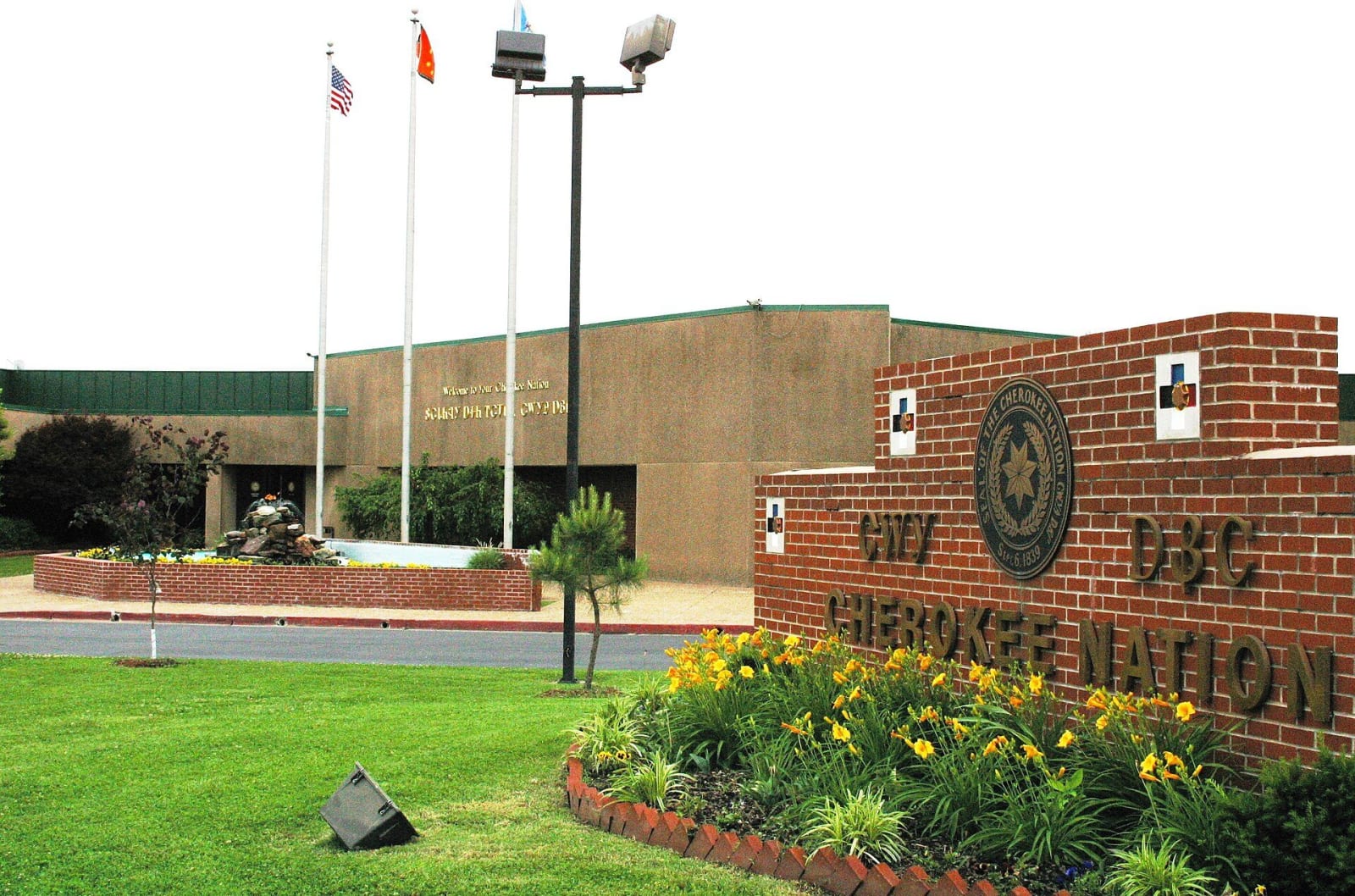
The machines were the easy part. The Nation counts about two thousand first-language speakers. Its Language and Cultural Preservation Act, signed July 13, 1991, declared that a people's survival depends on keeping its culture and language. In 2001 it opened Tsalagi Tsunadeloquasdi, the Cherokee Immersion School, with twenty-six students and four staff. Chartered in 2010, it now teaches well over a hundred children from pre-kindergarten through eighth grade entirely in Cherokee, and all its printed materials are in the syllabary. The Durbin Feeling Language Preservation Act of 2019 was the largest investment in language programs in the Nation's history. A second immersion campus opened in 2021 at Greasy in Adair County, in the heart of the largest community of Cherokee speakers, where children can go home to Cherokee-speaking houses. In 2022 the Durbin Feeling Language Center was finished in Tahlequah, a building with no English on its signs; even the exit signs show only a running figure.
Tahlequah's street signs carry the syllabary too. At the Cherokee National History Museum on the capitol square, and at Sequoyah's cabin outside Sallisaw, the story begins with one man and a council. In the classrooms it is still being written.